We use cookies to understand how you use our site and to improve the overall user experience. This includes personalizing content and advertising. Read our
Privacy Policy
Profacgen's GLP-Compliant Protein Production service is designed for project decision-makers who require reliable material and compliant data outputs to support preclinical programs, quality control activities, and regulatory submissions. Our GLP framework ensures reproducibility, traceability, and documentation integrity while providing flexibility to tailor solutions to your project's specific needs.
Why GLP-Compliant Protein Production Matters for Your Program
Good Laboratory Practice (GLP) is a globally recognized quality framework that provides confidence in non-clinical study outputs and manufacturing service data, ensuring they are meaningful and defensible in regulatory contexts. GLP does not refer to scientific technique or efficacy—it refers to process integrity, documentation, and reproducibility across every stage of production and testing.
For teams advancing preclinical biologic programs, GLP-compliant production:
Provides assurance that production processes and outcomes meet regulatory expectations for quality and reliability
Ensures that generated data can be trusted for safety evaluation and subsequent development decisions
Creates a documented workflow that can be integrated into broader development and transition strategies, such as process optimization, scale-up, and eventual GMP readiness
GLP compliance positions your program for successful preclinical execution and strengthens confidence in decision points where data quality directly impacts timelines and budgets.
When to Engage GLP-Compliant Protein Production
Profacgen's GLP-compliant protein production is most relevant when:
You require material with traceable quality and documented production history for non-clinical or regulatory studies.
Your project needs consistent and reproducible batches for repeat testing, safety assessments, or method validation.
Planning a transition to regulated manufacturing—GLP compliance aids downstream integration with process development and future GMP-aligned pathways.
Prioritizing GLP compliance early reduces risk and avoids repeated iterations due to poor documentation, inconsistent material quality, or untraceable production records.
Our GLP Protein Production Capabilities
Profacgen delivers a structured protein production service under GLP guidelines, supported by documented procedures, quality oversight, and production controls. Below we summarize the core areas of capability:
Upstream Production
We support protein expression using multiple systems, chosen according to your target's biology and downstream requirements:
Transient gene expression for rapid generation of protein material
Stable cell line development to support reproducible production batches
Scalable upstream platforms that balance yield, integrity, and consistency
Each production strategy is documented thoroughly and tied to quality checks to ensure production history integrity.
Process Development Integration
GLP-compliant production is more than execution—it requires thoughtful integration with process development activities. Profacgen's approach includes:
Evaluation and optimization of protein expression strategies
Alignment of purification workflows with documentation and monitoring needs
Defined process controls and checkpoints that support reproducibility
We focus on reducing variability and capturing clear, defensible process records, which helps prepare your program for next stages of development.
Purification and Material Handling
Under GLP conditions, downstream processes are executed with robust documentation and quality checks:
Controlled purification steps that maintain consistency
Traceable handling and storage protocols
Material release criteria aligned with project goals and study designs
All production batches are supported by documented records, enabling reliable interpretation of results and integration with broader study data.
Quality Assurance and Compliance Controls
GLP compliance requires more than following a checklist—it means implementing quality practices that govern:
Organizational responsibilities and oversight
Documented standard operating procedures (SOPs) and record retention
Facilities, equipment, and reagent controls
Mandatory reporting, archival systems, and audit readiness
Consistency in test systems, data collection, and result interpretation
Profacgen's GLP framework is designed to support structured, quality-oriented production across all of these dimensions, allowing your team to confidently integrate the resulting data and materials into study designs.
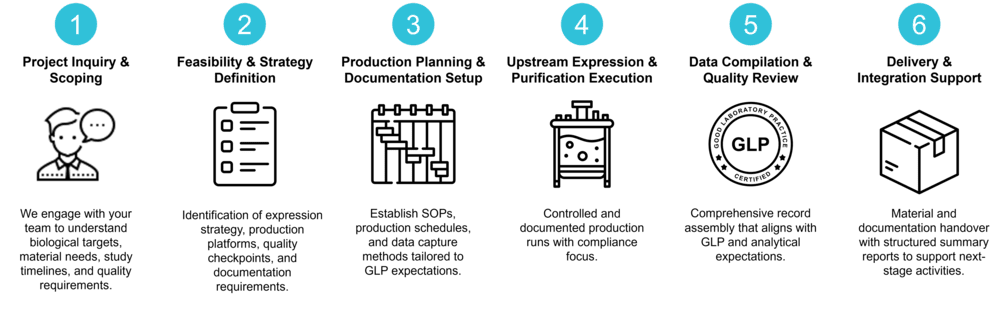
Typical Engagement Workflow
To support planning and decision-making, here is an example high-level workflow for GLP-compliant protein production:
Generation of reliable and reproducible data suitable for regulatory review Full documentation and traceability to support study reconstruction and audit readiness Controlled production environments aligned with GLP requirements Seamless integration of protein production with non-clinical safety studies
Representative Program Scenarios
The following scenarios are representative examples intended to illustrate how GLP-compliant protein production is typically applied in non-clinical development programs. They do not reference specific clients or confidential projects.
Scenario 1: GLP-Compliant Protein Production for Preclinical Toxicology Studies
Program Context:
A preclinical development program required protein material to support toxicology and safety evaluation studies conducted under regulated conditions. The program timeline depended on the availability of consistent, traceable protein batches suitable for repeated dosing and data interpretation.
Primary Objective:
To generate protein material under GLP conditions with documented production history, ensuring data integrity and reproducibility across non-clinical toxicology studies.
Key Challenges:
Ensuring batch-to-batch consistency to support reliable interpretation of toxicology results
Establishing production documentation that aligns with GLP requirements for traceability and audit readiness
Coordinating protein production timelines with downstream toxicology study schedules
GLP-Compliant Production Approach:
Defined upstream expression and purification workflows executed under GLP guidelines
Implementation of process controls and predefined acceptance criteria
Comprehensive documentation of production steps, materials, and handling conditions
Quality review of production records to support study reproducibility and data confidence
Program Outcome:
Delivery of GLP-compliant protein material suitable for toxicology assessments
Documented production history enabling confident interpretation of non-clinical safety data
Reduced risk of study repetition due to material variability or documentation gaps
Scenario 2: Repeat Batch Production to Support Method Validation and Bioanalytical Studies
Program Context:
A development team required multiple protein batches to support method development, validation, and repeat analytical testing during non-clinical development. Consistency and documentation were critical to ensure analytical results could be compared across studies.
Primary Objective:
To produce multiple GLP-compliant protein batches with defined comparability, supporting bioanalytical method validation and quality decision-making.
Key Challenges:
Maintaining comparability across repeat production batches
Ensuring analytical relevance of production data for downstream validation activities
Aligning production documentation with bioanalytical and quality workflows
GLP-Compliant Production Approach:
Standardized production processes with controlled parameters to minimize variability
Documented batch records supporting traceability and comparison
Coordination with analytical testing strategies to ensure alignment between production and method validation needs
Structured data compilation to support quality review and decision-making
Program Outcome:
Generation of repeat GLP-compliant protein batches suitable for analytical and bioanalytical validation
Improved confidence in comparability assessments across studies
Streamlined integration of production data into quality and regulatory documentation packages
Q: What does "GLP-compliant protein production" mean in practice?
A: GLP compliance refers to the quality system under which protein production activities are planned, executed, documented, and reviewed, rather than the scientific complexity of the production itself. In practice, GLP-compliant protein production ensures that processes are traceable, documented, reproducible, and auditable, enabling generated materials and data to be reliably used in non-clinical studies and regulatory-relevant decision-making.
Q: When should GLP-compliant protein production be considered in a development program?
A: GLP-compliant production is typically considered when protein material is intended to support non-clinical safety studies, toxicology evaluations, analytical method validation, or other regulated preclinical activities. It is particularly relevant when consistency, traceability, and documentation quality are essential to program progression or future regulatory interactions.
Q: Is GLP-compliant protein production required for all preclinical studies?
A: Not all preclinical activities require GLP-compliant production. However, when study outcomes are expected to support regulatory submissions, safety assessments, or critical development decisions, GLP compliance significantly reduces risk by ensuring data integrity and reproducibility.
Q: How does GLP-compliant production differ from non-GLP protein production?
A: The primary difference lies in process control and documentation, not necessarily in production scale or expression technology. GLP-compliant production requires defined procedures, controlled execution, traceable materials, and structured record keeping, whereas non-GLP production may lack the level of documentation required for regulatory confidence.
Q: Can GLP-produced protein material be used in multiple non-clinical studies?
A: Yes. GLP-compliant protein material is often used across multiple non-clinical studies, provided the production history, storage conditions, and handling records are appropriately documented and aligned with study requirements. Early planning is recommended to ensure batch size and documentation support extended or repeat use.
Q: Does GLP-compliant protein production support future GMP transition?
A: While GLP and GMP serve different regulatory purposes, GLP-compliant production establishes a strong documentation and process discipline foundation that can support smoother transition planning toward GMP manufacturing. Process knowledge, traceability, and quality records generated under GLP conditions are often valuable during later development stages.
Q: How are batch consistency and reproducibility ensured under GLP conditions?
A: Batch consistency is supported through defined production parameters, controlled execution, in-process monitoring, and comprehensive documentation. These measures allow variability to be identified, assessed, and managed, ensuring confidence in batch-to-batch comparability for non-clinical use.
Q: What level of documentation is provided with GLP-compliant protein production?
A: Documentation typically includes production records, material traceability information, process descriptions, and quality review summaries, aligned with GLP expectations. The specific scope of documentation can be tailored based on program needs and study objectives.
Q: Can existing non-GLP production processes be adapted for GLP-compliant manufacturing?
A: Yes. Existing expression or purification processes can often be evaluated and adapted to meet GLP requirements. This may involve introducing additional controls, documentation elements, or quality oversight to align with GLP guidelines, without fundamentally changing the underlying production strategy.
Q: How do we determine if GLP-compliant protein production is appropriate for our project?
A: The suitability of GLP-compliant production depends on your study objectives, regulatory strategy, and risk tolerance. An initial consultation allows evaluation of whether GLP compliance is necessary or beneficial at your current development stage.
Online Inquiry
Fill out this form and one of our experts will respond to you within one business day.