

Immunogenicity remains one of the most critical challenges throughout biologics development. Even highly promising therapeutic candidates may encounter significant setbacks if they induce unintended immune responses during preclinical or clinical studies. Such immune reactions can reduce therapeutic efficacy, alter pharmacokinetic behavior, compromise patient safety, and create substantial obstacles during regulatory progression.
As biologic modalities continue to increase in complexity, immunogenicity assessment has evolved far beyond conventional anti-drug antibody (ADA) testing alone. Modern immunogenicity evaluation requires an integrated understanding of molecular structure, product heterogeneity, aggregation behavior, process impurities, formulation stability, analytical consistency, and immune response mechanisms.
At Profacgen, we provide comprehensive Immunogenicity Assessment Services designed to support biologics developers throughout process development, analytical characterization, comparability evaluation, and IND-enabling development. Our multidisciplinary approach combines structural and physicochemical characterization, impurity profiling, bioanalytical immunogenicity testing, and in vitro immune response assessment into a coordinated risk evaluation framework.
We support a broad range of biologic modalities, including:
By integrating immunogenicity-focused assessment early in development, Profacgen helps clients identify potential liabilities, reduce downstream manufacturing risks, and establish more robust development strategies before advancing toward clinical studies and manufacturing transition.
Biologic therapeutics inherently possess the potential to trigger immune responses. While certain immune reactions may be clinically manageable, unexpected immunogenicity can significantly affect both product performance and development timelines.
Potential consequences of immunogenicity include anti-drug antibody (ADA) formation, neutralizing antibody (NAb) responses, reduced therapeutic efficacy, accelerated drug clearance, altered pharmacokinetics, loss of biological activity, cytokine release, hypersensitivity reactions, product instability, increased batch variability, and delayed clinical progression.
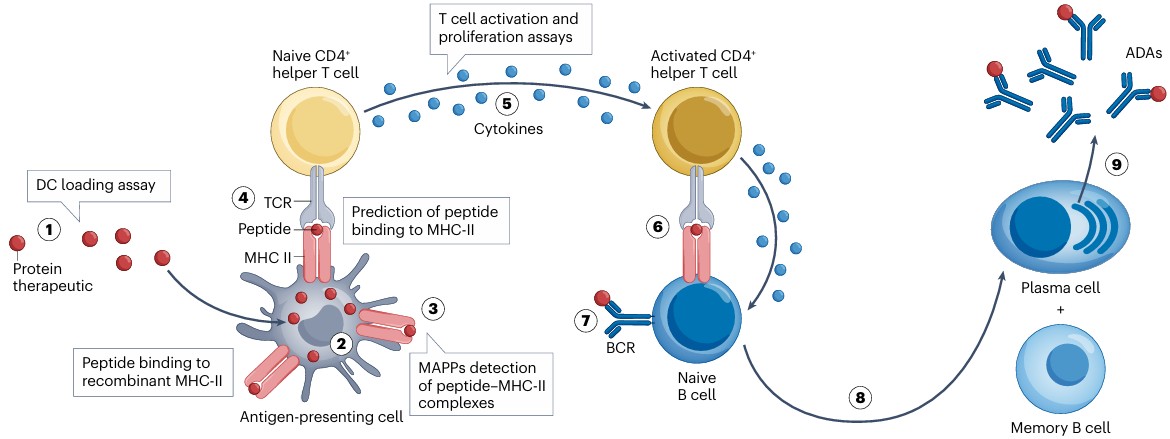 Figure 1. Immune system interactions involved in ADA generation with experimental methods of assessment. (Carter and Quarmby, 2024)
Importantly, immunogenicity risk is often influenced not only by the therapeutic molecule itself, but also by manufacturing processes, formulation conditions, and product quality attributes.
Common contributors to immunogenicity risk include:
Because these factors are closely linked to process development and analytical characterization, immunogenicity assessment has become an essential component of modern CMC and developability strategies.
Profacgen's Immunogenicity Assessment Services are designed to support:
Profacgen employs a multidisciplinary assessment strategy that combines analytical characterization, immunogenicity assay development, and immune response evaluation into a coordinated development framework.
| Steps | Services |
|---|---|
| Step 1: Molecule & Development Risk Evaluation | Each project begins with a comprehensive evaluation of:
This assessment helps identify potential immunogenicity liabilities and establish a customized analytical strategy aligned with the molecule's characteristics and regulatory objectives. |
| Step 2: Structural & Physicochemical Characterization for Immunogenicity Assessment | Structural consistency and physicochemical stability are closely associated with immunogenicity risk in biologics development. Profacgen provides comprehensive analytical characterization services to evaluate structural features that may influence immune response potential.
|
| Step 3: Impurity-Related Immunogenicity Assessment | Residual impurities may significantly affect immune response risk, particularly for chronic administration biologics.
|
| Step 4: Immunogenicity Assay Development & Validation | Robust immunogenicity assays are essential for evaluating anti-drug antibody responses and supporting biologics development programs. Our teams support both nonclinical and clinical immunogenicity testing strategies.
|
| Step 5: Biosimilar Immunogenicity Assessment Strategies | Immunogenicity assessment plays a central role in biosimilar development and comparability evaluation. Profacgen supports multiple biosimilar immunogenicity strategies, including:
|
| Step 6: In Vitro Immune Response Assessment | Profacgen provides multiple in vitro platforms for evaluating biologic-induced immune activation.
|
| Step 7: Immunogenicity Assessment During Process Development | Immunogenicity is closely linked to manufacturing consistency and process control. Profacgen integrates immunogenicity-focused evaluation into broader development activities, including:
This integrated approach helps clients identify potential liabilities earlier and reduce downstream development risks. |
| Step 8: Formulation & Stability Assessment | Formulation conditions can strongly influence product stability and immunogenicity profiles.
|
Challenge:
A biotechnology company developing a recombinant cytokine observed elevated aggregate formation during accelerated stability studies, with profiles worsening after freeze-thaw cycles and stressed incubation. Batch-to-batch variability during purification suggested that upstream processing and formulation conditions contributed to structural instability. As the program approached IND-enabling development, the client required a strategy to identify aggregation root causes and evaluate potential immunogenicity risks.
Solution:
Profacgen implemented an integrated immunogenicity-focused workflow. SEC-HPLC and dynamic light scattering quantified aggregates and particle distribution across batches. Stress-induced degradation studies identified aggregation-sensitive variables. Higher-order structure characterization using circular dichroism and fluorescence spectroscopy monitored conformational changes. PBMC-based cytokine release assays evaluated immune activation signals from aggregated samples. Formulation screening across multiple buffer systems, excipients, and surfactants identified optimal stabilization conditions.
Outcome:
The optimized formulation significantly reduced aggregate formation and improved structural stability under stressed storage conditions. PBMC assays demonstrated reduced cytokine induction following optimization, suggesting lower immunogenicity risk. The client gained critical insights into aggregation-immunogenicity relationships, enabling stronger process control strategies and supporting continued preclinical evaluation with strengthened IND readiness.
Challenge:
A biosimilar developer required a robust immunogenicity assessment strategy to evaluate anti-drug antibody responses against both a biosimilar monoclonal antibody candidate and its reference product. Early feasibility studies revealed inconsistent assay sensitivity across serum matrices and variable drug tolerance depending on assay platform. Glycosylation and impurity differences between the biosimilar and reference product raised concerns regarding assay specificity and cross-reactivity for global regulatory submission.
Solution:
Profacgen designed a comprehensive immunogenicity assay development workflow. Comparative ADA screening using both the biosimilar candidate and reference product assessed cross-reactivity and confirmed consistent antibody detection. Drug tolerance optimization studies evaluated assay performance under clinically relevant conditions. Matrix interference evaluation across multiple serum conditions identified variability sources and optimized sample handling protocols. Confirmatory assay strategies and titer workflows were established with recommendations for single-assay versus dual-assay approaches.
Outcome:
The analytical framework significantly improved assay reproducibility, sensitivity, and drug tolerance. Matrix interference was substantially reduced, enabling reliable ADA detection across different serum backgrounds. Comparative studies demonstrated robust cross-reactivity between the biosimilar and reference product, supporting a streamlined immunogenicity strategy. The client gained a clearer understanding of how glycosylation differences and assay platform selection influence biosimilar immunogenicity evaluation for global regulatory submissions.
References:
Fill out this form and one of our experts will respond to you within one business day.