We use cookies to understand how you use our site and to improve the overall user experience. This includes personalizing content and advertising. Read our
Privacy Policy
Profacgen offers HaloPROTAC development services, providing a rapid, reversible platform for induced degradation of HaloTag fusion proteins, enabling target validation, mechanistic studies, and proof-of-concept research without the need for target-specific ligand development.
Targeted protein degradation has emerged as a transformative strategy for eliminating disease-relevant proteins. However, developing protein degraders against endogenous targets from scratch requires substantial ligand discovery and optimization effort. The HaloPROTAC system offers an efficient alternative: by fusing the target protein with HaloTag—a 33 kDa monomeric protein engineered from a bacterial dehalogenase—researchers can leverage pre-optimized HaloTag ligands and established E3 ligase recruiters to achieve rapid, dose-dependent protein elimination.
Profacgen provides end-to-end HaloPROTAC development, from HaloTag fusion construct design and compound synthesis to cell-based validation and degradation kinetics characterization. Our platform supports cytoplasmic, nuclear, and endosomal target proteins, delivering a versatile chemical genetics tool for target validation and pathway dissection.
What Is HaloPROTAC?
HaloPROTAC is a heterobifunctional small molecule that bridges a HaloTag fusion protein to an E3 ubiquitin ligase, inducing proximity-dependent ubiquitination and subsequent proteasomal degradation. The system comprises three core components:
HaloTag fusion proteins: HaloTag is a 33 kDa monomeric protein engineered from a bacterial dehalogenase. It lacks catalytic activity but forms rapid, specific, and irreversible covalent bonds with chloroalkane-based ligands, including fluorescent derivatives (TMR, diacetylfluorescein, coumarin) and biotin. Target proteins are expressed as HaloTag fusions, either through transgenic constructs or endogenous genomic tagging via gene editing
Induced degradation: HaloPROTAC molecules contain a chloroalkane HaloTag ligand linked to an E3 ligase recruiter (e.g., VHL, CRBN, or IAP ligand). Binding to the HaloTag fusion protein recruits the E3 ligase complex, initiating K48-linked polyubiquitination and 26S proteasome-mediated degradation. The process is catalytic: a single HaloPROTAC molecule can induce degradation of multiple target protein copies
Research applications: HaloPROTAC serves as a powerful chemical genetics tool for target validation, enabling rapid, reversible elimination of proteins without genetic knockout. It supports mechanistic studies of protein function, pathway mapping, and proof-of-concept assessment prior to investment in endogenous-target degrader development
Mechanism of HaloPROTAC-Mediated Degradation
The HaloPROTAC degradation cascade proceeds through a well-defined sequence of molecular events:
HaloTag Fusion Protein Expression
The target protein is expressed as an N-terminal or C-terminal HaloTag fusion, either stably or transiently, in the relevant cellular background. HaloTag forms a covalent bond with the chloroalkane moiety of the HaloPROTAC molecule.
HaloPROTAC Binding
The heterobifunctional HaloPROTAC molecule simultaneously engages the HaloTag fusion protein via its chloroalkane ligand and recruits an E3 ubiquitin ligase (VHL, CRBN, or cIAP) via the corresponding ligand moiety, forming a ternary complex.
E3 Ligase Recruitment and Ubiquitination
The recruited E3 ligase complex catalyzes K48-linked polyubiquitin chain assembly on the target protein. Multiple ubiquitin molecules are conjugated to lysine residues on the HaloTag fusion substrate, marking it for proteasomal recognition.
Proteasomal Degradation
The 26S proteasome recognizes the polyubiquitinated target protein, unfolds the substrate, and proteolytically degrades it into peptides. The HaloPROTAC molecule is released and can catalyze additional degradation cycles, achieving substoichiometric target elimination.
Figure 1. Schematic depiction of a bifunctional HaloPROTAC containing chloroalkane (which binds HaloTag7 fusion proteins) and a hydroxyproline derivative which binds VHL. Buckley et al., 2015)
Our HaloPROTAC Development Services
Profacgen offers a comprehensive HaloPROTAC development workflow tailored to your target protein and research objectives:
HaloPROTAC Design
Rational design of heterobifunctional degraders optimized for target engagement and E3 ligase recruitment.
HaloTag ligand selection: chloroalkane derivatives with optimal binding kinetics and linker compatibility
E3 ligase recruiter pairing: VHL (VH032), CRBN (pomalidomide), or IAP (bestatin) ligands matched to cellular context
Linker optimization: PEG, alkyl, or rigid linker selection to maximize ternary complex stability and minimize hook effect
Compound Synthesis
Chemical synthesis and purification of HaloPROTAC molecules with quality-controlled analytical characterization.
Multi-step organic synthesis of chloroalkane-linker-E3 ligand conjugates
Analytical validation by HPLC, LC-MS, and NMR for purity and identity confirmation
Scale-up from milligram to gram quantities for extended studies
Cell-Based Validation
Functional assessment of HaloPROTAC activity in relevant cellular models.
HaloTag fusion protein expression: transient or stable transfection, or gene editing-mediated endogenous tagging
Cell viability and cytotoxicity assessment to rule off-target effects
Quantitative characterization of degradation kinetics, efficiency, and selectivity.
Western blot and quantitative mass spectrometry for target protein level quantification
DC50 and Dmax determination across dose-response and time-course experiments
Proteasome inhibitor (MG132, bortezomib) and NEDD8-activating enzyme inhibitor (MLN4924) rescue experiments to confirm UPS dependence
Washout and recovery studies to assess degradation reversibility
Applications
HaloPROTAC technology supports diverse research applications across target discovery and validation:
Target Validation: Rapid, reversible elimination of candidate therapeutic targets to assess phenotype and establish target-disease causality without genetic knockout. HaloPROTAC has been successfully applied to cytoplasmic proteins (ERK, MEK, GFP), endosomal proteins (VPS34, SGK3), and nuclear proteins (CREB1)
Mechanistic Studies: Temporal control of protein degradation enables dissection of protein function in signaling pathways, transcriptional regulation, and metabolic networks. The reversible nature of HaloPROTAC action supports pulse-chase and recovery experiments
Proof-of-Concept Research: Prior to investing in endogenous-target degrader development, HaloPROTAC studies with tagged target proteins establish proof of concept for degradation-mediated phenotype, guide ligand selection, and inform linker optimization strategies
Why Choose Profacgen
Integrated Workflow: From HaloTag fusion construct design and compound synthesis to cellular validation and degradation profiling, all stages are executed under one platform with seamless data transfer.
Multiple E3 Ligase Options: Access to VHL, CRBN, and IAP-based HaloPROTAC systems enables selection of the optimal recruiter based on target cellular context, expression profile, and resistance considerations.
Genomic Tagging Expertise: Gene editing-mediated endogenous HaloTag knock-in eliminates overexpression artifacts and supports physiologically relevant target levels and localization.
Comprehensive Analytics: Quantitative degradation assessment including DC50, Dmax, hook effect analysis, and proteasome dependence confirmation ensures robust, publication-ready data.
Flexible Engagement: Services are available as standalone modules (design-only, synthesis-only, full validation) or integrated packages to match project stage and budget.
Scenario 1: Kinase Target Validation by HaloPROTAC
Program Context:
A research team sought to validate a cytoplasmic kinase as a therapeutic target for an oncology program. Genetic knockout was lethal, preventing stable cell line generation, and the team required a reversible system to assess kinase-independent scaffold functions.
Objective:
To establish a HaloTag fusion system for the target kinase, synthesize a panel of VHL-recruiting HaloPROTACs, and demonstrate rapid, reversible degradation with phenotypic consequence confirmation.
Approach:
Profacgen designed an N-terminal HaloTag fusion construct and generated stable expression cell lines. A VHL-based HaloPROTAC with optimized PEG linker was synthesized and validated for HaloTag binding by fluorescent ligand competition. Degradation kinetics were assessed by Western blot and quantitative proteomics, confirming DC50 of 12 nM and Dmax > 90% at 4 hours. Proteasome inhibition (MG132) completely rescued target levels, confirming UPS dependence.
Outcome:
Target degradation induced the expected cell cycle arrest phenotype, validating the kinase as a genuine driver of proliferation. Washout experiments demonstrated full protein recovery within 24 hours, confirming reversibility. The HaloPROTAC data supported progression to endogenous-target PROTAC development.
A transcription factor implicated in inflammatory disease lacked small-molecule ligands, preventing direct PROTAC development. The team needed to understand its temporal role in cytokine induction without genetic manipulation.
Objective:
To engineer endogenous HaloTag knock-in at the transcription factor locus, develop a CRBN-recruiting HaloPROTAC, and execute pulse-degradation experiments to map transcriptional response dynamics.
Approach:
Profacgen performed gene editing-mediated C-terminal HaloTag insertion at the endogenous transcription factor locus. A CRBN-based HaloPROTAC was designed and synthesized, achieving >85% target degradation within 6 hours. RNA-seq was performed at 2, 6, 12, and 24 hours post-treatment, with washout recovery at 48 hours to assess reversibility.
Outcome:
Degradation induced rapid downregulation of known target genes within 6 hours, with off-target effects minimal. Recovery experiments confirmed transcriptional rebound upon protein restoration. The study established a causal, dose-dependent relationship between transcription factor levels and inflammatory gene expression, supporting therapeutic targeting rationale.
Q: What is the difference between HaloPROTAC and conventional PROTAC?
A: Conventional PROTACs recruit E3 ligases to endogenous target proteins and require target-specific ligand development. HaloPROTACs target HaloTag fusion proteins using a universal chloroalkane ligand, eliminating the need for target-specific warhead discovery. This makes HaloPROTAC ideal for rapid target validation and proof-of-concept studies, while conventional PROTACs are preferred for therapeutic development against endogenous targets.
Q: Is isotopic labeling required for HaloPROTAC studies?
A: No. HaloPROTAC degradation is monitored by standard biochemical methods including Western blot, quantitative mass spectrometry, and fluorescent ligand imaging. Isotopic labeling is not required for cellular degradation assessment. However, if structural characterization of the ternary complex is desired, NMR or cryo-EM may require labeled protein samples.
Q: What is the molecular weight limit for HaloPROTAC targets?
A: The HaloPROTAC system is effective for target proteins across a broad molecular weight range, from small regulatory proteins (~10 kDa) to large multi-domain proteins (>200 kDa). The 33 kDa HaloTag fusion adds mass but does not impair proteasomal degradation, as the proteasome routinely handles ubiquitinated substrates of varying sizes. Success depends more on target ubiquitin accessibility and proteasome engagement than on absolute molecular weight.
Q: How does HaloPROTAC compare to genetic knockout for target validation?
A: HaloPROTAC offers several advantages over genetic knockout: (1) rapid onset (hours vs. days/weeks), (2) dose-dependent control, (3) reversibility for recovery studies, and (4) applicability to essential genes where knockout is lethal. However, HaloPROTAC requires HaloTag fusion expression and may not fully replicate chronic knockout phenotypes. The two approaches are complementary: HaloPROTAC for acute, reversible validation; knockout for chronic, heritable assessment.
Q: What sample requirements are needed for HaloPROTAC development?
A: For cell-based validation, a HaloTag fusion expression construct or gene editing-edited cell line is required. Profacgen can assist with construct design, gene synthesis, and stable cell line generation. For compound synthesis, no biological sample is needed. For degradation assessment, cells are treated with synthesized HaloPROTAC at varying concentrations and time points, with target protein levels monitored by Western blot or mass spectrometry.
Q: Can HaloPROTAC be used for in vivo studies?
A: Yes, with appropriate considerations. HaloPROTAC molecules require suitable pharmacokinetic properties for in vivo administration. Profacgen can optimize HaloPROTAC design for improved solubility, metabolic stability, and tissue penetration. In vivo HaloPROTAC studies require transgenic animal models expressing the HaloTag fusion protein or viral delivery systems. Profacgen provides guidance on in vivo study design and can partner with specialized pharmacology CROs for execution.
References:
Buckley DL, Raina K, Darricarrere N, et al. HaloPROTACS: Use of Small Molecule PROTACs to Induce Degradation of HaloTag Fusion Proteins. ACS Chem Biol. 2015;10(8):1831-1837. doi:10.1021/acschembio.5b00272
Online Inquiry
Fill out this form and one of our experts will respond to you within one business day.

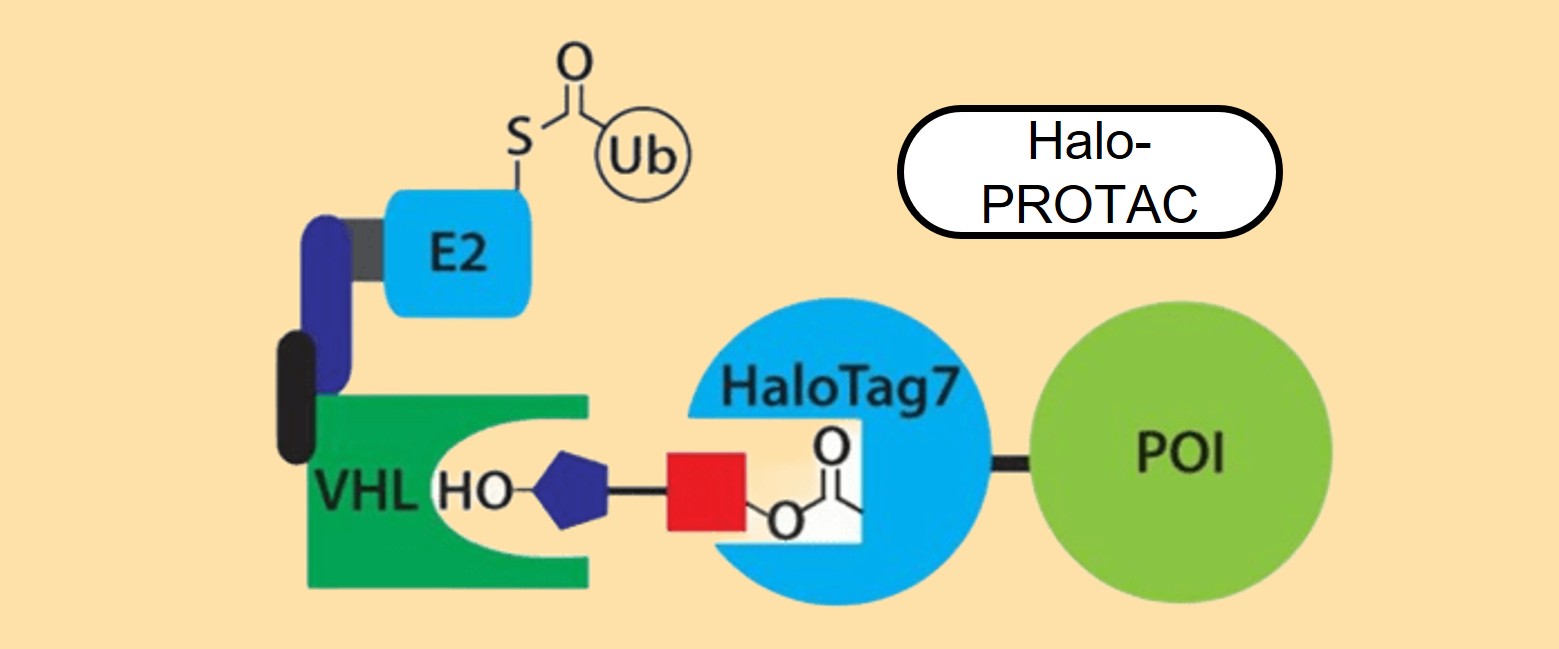
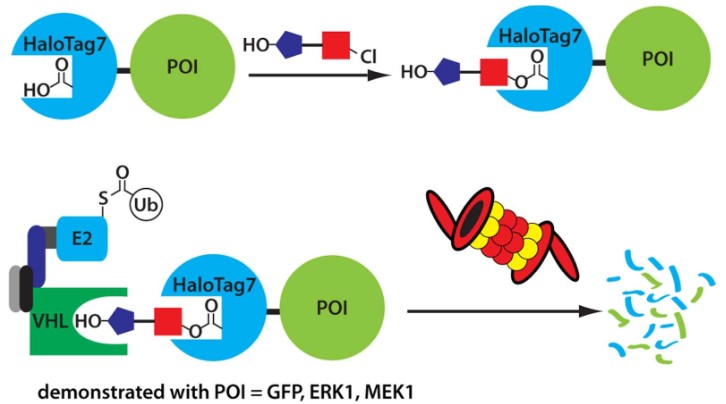 Figure 1. Schematic depiction of a bifunctional HaloPROTAC containing chloroalkane (which binds HaloTag7 fusion proteins) and a hydroxyproline derivative which binds VHL. Buckley et al., 2015)