We use cookies to understand how you use our site and to improve the overall user experience. This includes personalizing content and advertising. Read our
Privacy Policy
At Profacgen, our destabilization domain technology services provide a conditional, small-molecule-controlled protein degradation platform that combines the simplicity of small-molecule ligands with the specificity of genetic approaches, enabling precise temporal regulation of protein levels in vitro and in vivo.
Designing small-molecule ligands for proteins is often challenging and time-consuming, involving multiple rounds of screening and structural modification. A hybrid system that leverages both small-molecule control and genetic specificity offers a compelling alternative. Destabilization domains (DDs) are fusion protein components that are intrinsically unstable and destabilize partner proteins upon incorporation, leading to proteasomal degradation. The addition of a stabilizing ligand rescues the fusion protein, restoring normal expression and function.
Profacgen offers a one-stop destabilization domain development service, integrating ligand design and synthesis, protein fusion engineering, and comprehensive in vitro and in vivo validation. Our multidisciplinary team combines expertise in molecular biology, synthetic chemistry, and protein engineering to deliver conditional degradation systems tailored to your target protein and research objectives.
What Is Destabilization Domain Technology?
Destabilization domain technology enables conditional, reversible control of protein stability through small-molecule-regulated fusion protein systems. The platform comprises three defining features:
Conditional protein degradation: In the absence of stabilizing ligand, the destabilization domain confers intrinsic instability to the fusion protein, triggering rapid proteasomal degradation. This provides a genetic knockdown-like phenotype without permanent genetic modification, enabling reversible and dose-dependent protein elimination
Fusion protein systems: Destabilization domains are genetically encoded and fused to the target protein of interest at the N-terminus or C-terminus. Unlike small-molecule degraders that require ligand discovery for each target, DDs provide a universal platform where the same destabilizing domain can be applied to diverse targets through standard molecular cloning
Small molecule control: The addition of a cell-permeable stabilizing ligand binds the destabilization domain, restoring proper folding and preventing degradation. Ligand withdrawal reverses stabilization, re-initiating degradation. This on/off switch enables precise temporal control of protein levels for functional studies, target validation, and therapeutic applications
Mechanism of Destabilization Domain Technology
Destabilization domain-mediated degradation proceeds through ligand-dependent protein folding control:
DD Fusion Protein Expression: The destabilization domain is genetically fused to the target protein and expressed in the relevant cellular or organismal context. In the absence of stabilizing ligand, the DD adopts a misfolded conformation that exposes hydrophobic surfaces, rendering the entire fusion protein unstable.
Ligand Withdrawal and Protein Destabilization: Upon withdrawal of the stabilizing ligand, the DD reverts to its misfolded state. The exposed hydrophobic patches are recognized by molecular chaperones (Hsp70, Hsp90) and quality control E3 ubiquitin ligases, which polyubiquitinate the fusion protein with K48-linked chains.
Proteasomal Degradation: The 26S proteasome recognizes the ubiquitinated fusion protein, unfolds the substrate, and proteolytically degrades both the DD and the target protein into peptides. The process is rapid and efficient, typically achieving >90% target elimination within hours of ligand withdrawal.
Ligand-Induced Stabilization: Re-administration of the stabilizing ligand binds the DD with high affinity, inducing a conformational change that buries hydrophobic surfaces and restores native folding. The fusion protein is rescued from degradation, and target function is restored within hours.
Figure 1. Mechanism of destabilization domains: in the absence of ligand, the DD fusion protein is unstable and degraded; ligand binding stabilizes the fusion, restoring normal expression. (Burslem and Crews, 2017)
Our DD Technology Services
Profacgen provides a comprehensive, one-stop destabilization domain development platform:
Construct Design
Rational design of destabilization domain fusion constructs optimized for target protein stability and function.
DD selection: FKBP12F36V (Shield1-stabilized), DHFR (TMP-stabilized), BCR-ABL (imatinib-stabilized), and other engineered destabilizing domains
Fusion orientation optimization: N-terminal, C-terminal, and internal insertion strategies to preserve target protein activity
Linker engineering: flexible and rigid linker design to minimize DD-induced target misfolding while maintaining degradation efficiency
Stable Cell Line Development
Generation of validated cell lines with inducible, reversible target protein degradation.
Transient and stable transfection of DD fusion constructs in mammalian cell lines
Gene editing-mediated endogenous knock-in of DD cassettes at native loci
Clone selection and characterization: expression level, degradation kinetics, and ligand dose-response profiling
Functional Validation
Comprehensive assessment of fusion protein stability, activity, and degradation dynamics.
Western blot and quantitative mass spectrometry for target protein level quantification
DD-induced function assessment: activity assays, localization studies, and interaction mapping
Extensive method validation to ensure DD incorporation does not induce function change or activity loss
Controlled Degradation Studies
Quantitative characterization of degradation kinetics, reversibility, and phenotypic consequences.
Ligand withdrawal and re-administration time courses to establish degradation and recovery kinetics
Dose-response titration to determine optimal ligand concentrations for stabilization and degradation
Proteasome dependence confirmation: MG132, bortezomib, and MLN4924 rescue experiments
Applications
Destabilization domain technology enables diverse research and therapeutic applications:
Conditional Protein Knockdown: Reversible, ligand-dependent elimination of target proteins without permanent genetic modification. Ideal for studying essential genes where constitutive knockout is lethal, and for temporal dissection of protein function in development, signaling, and disease progression
Target Validation: Rapid assessment of target essentiality and therapeutic relevance by inducing acute protein degradation. The reversible nature enables comparison of degradation phenotypes with genetic knockout, providing confidence for downstream drug development investment
Functional Genomics: Genome-scale DD tagging enables systematic functional annotation of protein-coding genes. Ligand-dependent degradation supports high-throughput phenotypic screening, synthetic lethal interaction mapping, and pathway dissection in physiologically relevant cellular contexts
Advantages of DD Technology
Genetic Specificity: Unlike small-molecule degraders, DDs employ genetic encoding of the destabilization domain, ensuring exclusive targeting of the intended fusion protein without off-target effects on endogenous proteins.
Reversible Control: Ligand administration and withdrawal provide an on/off switch for protein stability, enabling pulse-chase experiments, recovery studies, and precise temporal control of protein function.
No Ligand Discovery Required: The same DD-ligand pair can be applied to diverse targets through standard cloning, eliminating the need for target-specific ligand development for each new protein.
Essential Gene Accessibility: DDs enable study of essential proteins where genetic knockout is lethal, by maintaining protein expression during development and inducing degradation only in adult or differentiated tissues.
In Vivo Applicability: DD systems function effectively in whole organisms, supporting conditional knockdown in animal models for disease modeling, target validation, and therapeutic proof-of-concept.
Why Choose Profacgen
Multidisciplinary Expertise: Our scientists with diverse backgrounds in molecular biology, synthetic chemistry, and protein engineering form a dynamic team focused on solving complex, multidisciplinary problems in conditional protein degradation.
One-Stop Service: Profacgen integrates ligand design and synthesis, protein fusion engineering, stable cell line development, and in vitro and in vivo testing within a single platform.
In Silico Capabilities: Computational drug design stations support in silico ligand discovery, DD structure prediction, and fusion protein modeling to accelerate project timelines.
Comprehensive Validation: Extensive method validation ensures DD incorporation does not induce function change or activity loss, with activity testing in solutions, living cells, and animal models.
Flexible Engagement: Services are available as standalone modules (construct design, ligand synthesis, cell line development) or integrated packages to match project stage and budget.
Scenario 1: Essential Kinase Conditional Knockdown for Target Validation
Program Context:
An oncology program identified a kinase as a candidate therapeutic target, but constitutive genetic knockout was embryonic lethal in mouse models. The team required a reversible system to validate the kinase's role in adult tumor maintenance without developmental complications.
Objective:
To develop an FKBP12F36V-based destabilization domain system for the kinase, generate stable knock-in cell lines, and demonstrate conditional degradation with phenotypic consequence assessment in tumor models.
Approach:
Profacgen designed a C-terminal FKBP12F36V fusion construct and generated gene editing-mediated endogenous knock-in cell lines. Shield1 dose-response was established to maintain basal kinase expression. Shield1 withdrawal induced rapid degradation, monitored by Western blot and quantitative proteomics. Tumor cell proliferation, downstream signaling, and xenograft growth were assessed.
Outcome:
Shield1 withdrawal achieved >95% kinase degradation within 6 hours. Tumor cell proliferation was suppressed by 80%, and downstream signaling (p-ERK, p-S6) was abolished. Xenograft tumor growth arrest was observed within 72 hours of Shield1 cessation. Shield1 re-administration restored kinase levels and tumor growth, confirming reversibility and target essentiality.
Scenario 2: Transcription Factor Temporal Control for Developmental Studies
Program Context:
A developmental biology program sought to dissect the temporal role of a transcription factor in lineage commitment. Constitutive knockout caused early embryonic lethality, and the team required stage-specific protein elimination to map critical developmental windows.
Objective:
To develop a DHFR-based destabilization domain system for the transcription factor, generate transgenic mouse lines, and execute stage-specific degradation with lineage marker assessment.
Approach:
Profacgen engineered an N-terminal DHFR fusion construct and generated transgenic mice under a tissue-specific promoter. TMP administration maintained transcription factor expression during development. TMP withdrawal at specific developmental stages induced degradation, monitored by immunohistochemistry and qPCR for lineage markers.
Outcome:
TMP withdrawal at embryonic day 12.5 induced >90% transcription factor degradation within 24 hours. Lineage commitment markers shifted toward an alternative fate, identifying a critical window for transcription factor function. TMP re-administration rescued the phenotype, confirming the specificity of the degradation effect. The study established the transcription factor as a master regulator of lineage choice during a defined developmental period.
Q: What is the difference between destabilization domains and PROTACs?
A: PROTACs are small-molecule heterobifunctional compounds that recruit E3 ligases to induce proteasomal degradation of endogenous target proteins. Destabilization domains are genetically encoded fusion protein components that confer intrinsic instability, triggering degradation in the absence of a stabilizing ligand. PROTACs act on endogenous proteins without genetic modification; DDs require transgenic expression of the fusion protein but offer higher specificity and reversible control. DDs are ideal for conditional knockdown and essential gene studies; PROTACs are preferred for therapeutic development against endogenous targets.
Q: What destabilization domain systems are available?
A: The most widely used systems include FKBP12F36V (stabilized by Shield1, a rapamycin analog), DHFR (dihydrofolate reductase, stabilized by TMP), and BCR-ABL (stabilized by imatinib). Each system offers distinct advantages in ligand permeability, stability, and tissue distribution. Profacgen provides guidance on DD selection based on target protein properties, cellular context, and in vivo requirements.
Q: Does DD fusion affect target protein function?
A: Incorporation of a destabilization domain may induce function change or activity loss in the fusion protein, depending on fusion orientation, linker composition, and target protein structure. Profacgen conducts extensive method validation to assess fusion protein activity, localization, and interaction profiles. Multiple fusion configurations (N-terminal, C-terminal, internal) are tested to identify the optimal design that preserves native function while maintaining degradation efficiency.
Q: What types of proteins can be targeted by DD technology?
A: DD technology can be applied to virtually any protein that can be expressed as a fusion, including cytosolic proteins, nuclear proteins, membrane proteins, and secreted proteins. The Shield system has been particularly successful for secreted proteins, enabling regulation of their biological activity. Essential proteins are especially well-suited for DD approaches, as the stabilizing ligand maintains expression during critical developmental or physiological periods.
Q: What sample requirements are needed for DD development?
A: For construct design, the target protein cDNA sequence and preferred fusion orientation are required. For cell line development, the target-expressing cell line or parental line is needed. Profacgen can assist with gene synthesis, cloning, and stable cell line generation. For in vivo studies, appropriate animal models are required. Ligand synthesis and validation do not require biological samples. Profacgen provides detailed guidance at each project stage.
Q: Can DD systems be used in vivo?
A: Yes. DD systems function effectively in whole organisms, including transgenic mice and other animal models. The FKBP12F36V/Shield1 system has been validated in living mice for conditional protein knockdown. In vivo applications require optimization of ligand pharmacokinetics, including oral bioavailability, tissue distribution, and metabolic stability. Profacgen provides in vivo testing services, assessing DD system reliability and efficacy in animal disease models.
References:
Burslem GM, Crews CM. Small-molecule modulation of protein homeostasis. Chem Rev. 2017;117(17):11269-11301. doi:10.1021/acs.chemrev.7b00077
Online Inquiry
Fill out this form and one of our experts will respond to you within one business day.

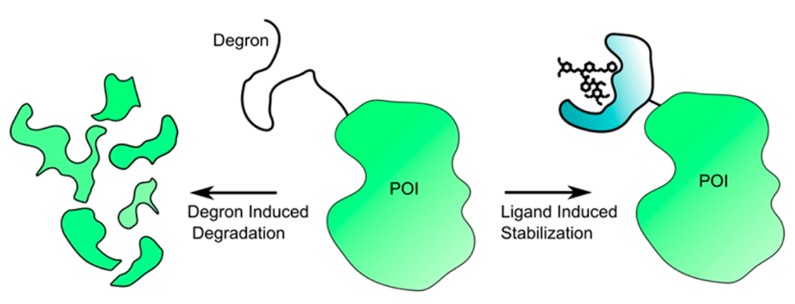 Figure 1. Mechanism of destabilization domains: in the absence of ligand, the DD fusion protein is unstable and degraded; ligand binding stabilizes the fusion, restoring normal expression. (Burslem and Crews, 2017)