We use cookies to understand how you use our site and to improve the overall user experience. This includes personalizing content and advertising. Read our
Privacy Policy
Corynebacterium glutamicum (C. glutamicum) has emerged as a leading prokaryotic host for recombinant protein expression, offering a safe, scalable, and efficient alternative to traditional bacterial systems. With inherent advantages such as fast growth, endotoxin-free production, and low protease activity, C. glutamicum is ideal for producing biologics, enzymes, and industrial biochemicals. Profacgen provides a comprehensive C. glutamicum expression platform, combining strain engineering, vector optimization, secretion enhancement, and process development. Our services enable high-quality, properly folded, and functionally active proteins with short turnaround times, supporting both industrial manufacturing and pharmaceutical applications.
Background: The Advantages of C. glutamicum as a Protein Expression Host
C. glutamicum has been recognized as a Generally Regarded as Safe (GRAS) organism, widely used in the production of amino acids, enzymes, and biologics. Unlike E. coli, which can produce endotoxins and often requires complex downstream purification, C. glutamicum is inherently non-pathogenic and secretes proteins with low contamination risk. Key features include:
Fast Growth and Low-Cost Cultivation: C. glutamicum grows efficiently in minimal media, reducing production costs and facilitating scale-up.
Minimal Protease Activity: Low intracellular and extracellular protease levels preserve protein integrity and reduce degradation.
Endotoxin-Free Secretion: Secreted proteins are safer for pharmaceutical applications, eliminating costly endotoxin removal steps.
Genetic Tractability: Plasmid-based expression systems, genome editing tools, and host strain engineering enable tailored production of complex proteins.
Robust Secretion Mechanisms: Proteins can be secreted directly into the culture medium, simplifying purification and improving protein folding.
Scalability: C. glutamicum has been successfully applied in both laboratory-scale and industrial bioreactor settings, demonstrating reproducible yields and robust process control.
Its versatility has led to widespread use in pharmaceutical production (antibodies, growth factors, hormones), industrial enzymes (amylases, proteases), and biochemicals (L-glutamate, L-lysine).
Figure 1. Process diagram of recombinant protein expression using C. glutamicum as host and bioprocess parameters involved in process optimization. (Liu et al., 2015)
Challenges Addressed by C. glutamicum
While C. glutamicum is a highly promising host, certain challenges need to be addressed for optimal protein production:
Host-Specific Codon Usage: Eukaryotic proteins often require codon adaptation to match the tRNA abundance in C. glutamicum.
Secretion Efficiency: Some proteins are poorly secreted without optimized signal peptides or promoter engineering.
Protein Folding: Multimeric or complex proteins may misfold if intracellular chaperone systems are overwhelmed.
Metabolic Constraints: High-level expression can strain cellular metabolism, necessitating careful optimization of media and culture conditions.
Profacgen's platform is specifically designed to address these issues through integrated strain engineering, codon optimization, and high-throughput process development, ensuring robust expression of functional, active proteins.
Our C. glutamicum Protein Expression Service Offerings
Profacgen offers a comprehensive solution for C. glutamicum production:
Step
Services
Vector and Gene Optimization
Promoter, Terminator, and Codon Optimization: Enhances transcription and translation efficiency for maximal protein expression.
Signal Peptide Screening: Identifies and optimizes N-terminal secretion signals to improve extracellular protein yields.
Fusion Tag Incorporation: Facilitates purification, solubility, and functional detection without compromising protein activity.
Custom Constructs: Flexible design options for multimeric proteins, membrane proteins, and aggregation-prone targets.
Strain Selection and Engineering
Tailored Host Strains: Access to wild-type and engineered strains with reduced protease activity, improved secretion machinery, or optimized metabolic pathways.
Metabolic Engineering: Redirects cellular resources toward protein production, minimizing byproduct formation and enhancing yield.
Genetic Stability: Ensures consistent expression across batches and long-term production runs.
Process Development and Optimization
Culture Media Design: Customized formulations to support rapid growth, protein stability, and high secretion efficiency.
Bioreactor Parameter Optimization: Dynamic control of dissolved oxygen, pH, temperature, and feeding strategies.
High-Throughput Microtiter Plate Cultivation: Parallel testing of multiple conditions to identify optimal expression parameters rapidly.
Online Monitoring: Real-time assessment of biomass, oxygen consumption, and protein secretion enables data-driven process refinement.
Protein Purification and Quality Assurance
Minimized Downstream Steps: Secreted proteins simplify purification, reducing processing time and cost.
Activity and Folding Verification: Functional assays, SDS-PAGE, and analytical techniques ensure properly folded, biologically active proteins.
Endotoxin-Free Products: Suitable for research, preclinical studies, and industrial applications.
Advantages of Our C. glutamicum Expression Platform
High Protein Yield: Optimized genetic constructs and bioprocesses ensure robust production.
Functional Secretion: Proteins are exported in soluble, properly folded form, minimizing inclusion bodies.
Scalability: From high-throughput screening to pilot and industrial scale, processes remain reproducible.
Endotoxin-Free Production: Proteins are safer and require less purification.
Versatile Host Options: Multiple engineered strains to match protein characteristics.
Rapid Development: High-throughput and automated systems accelerate optimization timelines.
Cost Efficiency: Reduced media costs, simplified purification, and optimized yields lower overall production expenses.
Technical Expertise: Experienced team providing guidance across molecular design, strain selection, and process development.
Representative Case Studies
Case 1: Secretion of a Therapeutic Hormone
Background
A pharmaceutical client struggled with high-yield secretion of a human growth hormone. Standard E. coli systems caused cytosolic aggregation and inactive inclusion bodies, resulting in low functional yields that stalled preclinical testing.
Our Solution
Using our C. glutamicum platform, we screened a library of signal peptides and promoters to identify optimal combinations for efficient translocation. We then optimized bioreactor parameters—specifically pH, dissolved oxygen, and nutrient-feeding strategies—to maximize metabolic flux toward the target hormone while maintaining cellular health.
Final Results
The hormone was successfully secreted with high purity and correct folding. Yields increased threefold compared to initial attempts, providing high-quality soluble protein that directly facilitated preclinical assays and simplified downstream purification.
Case 2: Industrial Enzyme Production
Background
An industrial biotech firm required large-scale production of an amylase enzyme. Their existing system suffered from low functional titers and high proteolytic degradation, requiring costly cell lysis and complex downstream processing.
Our Solution
We applied codon optimization and high-throughput signal peptide screening to enhance export. To ensure product stability, we engineered a protease-deficient C. glutamicum strain. Finally, we optimized fermentation conditions in 50L fermenters to maximize volumetric productivity and enzyme activity.
Final Results
Secretion efficiency rose from 25% to over 80%. The active enzyme was harvested directly from the supernatant, eliminating cell disruption. This streamlined process enabled rapid scale-up and industrial deployment with significantly reduced production costs.
Case 3: Recombinant Antibody Fragment Expression
Background
A client needed efficient production of a single-chain antibody fragment (scFv). Traditional bacterial expression led to insoluble inclusion bodies, making it impossible to conduct necessary binding affinity and validation studies.
Our Solution
We utilized a tailored C. glutamicum strain with low endogenous protease activity. By optimizing codon usage and selecting "soft" promoters, we prevented metabolic overload and inclusion body formation. We refined feeding strategies to ensure consistent growth and steady-state protein secretion into the extracellular space.
Final Results
The scFv was produced in a soluble, fully functional form. The secreted protein was purified directly from the culture medium, reducing processing time by 40% and ensuring the batch-to-batch consistency required for diagnostic applications.
Q: Why choose C. glutamicum over E. coli for protein expression?
A: C. glutamicum is non-pathogenic, endotoxin-free, and naturally secretes proteins into the culture medium. Its low protease activity preserves protein integrity, simplifying purification and making it ideal for both research and industrial applications.
Q: How are signal peptides selected and optimized?
A: Signal peptides are chosen based on protein characteristics and host compatibility. We screen multiple sequences, test secretion efficiency, and combine promoter and codon optimization to maximize soluble, functional protein yield.
Q: Are custom strains available?
A: Yes. We provide a range of engineered and mutant C. glutamicum strains. These are tailored for reduced protease activity, improved secretion, enhanced growth, or specific metabolic profiles depending on your protein target.
Q: How long does protein production take?
A: Small-scale expression and screening can be completed within days. Optimized production batches in bioreactors typically take a few weeks, depending on protein complexity, size, and secretion requirements.
Q: Can C. glutamicum produce functional eukaryotic proteins?
A: Yes. Many eukaryotic proteins—including hormones, antibody fragments, and enzymes—have been successfully expressed in soluble, active forms with correct folding and functional activity.
Q: What proteins are most suitable for C. glutamicum expression?
A: Secreted proteins, enzymes, therapeutic proteins, multimeric complexes, and aggregation-prone proteins benefit the most. Proteins sensitive to proteolysis or requiring minimal endotoxin exposure are particularly well-suited.
Q: Is downstream purification simplified with this system?
A: Yes. Because proteins are secreted into the medium and protease activity is low, purification steps are fewer and less complex, reducing time and cost while preserving protein quality.
Q: How do you ensure protein quality and activity?
A: We employ analytical assays to confirm protein integrity, folding, solubility, and functional activity. High-quality purification and secretion strategies ensure reproducibility and suitability for downstream applications.
Reference:
Liu X, Yang Y, Zhang W, et al. Expression of recombinant protein using Corynebacterium Glutamicum: progress, challenges and applications. Critical Reviews in Biotechnology. 2016;36(4):652-664. doi:10.3109/07388551.2015.1004519
Online Inquiry
Fill out this form and one of our experts will respond to you within one business day.

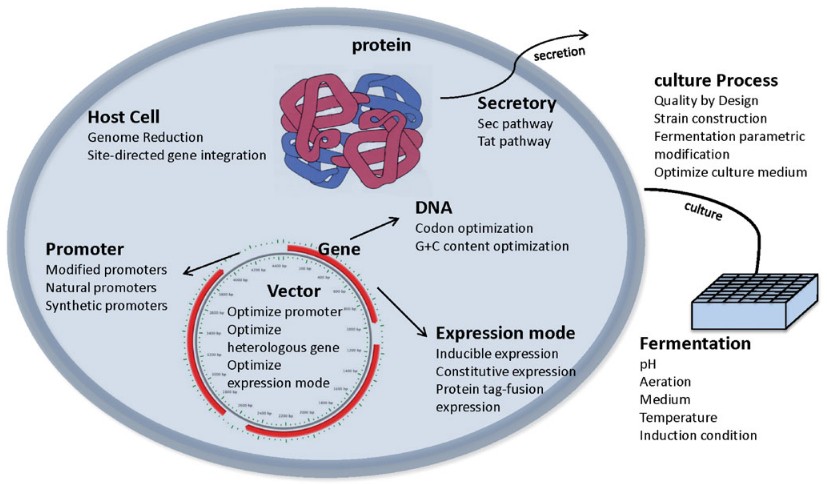 Figure 1. Process diagram of recombinant protein expression using C. glutamicum as host and bioprocess parameters involved in process optimization. (Liu et al., 2015)