
At Profacgen, our direct chemical modification service provides the fastest and most straightforward route to installing bioorthogonal handles on purified proteins. Unlike genetic code expansion or metabolic glycoengineering, which require extensive cell line engineering or cell culture, direct chemical modification attaches bioorthogonal functional groups to native amino acid side chains using chemoselective reagents that react under mild, controlled conditions. This approach is ideal for rapid prototyping, analytical applications, and situations where genetic manipulation of the expression host is not feasible or desirable.
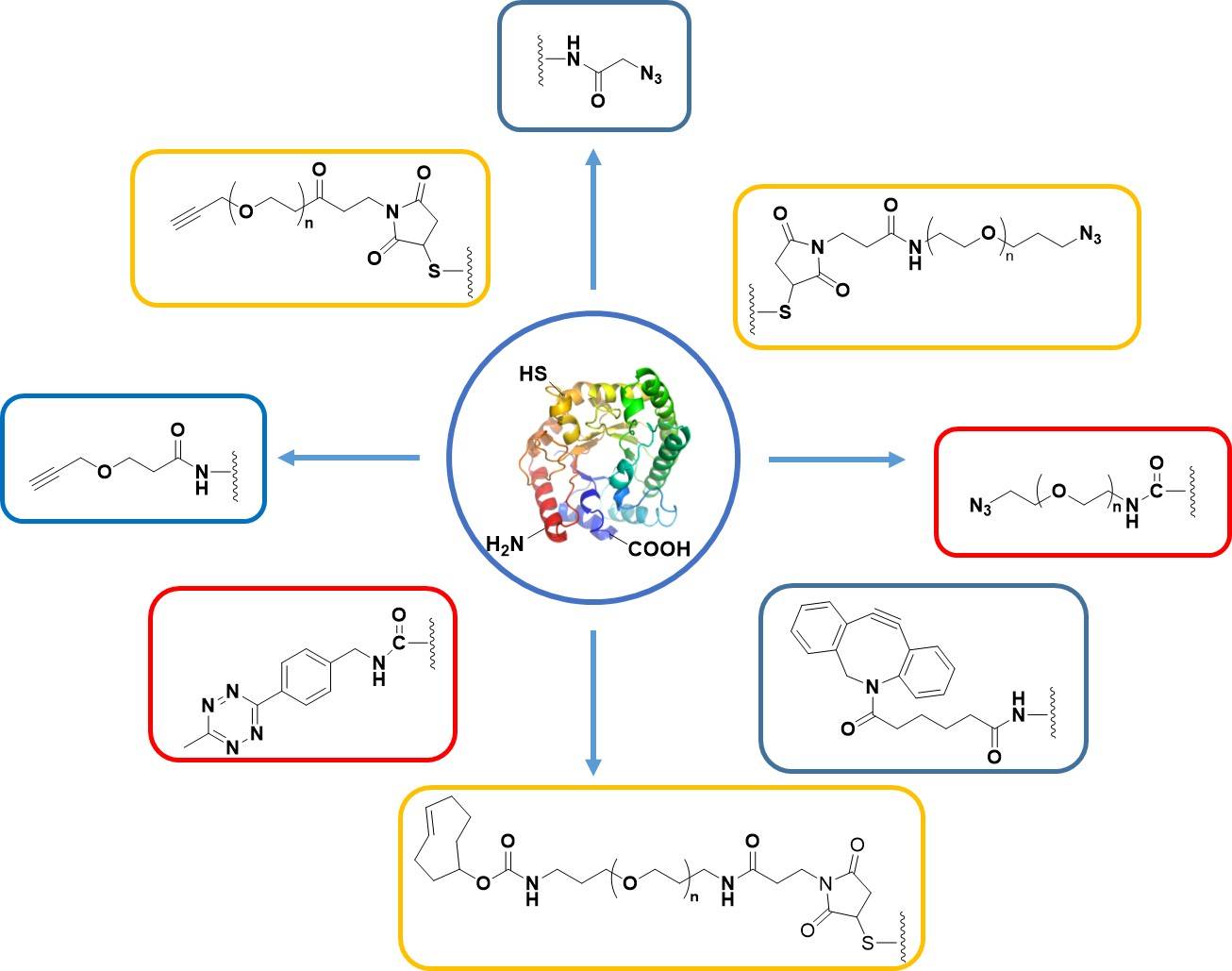
Our bioorthogonal chemistry toolbox encompasses reagents targeting the three most reactive functional groups on protein surfaces: primary amines (lysine ε-amino and N-terminal α-amino groups), thiols (cysteine sulfhydryl groups), and carboxylates (aspartate, glutamate, and C-terminal α-carboxyl groups). Each reagent is designed to introduce a specific bioorthogonal handle—azide, alkyne, tetrazine, trans-cyclooctene (TCO), or aldehyde—that enables subsequent conjugation with complementary functionalized probes, payloads, or surfaces through rapid, high-yielding bioorthogonal reactions.
Direct chemical modification of proteins exploits the differential reactivity of amino acid side chains toward electrophilic reagents. Among the 20 canonical amino acids, three functional groups are sufficiently nucleophilic to react selectively under controlled conditions: the primary amine (lysine ε-NH2, N-terminal α-NH2, pKa ~10.5 and ~8.0 respectively), the thiol (cysteine –SH, pKa ~8.3), and the carboxylate (aspartate/glutamate γ/δ-COO-, C-terminal α-COO-, pKa ~4.0). The reactivity of each group is strongly pH-dependent, enabling selective targeting through careful buffer control.
Amine-reactive reagents are the most widely used for protein modification. N-Hydroxysuccinimide (NHS) esters react with primary amines at mildly basic pH (7.5–9.0) to form stable amide bonds. Profacgen offers NHS ester reagents bearing bioorthogonal handles including azido-acetate NHS ester (introduces a short azide), propargyl NHS ester (introduces a terminal alkyne), and DBCO-NHS ester (introduces a strained alkyne for direct SPAAC without a second reagent). The reaction is complete within 30–60 minutes at room temperature and produces a stable covalent linkage resistant to hydrolysis, reduction, and physiological conditions.
Thiol-reactive reagents offer greater site specificity because free cysteine residues are less abundant than lysines on most protein surfaces. Maleimides react with thiols at near-neutral pH (6.5–7.5) to form stable thioether bonds. Our thiol-reactive bioorthogonal reagents include TCO-PEG3-maleimide (introduces trans-cyclooctene for ultra-fast IEDDA with tetrazines), alkyne-PEG4-maleimide (terminal alkyne for CuAAC), and tetrazine-PEG4-maleimide (tetrazine for IEDDA with TCO or norbornene partners). The maleimide-thiol reaction is highly selective and proceeds rapidly even at low micromolar concentrations.
Carboxyl-reactive reagents enable modification at acidic residues using carbodiimide-mediated coupling. Tetrazine-amine and azide-PEG3-amine reagents are activated by EDC/NHS chemistry to form amide bonds with carboxylate side chains. Additionally, Profacgen offers specialized strategies for generating aldehyde handles on proteins: periodate oxidation of N-terminal serine or threonine residues cleaves the α-amino-β-hydroxy motif to generate an N-terminal aldehyde; and pyridoxal-5'-phosphate (PLP)-mediated transamination converts the N-terminal amine to a ketone or aldehyde. These carbonyl handles enable subsequent oxime or hydrazone ligation with aminooxy- or hydrazide-functionalized probes.
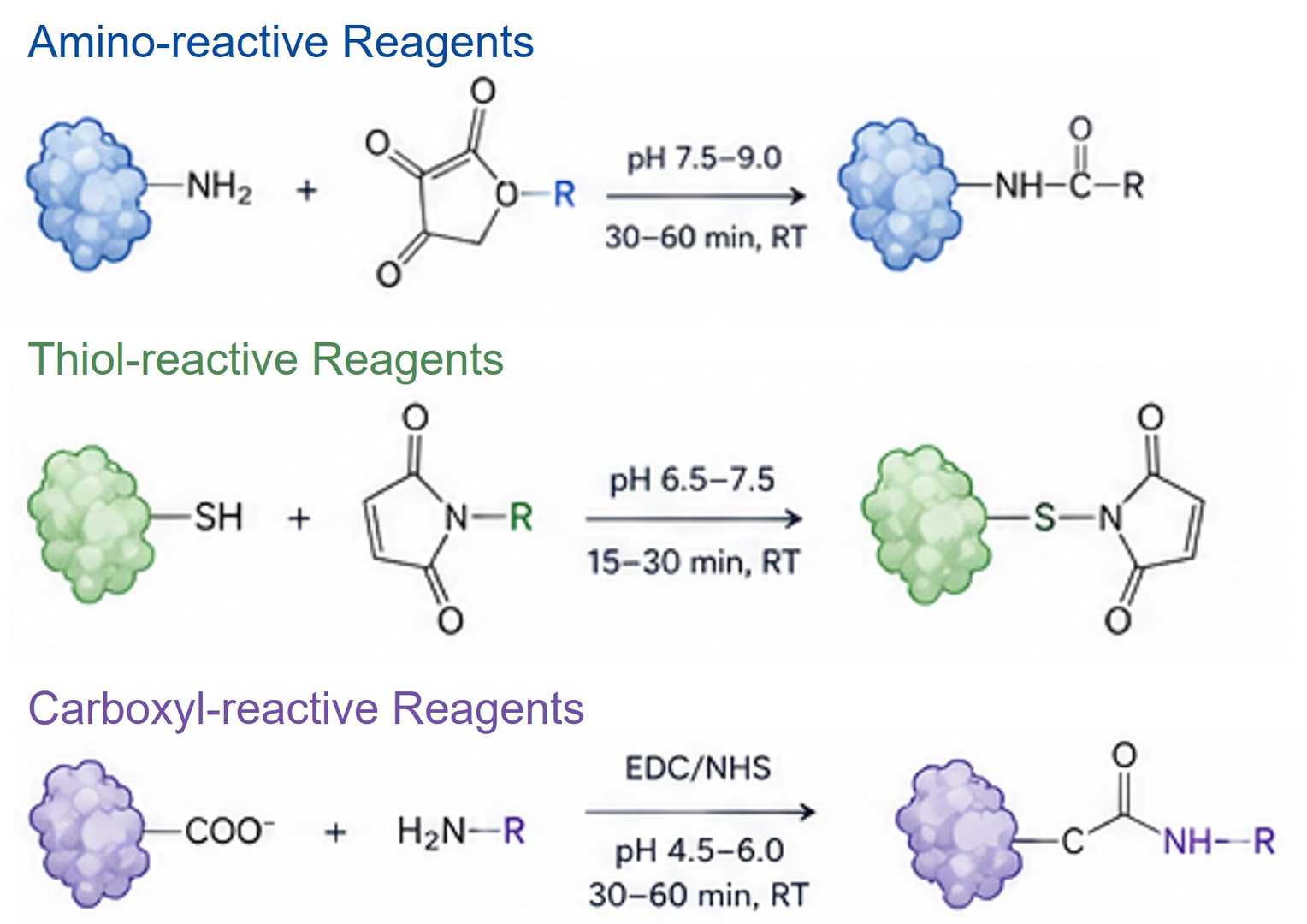
Amine-Directed Handle Installation
Modification of lysine and N-terminal amines with NHS ester reagents bearing bioorthogonal handles.
Thiol-Directed Handle Installation
Highly specific modification of cysteine residues with maleimide reagents bearing bioorthogonal handles.
Carboxyl-Directed Handle Installation
EDC/NHS-mediated coupling of amine-containing bioorthogonal reagents to aspartate, glutamate, and C-terminal carboxyl groups.
N-Terminal Aldehyde Generation
Chemoselective conversion of N-terminal serine, threonine, or cysteine to aldehyde/ketone handles for oxime/hydrazone ligation.
Background:
A biopharmaceutical company needed to screen 200+ antibody clones for binding to a membrane protein antigen by SPR. Random amine coupling of the antigen to the sensor chip resulted in heterogeneous orientation and poor binding capacity, requiring lengthy optimization for each chip.
Approach:
Profacgen modified the antigen (a His-tagged membrane protein extracellular domain) with TCO-PEG3-maleimide at a single surface cysteine engineered distal from the antibody-binding site. The TCO-bearing antigen was then immobilized on a tetrazine-functionalized SPR chip via IEDDA ligation (t1/2 <1 min at RT), creating a uniformly oriented antigen surface.
Outcome:
Oriented immobilization increased antigen-binding capacity 4-fold compared to random coupling. The rapid IEDDA ligation (<1 min) enabled chip regeneration and re-functionalization between screening campaigns. All 200 antibody clones were screened in 3 days versus 3 weeks with the previous protocol. The oriented antigen chip was stable for >6 months at 4°C, and the protocol was transferred to the company's high-throughput screening group for routine use.
Background:
A peptide therapeutic with an N-terminal serine required site-specific PEGylation to extend its 15-minute half-life. Random lysine PEGylation produced heterogeneous products with reduced receptor-binding affinity.
Approach:
Profacgen treated the peptide with sodium periodate (2 mM, 0°C, 15 min) to oxidatively cleave the N-terminal serine to an aldehyde. The aldehyde was then reacted with aminooxy-PEG20k at pH 4.5 to form a stable oxime linkage. The PEGylated product was purified by SEC and characterized by MALDI-MS.
Outcome:
The N-terminal PEGylation proceeded with >95% chemoselectivity—no modification of the two internal lysines was detected by MS. The mono-PEGylated product was >98% homogeneous by RP-HPLC. Receptor-binding affinity was fully retained (KD = 2.1 nM vs. 1.8 nM for unmodified peptide). Pharmacokinetic studies showed half-life extension from 15 minutes to 36 hours, and the homogeneous product simplified regulatory documentation compared to the random PEGylation mixture.
Request a Direct Chemical Modification Quote
Fill out this form and one of our experts will respond to you within one business day.