
At Profacgen, we provide comprehensive services for the incorporation of bioorthogonal handles into proteins, antibodies, and other biomolecules, enabling precise, site-specific chemical modification without disrupting native structure or function. Bioorthogonal chemistry has emerged as one of the most powerful and reliable approaches for protein labeling, offering chemoselective reactivity that proceeds efficiently under physiological conditions without interference from the complex chemical environment of biological systems.
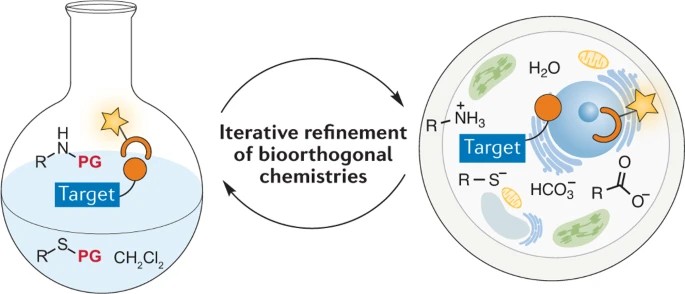
Typically, a bioorthogonal handle is first introduced into a target protein at a defined position, then subsequently reacted with a complementary functionalized probe, payload, or affinity tag through a rapid, high-yielding bioorthogonal coupling reaction. This two-step strategy provides exceptional control over labeling stoichiometry, site selectivity, and conjugate homogeneity—critical parameters for therapeutic development, structural analysis, and functional interrogation.
Profacgen has established a robust, highly efficient platform supporting multiple bioorthogonal handle incorporation strategies. Our integrated capabilities encompass genetic code expansion for site-specific insertion of unnatural amino acids bearing azide, alkyne, ketone, or alkene handles; metabolic glycoengineering for introducing bioorthogonal sugars into glycoproteins; and direct chemical modification for rapid attachment of handles to native amino acid side chains without genetic manipulation. This diverse toolkit ensures that we can match the optimal incorporation strategy to your specific protein, application, and development stage.
Bioorthogonal chemistry refers to chemical reactions that proceed selectively between two functional groups that are inert toward all naturally occurring biomolecules and cellular components. The concept, pioneered by Carolyn Bertozzi in the early 2000s, has transformed how researchers label, track, and modify biomolecules in their native environments. For protein modification applications, bioorthogonal chemistry operates through a two-step paradigm:
Step 1: Handle incorporation. A bioorthogonal functional group (the handle) is introduced into the protein at a defined site. Common handles include azides (R–N3), terminal alkynes (R–C≡CH), strained alkynes such as DBCO (dibenzocyclooctyne), trans-cyclooctenes (TCO), tetrazines, ketones (R2C=O), and aldehydes (R–CHO). Each handle is designed to be chemically inert under biological conditions and to react exclusively with a specific complementary partner.
Step 2: Bioorthogonal conjugation. The handle-bearing protein is reacted with a probe or payload bearing the complementary functional group. The most widely used bioorthogonal reactions include: copper-catalyzed azide-alkyne cycloaddition (CuAAC), forming a stable triazole linkage; strain-promoted azide-alkyne cycloaddition (SPAAC), enabling copper-free click chemistry compatible with live cells; inverse-electron-demand Diels-Alder (IEDDA) reactions between tetrazines and trans-cyclooctenes or norbornenes, offering exceptionally rapid kinetics (up to 104 M-1s-1); and oxime/hydrazone ligation between ketone/aldehyde handles and aminooxy/hydrazide probes.
The key advantage of this two-step approach is the decoupling of handle introduction from final conjugation, allowing each step to be independently optimized. This modularity enables precise control over conjugation site, stoichiometry, and probe selection that is unattainable with traditional direct chemical modification approaches.
Profacgen offers three complementary platforms for introducing bioorthogonal handles into proteins:
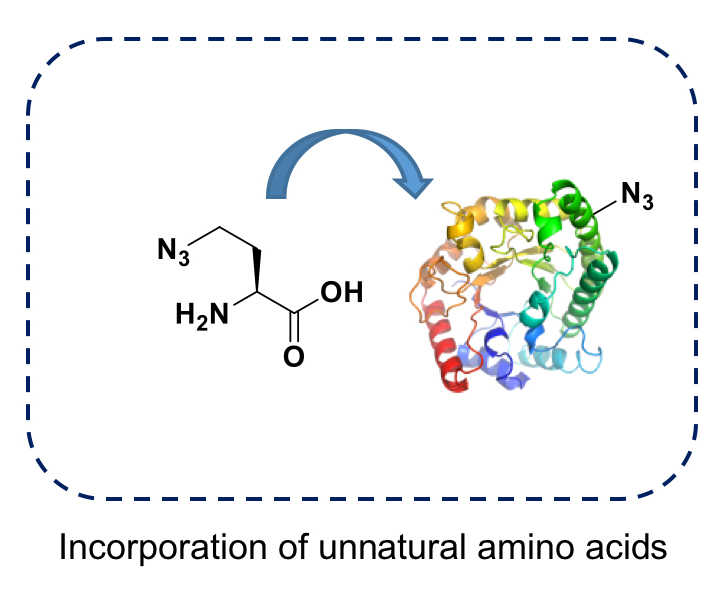
Incorporation of Unnatural Amino Acids
Site-specific installation of bioorthogonal handles through genetic code expansion technology. An orthogonal tRNA/aminoacyl-tRNA synthetase pair directs the incorporation of an unnatural amino acid bearing a bioorthogonal functional group in response to a reassigned stop codon.
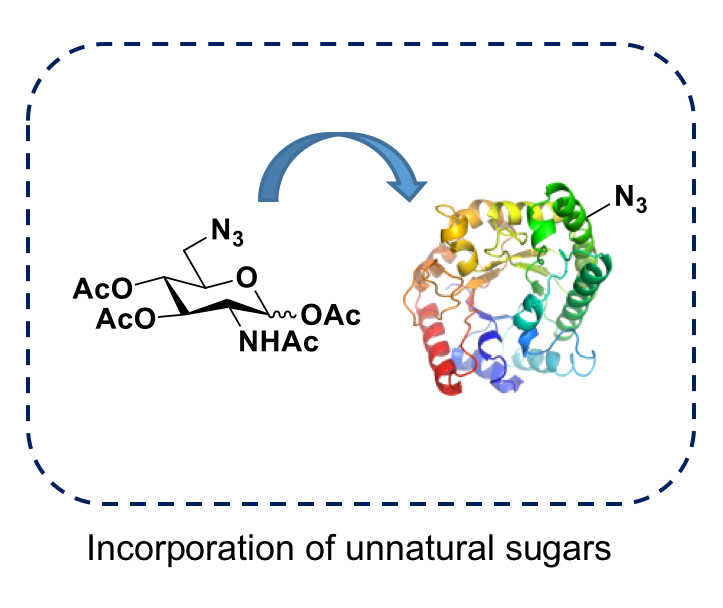
Incorporation of Unnatural Sugars
Metabolic glycoengineering approach that introduces bioorthogonal chemical reporters into the glycan chains of glycoproteins by supplementing cell culture media with unnatural sugar analogs.
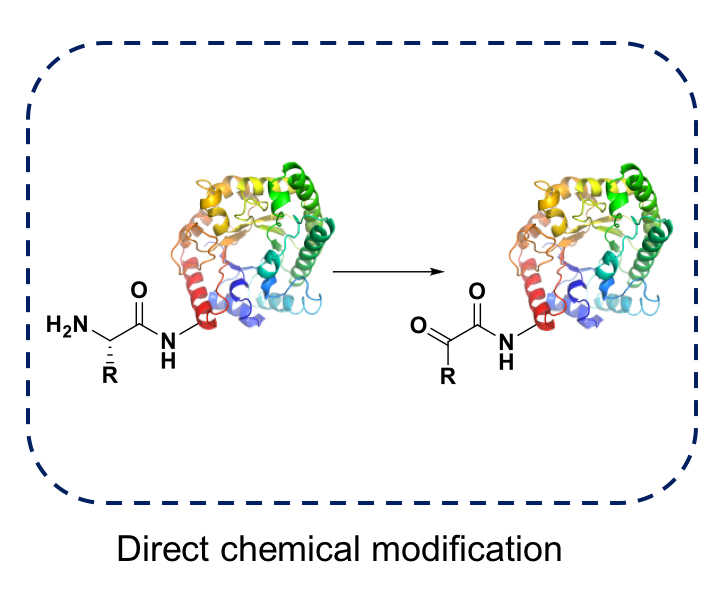
Rapid attachment of bioorthogonal handles to native amino acid side chains using chemoselective reagents, enabling handle installation without genetic engineering or cell line development.
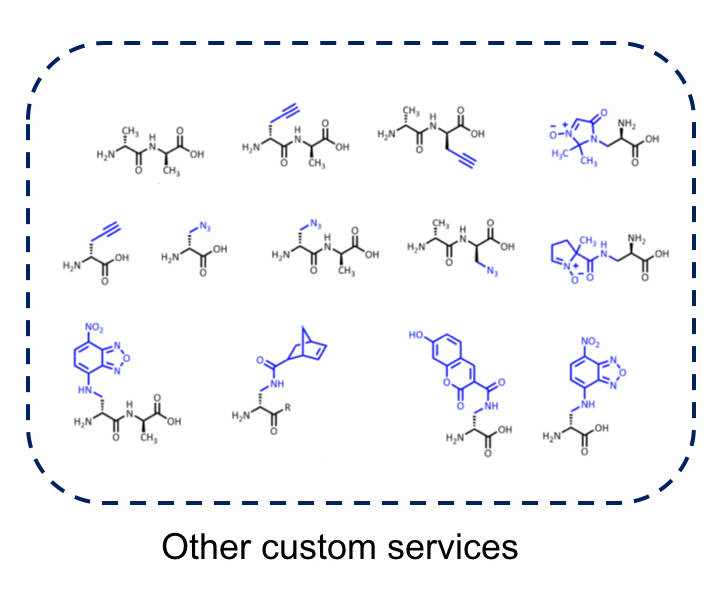
Other Custom Services
Beyond these platforms, Profacgen offers flexible custom solutions—including enzymatic ligation (sortase, transglutaminase), alternative expression systems (insect cells, cell-free), and integrated workflows from handle installation to purification and characterization. We also support specialized chemistries, multiplexed labeling, and scaled production for in vivo studies, with strategies tailored to your timeline and application needs.
Our bioorthogonal handle incorporation services support diverse research and therapeutic development programs:
Background:
An oncology program required a homogeneous antibody-drug conjugate with a defined drug-to-antibody ratio. Random lysine conjugation produced heterogeneous mixtures with variable DAR (0–8), compromising pharmacokinetics and therapeutic index.
Approach:
Profacgen incorporated p-azidomethyl-L-phenylalanine (AzMF) at a specific site in the antibody constant region using an orthogonal tRNA/synthetase pair in CHO cells. The azide handle was subsequently reacted with a DBCO-functionalized maytansinoid payload via SPAAC, yielding a homogeneous conjugate with DAR = 2.
Outcome:
The bioorthogonal ADC exhibited >95% homogeneity by hydrophobic interaction chromatography. Antigen-binding affinity was fully retained. In vivo studies showed 40% improved tumor regression and reduced off-target toxicity compared to the conventional lysine-conjugated counterpart, supporting advancement to IND-enabling studies.
Background:
A cell biology team needed to visualize the trafficking dynamics of a native membrane glycoprotein without genetic fusion to GFP, which can perturb trafficking behavior due to its large size.
Approach:
Profacgen treated live cells with Ac4ManNAz, an unnatural sugar analog that is metabolically converted to azido-sialic acid and incorporated into cell surface glycoproteins. After 48 hours, cells were reacted with a DBCO-Cy5 fluorophore for 30 minutes to label azide-bearing glycoproteins via copper-free click chemistry.
Outcome:
The metabolic labeling strategy enabled real-time visualization of glycoprotein endocytosis and recycling with minimal perturbation. Time-lapse imaging revealed a previously uncharacterized rapid recycling pathway with a half-time of ~4 minutes. The approach was subsequently adapted to a high-throughput format for screening trafficking modulators.
Discuss Your Bioorthogonal Handle Project
References:
Fill out this form and one of our experts will respond to you within one business day.