We use cookies to understand how you use our site and to improve the overall user experience. This includes personalizing content and advertising. Read our
Privacy Policy
Current Good Manufacturing Practice (cGMP) is the primary regulatory standard for ensuring the quality and safety of human pharmaceutical products and is enforced by the U.S. Food and Drug Administration (FDA). cGMP regulations establish a comprehensive quality framework governing the design, monitoring, documentation, and control of manufacturing processes and facilities, ensuring that drug substances are consistently produced and suitable for their intended clinical use.
In biologics development, cGMP-compliant protein production represents a critical transition point, where manufacturing processes must demonstrate robustness, reproducibility, and full traceability to support preclinical studies, IND submissions, and clinical trials.
Profacgen provides cGMP-compliant protein production services to ensure that our customers' protein drug products meet quality standards and accelerate the preclinical drug development process.
When Do You Need cGMP-Compliant Protein Production
Many programs encounter challenges when transitioning from research-grade material to GMP-compliant production. Profacgen supports protein manufacturing at multiple development stages, including:
IND-Enabling Studies: Production of protein material suitable for toxicology, formulation development, and CMC documentation preparation.
Clinical Trial Material (CTM) Manufacturing: GMP-compliant production to support Phase I and early Phase II clinical trials.
Process Scale-Up and Technical Transfer: Transition from non-GMP or pilot-scale processes into controlled, reproducible GMP manufacturing workflows.
Bridging GLP / Non-GMP to cGMP: Alignment of process, analytical methods, and documentation to minimize regulatory risk during development transitions.
Key Challenges We Help You Address
Project leaders often face similar concerns when planning GMP protein production. Our service is structured to address these realities directly:
Reducing Regulatory Risk: Ensuring manufacturing processes, controls, and documentation align with cGMP expectations from early development onward.
Avoiding Costly Rework: Designing processes that can scale and adapt, rather than rebuilding manufacturing workflows at each development stage.
Managing Timeline Pressure: Coordinating development, manufacturing, and QC activities to meet IND and clinical milestones.
Ensuring Material Consistency: Producing protein materials with defined quality attributes suitable for clinical use and regulatory review.
Our cGMP Protein Production Capabilities
Profacgen provides comprehensive cGMP-compliant protein production services designed to ensure that protein drug substances meet applicable quality standards and regulatory expectations. Our services support accelerated preclinical and early clinical development by delivering high-quality protein materials produced under controlled and auditable conditions.
Our multidisciplinary team is dedicated to achieving shared project objectives by operating validated equipment within flexible, high-quality manufacturing suites. This infrastructure enables consistent, well-controlled operations across multiple production runs, reducing manufacturing risk and supporting regulatory readiness.
Scope of cGMP-Compliant Protein Production Services
Profacgen's cGMP-compliant protein production services include, but are not limited to, the following capabilities:
Cell Banking Services
Comprehensive support from cell line generation and characterization through master and working cell bank production and cryogenic storage under cGMP conditions.
Upstream Manufacturing
Fermentation and cell culture using batch, fed-batch, or perfusion strategies, with production volumes up to 300 liters, supporting both microbial and mammalian expression systems.
Downstream Purification
Scalable purification technologies, including cell homogenization, continuous centrifugation, depth and membrane filtration, and chromatographic purification systems designed to achieve consistent purity and yield.
Facility and Quality Features
Profacgen's state-of-the-art, fully certified manufacturing facility is designed to support compliant and efficient biologics production:
Qualified Class 10,000 and Class 100,000 cleanrooms, equipped with Class 100 biological safety cabinets Dedicated cleanroom suites for upstream and downstream processing, minimizing cross-contamination risk Protein production and purification capabilities for both mammalian and microbial expression systems Independent quality control and analytical testing laboratories Reliable and secure cell banking and sample storage services
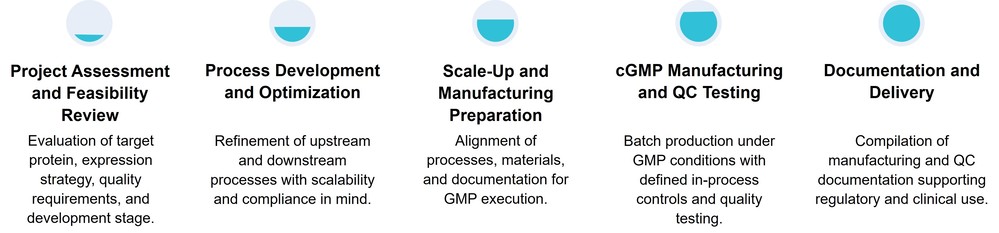
Typical Project Workflow
A typical cGMP protein production project follows a structured yet flexible workflow:
Our facility is designed for multi-product operation and delivers a comprehensive range of services required to advance novel biopharmaceuticals from proof-of-concept through cGMP manufacturing for clinical trials, market launch, and commercial supply. By integrating manufacturing, quality systems, and documentation within a single organization, Profacgen helps ensure continuity and efficiency throughout the development lifecycle.
From early-stage planning through regulated manufacturing, clients can rely on Profacgen's validated facilities, experienced personnel, and professional manufacturing capacity to support their development goals.
Applications and Program Types Supported
Our cGMP-compliant protein production services support a wide range of development programs, including:
Therapeutic proteins
Enzymes for clinical research or therapeutic use
Protein-based biologics
Vaccine-related proteins
Fusion proteins and modified protein constructs
Each program is evaluated individually to ensure appropriate manufacturing and quality strategies.
Representative Program Scenarios
The following scenarios are representative examples illustrating how cGMP-compliant protein production programs are typically supported. They are provided for demonstration purposes only and do not reference specific clients or confidential projects.
Scenario 1: IND-Enabling cGMP Protein Production for Early Clinical Development
Program Stage: Pre-IND / IND-enabling development
Program Objective: To produce cGMP-compliant protein material suitable for toxicology studies and IND submission, while establishing a manufacturing and quality framework scalable to early clinical trials.
Key Program Challenges:
Transition from non-GMP or research-grade production to a cGMP-compliant manufacturing process
Alignment of upstream and downstream processes with regulatory expectations
Definition of an appropriate quality control and release testing strategy
Tight timelines associated with IND submission planning
Profacgen's Role:
Assessment of existing expression and purification processes for GMP suitability
Process optimization to improve robustness, reproducibility, and scalability
Execution of cGMP-compliant protein production under controlled manufacturing conditions
Implementation of in-process controls and defined batch documentation
Quality control testing to support material release and CMC documentation
Program Outcome:
Delivery of cGMP-compliant protein material suitable for IND-enabling studies
Manufacturing and QC documentation aligned with regulatory submission requirements
Establishment of a scalable manufacturing foundation for subsequent clinical development
Scenario 2: Transition from GLP / Non-GMP Production to cGMP Manufacturing
Program Stage: Late preclinical development transitioning toward clinical supply
Program Objective: To bridge existing GLP or non-GMP protein production processes into a cGMP-compliant manufacturing workflow, minimizing development disruption while maintaining material comparability.
Key Program Challenges:
Ensuring continuity between non-GMP and GMP production batches
Managing process changes while maintaining defined product quality attributes
Supporting comparability assessments required for regulatory review
Coordinating manufacturing, QC, and documentation activities across development stages
Profacgen's Role:
Review and gap analysis of existing non-GMP manufacturing processes
Adaptation of upstream and downstream processes to meet cGMP requirements
GMP batch production with defined process controls and traceability
Analytical testing to support batch release and comparability considerations
Compilation of manufacturing and quality documentation for regulatory use
Program Outcome:
Successful transition to cGMP-compliant protein production without significant process redesign
Generation of GMP material suitable for clinical use
Reduced regulatory risk through structured documentation and controlled process evolution
Q: When should we transition from research-grade production to cGMP-compliant manufacturing?
A: The transition should occur once your program is moving toward IND-enabling studies or clinical trial planning. Waiting too long increases CMC risk, while transitioning too early can strain budgets. Profacgen helps clients identify the optimal timing and smoothly bridge non-GMP and cGMP production, preserving development momentum without unnecessary rework.
Q: How does cGMP protein production reduce regulatory risk for IND submission?
A: cGMP production ensures controlled processes, full traceability, and defensible documentation—all critical elements reviewed by regulators. Our integrated approach aligns manufacturing, quality control, and batch documentation with regulatory expectations, helping clients avoid delays, questions, or repeat studies during IND review.
Q: Can existing expression or purification processes be adapted for cGMP manufacturing?
A: Yes. In many cases, existing processes can be optimized and qualified for cGMP use rather than rebuilt from scratch. Profacgen evaluates current upstream and downstream workflows for robustness, scalability, and compliance, then refines them to meet cGMP standards while minimizing changes that could affect product comparability.
Q: What expression systems are available for cGMP protein production?
A: Profacgen supports multiple expression platforms, including bacterial, yeast, insect/baculovirus, and mammalian systems, each selected based on protein complexity, yield requirements, and regulatory strategy. This flexibility allows programs to balance biological relevance, scalability, and timeline constraints without compromising compliance.
Q: How do you ensure batch-to-batch consistency?
A: Consistency is achieved through defined process parameters, in-process controls, validated purification steps, and standardized documentation. Our manufacturing workflows are designed to deliver reproducible quality attributes across batches—critical for toxicology studies, clinical trials, and future process validation.
Q: What quality control testing is included?
A: Our cGMP programs include identity, purity, concentration, and impurity testing, with methods selected to support IND and clinical requirements. QC strategies are customized to the program stage and aligned with regulatory expectations, ensuring material is suitable for release and downstream use.
Q: How do you manage documentation for regulatory submissions?
A: All manufacturing activities are supported by comprehensive batch records, deviation tracking, change control, and QC reports. Documentation is generated with regulatory review in mind, making it directly usable for IND submissions and other regulatory filings.
Q: What timelines can we expect for cGMP protein production?
A: Timelines depend on expression system, scale, and process maturity, but Profacgen emphasizes predictable scheduling and transparent communication. Early planning, parallel process development, and risk-based execution help keep programs aligned with IND and clinical milestones.
Online Inquiry
Fill out this form and one of our experts will respond to you within one business day.