
Yeast surface display is a powerful protein engineering platform that fuses target proteins to the yeast cell wall, enabling genotype-phenotype linkage and quantitative selection by fluorescence-activated cell sorting (FACS). Profacgen provides comprehensive yeast display services using both Saccharomyces cerevisiae and Pichia pastoris platforms for antibody affinity maturation, novel binder discovery, enzyme engineering, and protein specificity optimization.
The yeast surface display system exploits the native yeast mating adhesion receptor a-agglutinin, which consists of two subunits: Aga1p (anchored to the cell wall via a GPI linkage) and Aga2p (secreted and tethered to Aga1p through disulfide bonds). By genetically fusing a protein or peptide library to Aga2p, each variant is presented on the yeast surface where it can bind fluorescently labeled target molecules. The yeast genotype (encoding the displayed variant) and phenotype (binding activity) are physically linked within the same cell, enabling efficient enrichment of binders by FACS.
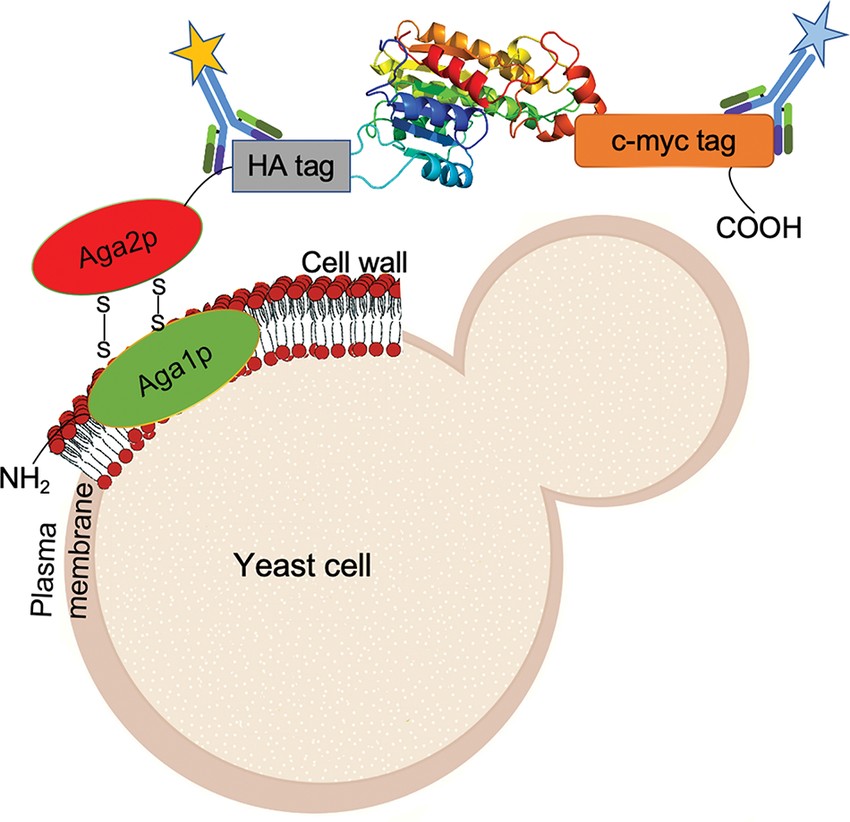 Figure 1. Overview of the Yeast Surface Display (YSD) system, a biotechnological technique used for the cell surface expression of heterologous proteins, which are fused to the C-terminus of the mating agglutinin protein Aga2. (Li et al, 2025)
Two complementary yeast platforms are available:
Flow cytometry enables simultaneous quantification of both display level (via epitope tags) and binding activity (via fluorescent ligand), allowing discrimination of variants based on affinity, specificity, and expression yield.
Profacgen provides comprehensive yeast display services for research, diagnostic, and therapeutic applications. Our offerings include:
| Service Component | Description |
|---|---|
| Antibody Affinity Maturation | Directed evolution of antibody variants through CDR randomization and FACS-based selection. Iterative rounds of mutation and selection yield 10- to 100-fold affinity improvements while maintaining specificity. Deliverables: improved variant sequences, affinity data, selection report. |
| Novel Binder Discovery | Screen naive or synthetic libraries against your target protein. Library sizes exceeding 108 variants interrogated per campaign. Deliverables: binder sequences, affinity ranking, specificity profile. |
| Specificity Engineering | Select for binders with enhanced specificity over related homologs. Negative selection against off-targets enforces discrimination. Deliverables: specificity-optimized variants, cross-reactivity data. |
| Yeast Library Construction | Custom display library generation by error-prone PCR, DNA shuffling, or targeted mutagenesis. Deliverables: library titer, diversity assessment, QC report. |

To complement your protein interaction analysis, explore our comprehensive portfolio of related screening and profiling services.
Background:
A biopharmaceutical company required improvement of a therapeutic anti-PD-1 antibody with suboptimal binding affinity (120 nM). The antibody showed promising checkpoint blockade activity in preliminary assays, but the modest affinity limited its clinical potency.
Our Solution:
Using our S. cerevisiae yeast display platform, we constructed a combinatorial library randomizing all three CDR heavy chains simultaneously, generating a diversity of 2 x 10⁸ variants. After three rounds of FACS selection with decreasing antigen concentration, enriched clones were sequenced and characterized.
Final Results:
We identified 12 variants with 50- to 200-fold improved affinity (from 120 nM to 0.6-2.4 nM) while maintaining epitope specificity. The lead variant showed enhanced checkpoint blockade activity in a T-cell activation assay, supporting its continued development toward clinical candidate status.
Background:
A cell therapy developer needed peptide ligands targeting a solid tumor-associated antigen for next-generation CAR-T applications. The target was a cell surface glycoprotein overexpressed in multiple solid tumor types.
Our Solution:
Using our naive peptide library displayed on P. pastoris, we performed four rounds of FACS selection against the recombinant extracellular domain of the target antigen. The methanol-inducible display system enabled precise control of peptide density to minimize avidity artifacts during selection.
Final Results:
We recovered 8 unique peptide sequences with binding affinities between 15-180 nM as measured by SPR. The top binder demonstrated specific cell surface binding to antigen-positive tumor cells by flow cytometry and mediated CAR-T cell activation at picomolar antigen concentrations, meeting the client's criteria for clinical development.
Get a Quote for your yeast display project
References:
Fill out this form and one of our experts will respond to you within one business day.