We use cookies to understand how you use our site and to improve the overall user experience. This includes personalizing content and advertising. Read our
Privacy Policy
Profacgen offers hydrophobic tag technology services, providing a versatile platform for small-molecule-induced protein degradation, enabling target validation and functional studies in the absence of direct target ligands by exploiting the cell's intrinsic quality control machinery.
Despite substantial progress in ligand development, only approximately 300 molecular targets have been characterized for approved drugs, leaving a vast fraction of the proteome considered "undruggable" by conventional inhibition strategies. A critical challenge in small-molecule discovery is determining whether inhibitor failure stems from poor target selection or unpredicted in vivo metabolism—a question addressable through robust target validation, which typically requires a known inhibitor.
Hydrophobic tag technology overcomes this limitation by mimicking protein misfolding through attachment of a hydrophobic moiety to the target protein surface. The exposed hydrophobic patch is recognized by cellular quality control factors, triggering chaperone engagement and proteasomal degradation. This approach provides small-molecule control over target proteins without requiring a direct ligand, offering an ideal strategy for studying and validating potential drug targets across diverse disease models.
What Is Hydrophobic Tag Technology?
Hydrophobic tag technology exploits the hydrophobicity-driven nature of protein folding to induce target degradation. The platform comprises three core elements:
Hydrophobic tagging: A hydrophobic moiety—such as adamantane, Boc3Arg, or other bulky nonpolar groups—is attached to the target protein surface via either non-covalent interaction or HaloTag-induced conjugation. The exposed hydrophobic patch disrupts native folding, creating a misfolding signal that recruits cellular quality control machinery
Protein destabilization: Partially folded or misfolded proteins are recognized by molecular chaperones (Hsp70, Hsp90) and co-chaperones, which attempt refolding. Persistent misfolding triggers transfer to the proteasome for degradation. The hydrophobic tag effectively converts a stable target protein into a substrate for the protein quality control pathway
Proteasomal degradation: The ubiquitin-proteasome system recognizes chaperone-client complexes and misfolded substrates, assembling K48-linked polyubiquitin chains and directing the target to the 26S proteasome for ATP-dependent proteolytic degradation. The process is catalytic when the hydrophobic tag is reversibly bound
Figure 1. Schematic demonstration of hydrophobic tag strategy: hydrophobic moiety attachment induces protein misfolding, chaperone recognition, and proteasomal degradation. (Xin et al., 2025)
Our Hydrophobic Tag Services
Profacgen offers a comprehensive hydrophobic tag development platform designed to bend the cost and time curve of target validation projects:
Tag Design
Rational design of hydrophobic moieties and conjugation strategies tailored to target protein properties.
Hydrophobic moiety selection: adamantane, Boc3Arg, and other bulky nonpolar groups with optimal misfolding induction
HaloTag fusion strategy: design of N-terminal or C-terminal HaloTag constructs for covalent chloroalkane conjugation
Non-covalent tag design: identification of reversible ligands that position hydrophobic groups on the target surface
Compound Synthesis
Chemical synthesis of hydrophobic tag molecules and HaloTag-compatible chloroalkane conjugates.
Design and synthesis of halogen-containing hydrophobic small molecules compatible with HaloTag-induced conjugation
Adamantane and Boc3Arg derivative synthesis with validated purity by HPLC and LC-MS
Linker optimization for optimal tag orientation and protein surface exposure
Functional Validation
Comprehensive biochemical and cellular characterization of hydrophobic tag activity.
HaloTag fusion protein production: expression, purification, and recombinant product activity evaluation
Tag binding confirmation: fluorescent ligand competition, SPR, and thermal shift assays
Protein stability assessment: differential scanning fluorimetry and hydrogen-deuterium exchange to confirm misfolding
Degradation Studies
Quantitative assessment of target degradation kinetics, efficiency, and pathway specificity.
Western blot and quantitative mass spectrometry for target protein level quantification
DC50 and Dmax determination across dose-response and time-course experiments
Proteasome dependence confirmation: MG132, bortezomib, and chaperone inhibitor rescue experiments
Applications
Hydrophobic tag technology enables target validation and research applications across diverse protein classes:
Target Validation: Rapid assessment of whether a protein is essential for a disease phenotype without requiring target-specific inhibitor development. By inducing degradation through misfolding, hydrophobic tags provide a universal tool for target-disease causality assessment, particularly valuable for proteins lacking druggable pockets
Protein Function Studies: Temporal control of protein levels enables mechanistic dissection of protein function in signaling pathways, transcriptional regulation, and metabolic networks. The reversible nature of non-covalent hydrophobic tags supports pulse-chase and recovery experiments
Degrader Discovery: Hydrophobic tag systems serve as proof-of-concept platforms for degrader development. Successful target validation by hydrophobic tagging informs investment decisions for subsequent PROTAC or molecular glue development against the same target
Advantages of Hydrophobic Tag Technology
Ligand-Independent Targeting: Degrades proteins without requiring a specific high-affinity ligand, expanding the druggable target space to proteins previously considered undruggable.
E3 Ligase Independence: Unlike PROTACs, hydrophobic tags do not require E3 ligase recruitment; degradation is mediated by the constitutive protein quality control machinery present in all cell types.
Universal Mechanism: The misfolding-induced degradation signal is recognized by conserved chaperone and proteasome systems, enabling broad applicability across target classes and cellular contexts.
Rapid Target Validation: Provides a faster, more cost-effective route to target validation compared to developing target-specific inhibitors or genetic knockout systems.
Reversible Control: Non-covalent hydrophobic tags enable dose-dependent and reversible protein elimination, supporting temporal studies of protein function and recovery dynamics.
Why Choose Profacgen
Integrated Platform: Profacgen offers end-to-end hydrophobic tag development from HaloTag fusion protein production and compound synthesis to degradation validation and in vivo testing.
Cost and Time Efficiency: Our well-designed strategies bend the cost and time curve of target validation projects, with risk management ensuring maximum cost efficiency for smaller companies and research institutes.
Comprehensive Analytics: All products undergo full characterization at our analytical facility, including protein activity evaluation, degradation assessment, and method validation.
In Vivo Capabilities: The reliability and efficacy of newly developed systems are tested in vivo to bring ultimate confidence, with potential drug targets identified in both cell lines and animal models.
Flexible Engagement: Services are available as standalone modules or integrated packages, from protein production and tag design to full in vivo validation.
Scenario 1: Transcription Factor Target Validation by Hydrophobic Tagging
Program Context:
A drug discovery program identified a transcription factor as a potential oncology target, but the protein lacked druggable pockets and no suitable small-molecule inhibitors existed. Genetic knockout was embryonic lethal, preventing stable cell line generation. The team required a reversible system to validate target essentiality.
Objective:
To develop a HaloTag fusion system for the transcription factor, synthesize an adamantane-based hydrophobic tag, and demonstrate dose-dependent degradation with phenotypic consequence confirmation.
Approach:
Profacgen designed a C-terminal HaloTag fusion construct and generated stable expression cell lines. An adamantane-chloroalkane hydrophobic tag was synthesized and validated for HaloTag binding by fluorescent ligand competition. Cells were treated with varying concentrations of the tag, and target protein levels were monitored by Western blot and immunofluorescence over 72 hours.
Outcome:
The hydrophobic tag induced >85% transcription factor degradation at 1 µM with DC50 of 320 nM. Degradation was blocked by MG132 and bortezomib, confirming proteasome dependence. Target elimination suppressed known downstream genes by >70% and induced cell cycle arrest, validating the transcription factor as a genuine driver of proliferation. Washout experiments demonstrated full protein recovery within 48 hours, confirming reversibility.
Scenario 2: Scaffold Protein Degradation for Pathway Dissection
Program Context:
A signaling pathway study required elimination of a scaffold protein that lacked enzymatic activity and conventional binding pockets. The protein organized multi-protein complexes, and its role in signal transduction was inferred but not validated. No inhibitors or genetic tools were available.
Objective:
To apply hydrophobic tag technology to induce scaffold protein degradation, assess pathway disruption, and establish the protein's causal role in signal transduction.
Approach:
Profacgen generated a HaloTag-scaffold fusion and synthesized a Boc3Arg-based hydrophobic tag. Degradation was validated by Western blot, and pathway engagement was assessed by phospho-specific antibodies against known scaffold-dependent kinases. Complex disruption was evaluated by co-immunoprecipitation.
Outcome:
The Boc3Arg tag achieved >75% scaffold degradation at 48 hours. Downstream kinase phosphorylation was reduced by >60%, and protein complex assembly was disrupted as confirmed by co-immunoprecipitation. The study established a direct, causal role for the scaffold protein in organizing the signaling complex, supporting its prioritization as a therapeutic target.
Q: What is the difference between hydrophobic tag technology and PROTAC?
A: PROTACs recruit specific E3 ubiquitin ligases to induce proximity-dependent ubiquitination and proteasomal degradation. Hydrophobic tags induce protein misfolding, which is recognized by constitutive cellular quality control machinery (chaperones and the proteasome) without requiring E3 ligase recruitment. PROTACs need target-specific ligands and E3 recruiters; hydrophobic tags can operate with minimal target recognition elements and do not depend on cell-type-specific E3 expression.
Q: What types of hydrophobic tags are commonly used?
A: Common hydrophobic tags include adamantane, Boc3Arg (Boc-protected arginine trimer), and other bulky nonpolar groups. Adamantane is a rigid, highly hydrophobic cage structure. Boc3Arg presents a hydrophobic surface while maintaining water solubility. The choice depends on target protein size, surface accessibility, and the conjugation strategy (HaloTag covalent or non-covalent reversible).
Q: Does hydrophobic tag technology require HaloTag fusion?
A: HaloTag fusion is one implementation strategy that provides site-specific, covalent conjugation of hydrophobic tags via chloroalkane chemistry. Non-covalent approaches are also possible, where reversible ligands position hydrophobic moieties on the target surface. HaloTag fusions offer precise stoichiometry and orientation control, while non-covalent approaches provide reversibility and avoid genetic modification. Profacgen offers both strategies.
Q: What types of proteins can be degraded by hydrophobic tags?
A: Hydrophobic tags can degrade soluble intracellular proteins, including transcription factors, scaffold proteins, kinases, and other proteins lacking conventional druggable features. The technology is particularly valuable for proteins resistant to inhibitor development or those with poorly characterized binding sites. Membrane proteins and extracellular proteins are not suitable for this approach and are better addressed by LYTACs.
Q: What sample requirements are needed for hydrophobic tag development?
A: For HaloTag-based systems, a target protein expression construct or gene-edited cell line is required. Profacgen can assist with construct design, gene synthesis, and stable cell line generation. For non-covalent approaches, a validated target ligand is needed. For degradation assessment, target-expressing cell lines are essential. In vivo studies require appropriate animal models. Profacgen provides guidance at each stage.
Q: Can hydrophobic tags be used for in vivo target validation?
A: Yes. Hydrophobic tags can be administered in vivo to validate targets in animal disease models. The approach requires optimization of tag pharmacokinetics, including solubility, metabolic stability, and tissue distribution. HaloTag-based in vivo systems require transgenic animals expressing the HaloTag fusion or viral delivery systems. Profacgen provides in vivo validation services, testing reliability and efficacy in both cell lines and animal models.
References:
Xin L, Wang H, Yang M, et al. Hydrophobic tagging: A promising paradigm for targeted protein degradation. Cell Insight. 2026;5(1):100295. doi:10.1016/j.cellin.2025.100295
Online Inquiry
Fill out this form and one of our experts will respond to you within one business day.

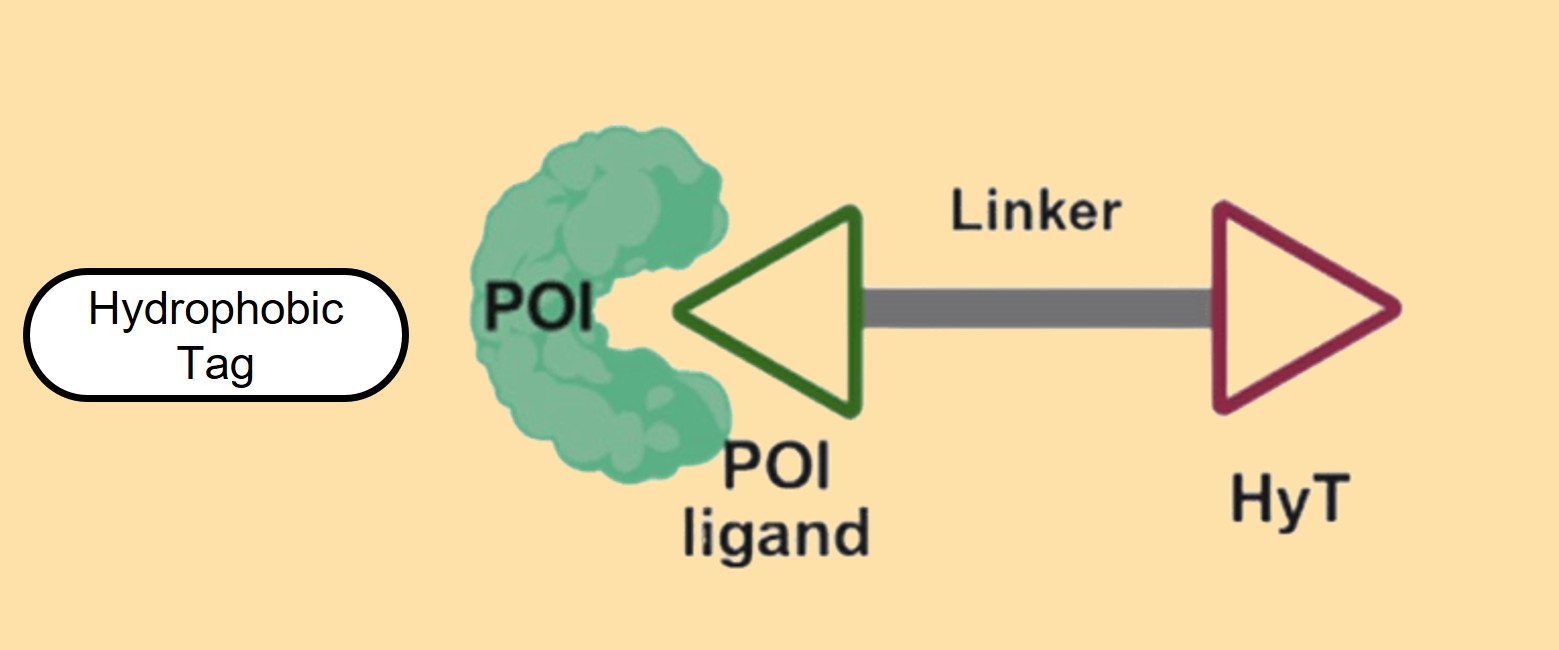
 Figure 1. Schematic demonstration of hydrophobic tag strategy: hydrophobic moiety attachment induces protein misfolding, chaperone recognition, and proteasomal degradation. (Xin et al., 2025)