
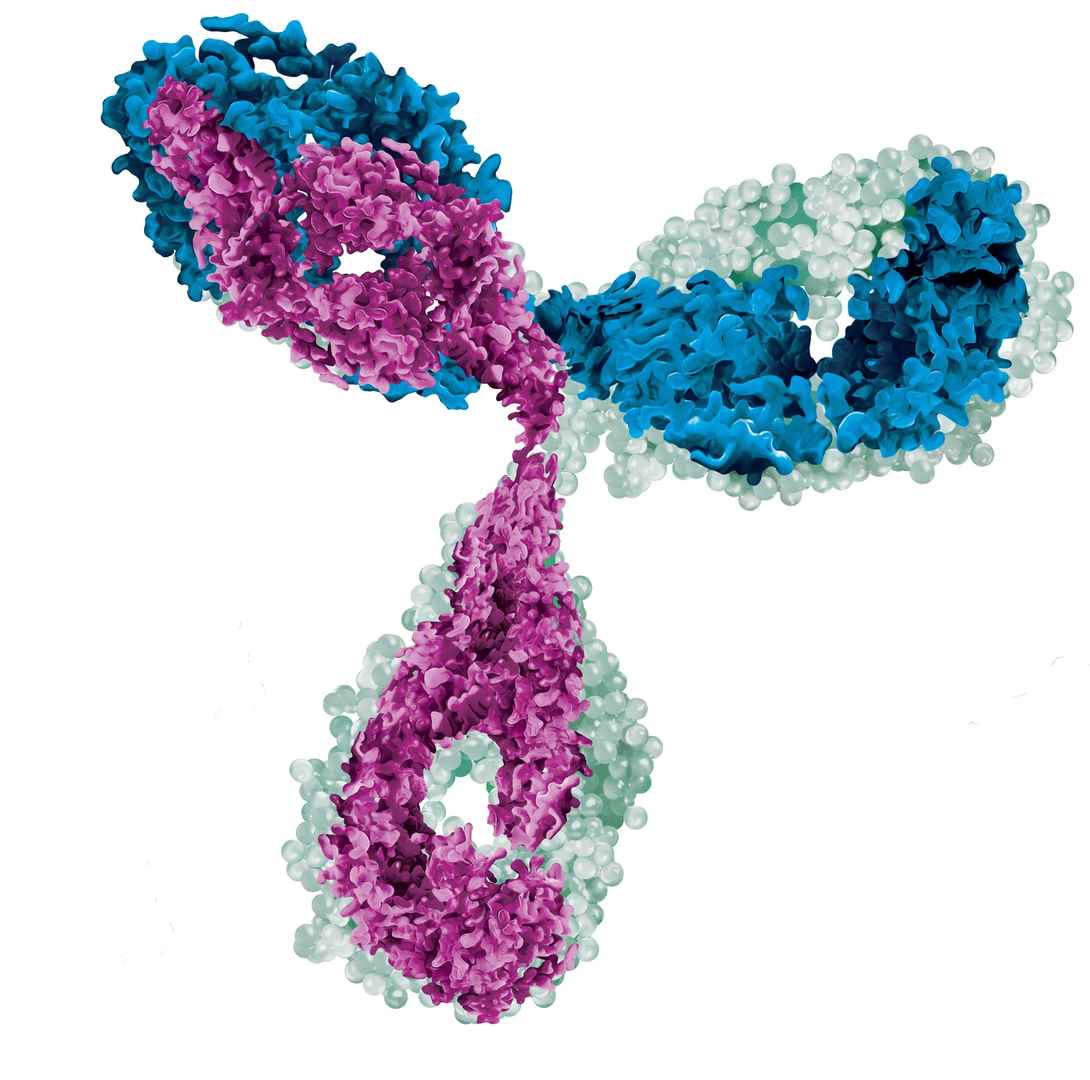
Profacgen offers Antibody Modeling services, delivering high-quality three-dimensional structural models of antibodies and antibody-antigen complexes, supporting therapeutic antibody development, affinity optimization, and epitope analysis through advanced computational approaches.
Antibodies are essential immune proteins widely used as diagnostics and therapeutics. While experimental structure determination is costly and often challenging, computational modeling offers a rapid, cost-effective alternative. The variable domains (Fv) of heavy and light chains are the primary focus, as they determine antigen specificity. Our modeling strategy begins with a template search for the framework region (FR) using a curated antibody database derived from PDB crystal structures. CDR loop templates are then selected based on canonical conformation homology, followed by structure assembly and H3 loop refinement. Full-length antibody models, including the constant region (Fc), can also be generated upon request.
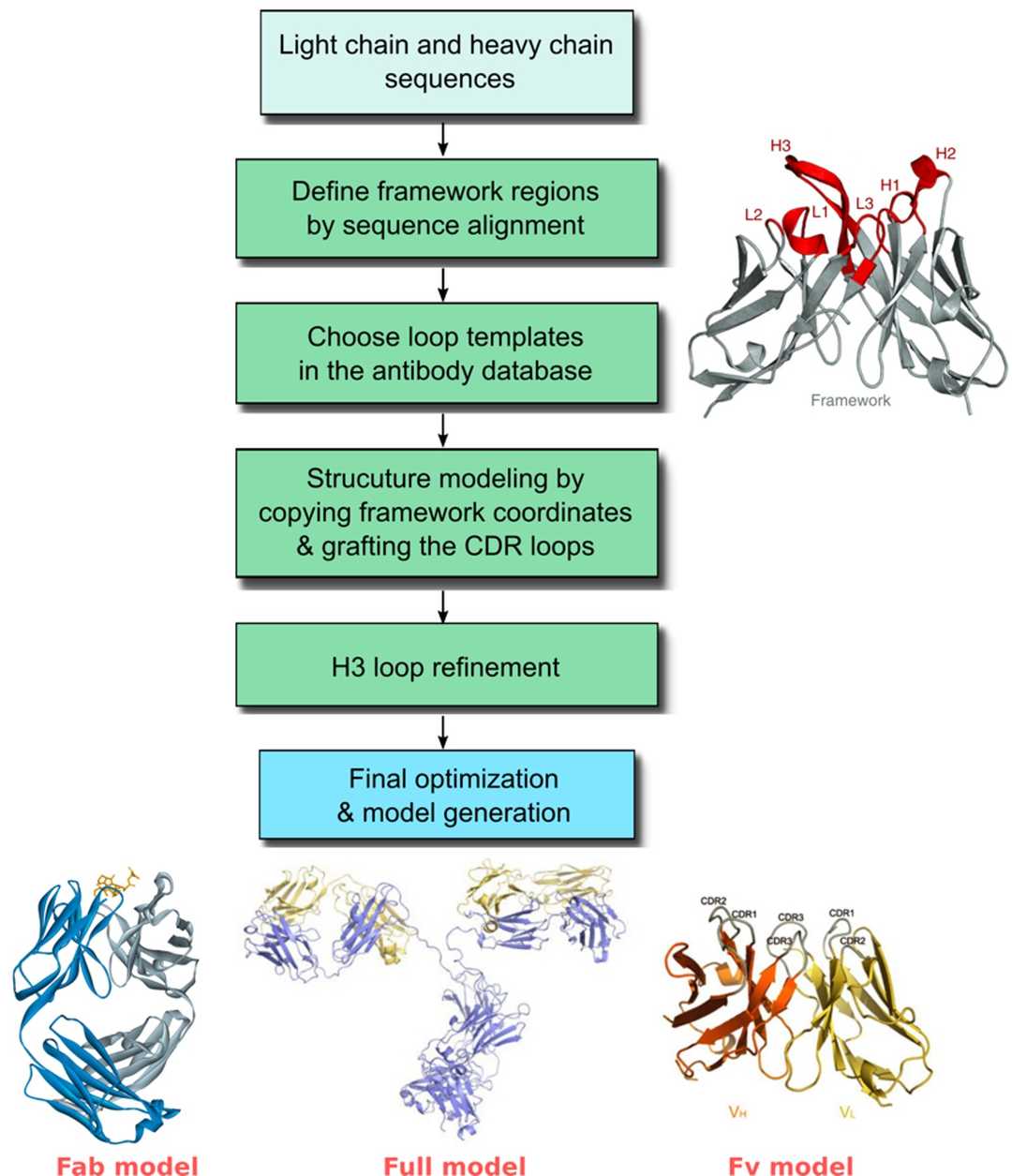
Computational antibody modeling is a powerful approach for generating accurate three-dimensional structures of antibodies when experimental methods are impractical or unavailable:
Profacgen takes advantage of computational modeling methods to help customers predict the three-dimensional structure of antibodies of interest. We have extensive experience with the structural modeling of various antibodies. The resultant antibody models are all quality verified and can be used for designing and engineering novel antibodies with desired therapeutic properties.
Our antibody modeling platform encompasses four specialized service modules, each addressing critical aspects of antibody structural analysis and engineering:
Antibody Structure Modeling
Complete three-dimensional structure prediction for antibody domains and full-length constructs.
CDR Loop Modeling
Specialized prediction and refinement of complementarity-determining regions.
Antibody Humanization Support
Structure-guided prediction and design for therapeutic antibody development.
Antibody-Antigen Complex Modeling
Structural prediction and analysis of antibody-antigen interactions.
Our Antibody Modeling services support a broad spectrum of applications across therapeutic development and protein engineering:
Profacgen provides structured, analysis-ready documentation aligned with your structural modeling and engineering requirements:
| Deliverable | Description |
|---|---|
| Antibody 3D Models | PDB-format coordinate files for Fv, Fab, or full-length antibody models, including heavy and light chain assemblies, CDR loops, and optional constant regions |
| Structural Assessment Reports | Model quality metrics including Ramachandran statistics, clash scores, energy profiles, and comparison to template structures with confidence assessments |
| Interaction Analysis | Antibody-antigen interface mapping, contact residue identification, hydrogen bond and salt bridge networks, and predicted binding energy estimates |
Program Context:
A biopharmaceutical company developed a potent murine monoclonal antibody targeting a tumor-associated antigen but required humanization to reduce immunogenicity risk before clinical development. Experimental structure determination was not feasible due to limited material availability.
Objective:
To generate a high-quality structural model of the murine antibody Fv region and identify optimal human framework templates for CDR grafting while preserving antigen-binding affinity.
Approach:
Profacgen performed template-based modeling of the Fv domain using curated PDB structures with >90% framework homology. The CDR H3 loop was modeled de novo and refined through conformational sampling. Human framework candidates were evaluated using structure-based immunogenicity prediction, and critical back-mutation sites were identified through interaction energy analysis. Models were validated against known humanized antibody structures.
Outcome:
The structural model identified a human framework template with 94% sequence identity and predicted only 3 critical back-mutations to maintain binding affinity. The humanized design retained the predicted binding interface geometry and was subsequently validated experimentally with comparable affinity to the murine parent.
Program Context:
A biosimilar developer required detailed understanding of the reference antibody's epitope to ensure their candidate bound the same antigenic determinant with comparable specificity and affinity.
Objective:
To generate a structural model of the reference antibody in complex with its target antigen and define the epitope-paratope interface at the residue level.
Approach:
Profacgen modeled the reference antibody Fv structure and performed docking with the known antigen crystal structure. The complex model was refined through molecular dynamics simulation, and the interface was analyzed for contact residues, hydrogen bonds, and hydrophobic interactions.
Outcome:
The model defined a conformational epitope comprising 18 contact residues on the antigen surface and 12 CDR residues in the antibody paratope. This structural information guided the biosimilar CDR design and provided a benchmark for subsequent experimental epitope mapping studies.
Fill out this form and one of our experts will respond to you within one business day.