We use cookies to understand how you use our site and to improve the overall user experience. This includes personalizing content and advertising. Read our
Privacy Policy
Large-scale protein production becomes a critical requirement as biologics programs progress from discovery into preclinical and regulated development. At this stage, material demand increases, regulatory expectations rise, and manufacturing decisions begin to directly influence development timelines and CMC risk.
Profacgen's large-scale protein production services are designed to support GLP-compliant preclinical studies and late-stage research programs, providing reliable material supply through controlled, scalable, and well-documented manufacturing processes.
Why Large-Scale Protein Production Is Necessary
As programs advance, small-scale or research-grade production is often no longer sufficient. Large-scale protein production is typically required when:
Programs transition from discovery or feasibility studies into GLP toxicology or safety studies
Larger quantities of protein (mg to g scale) are needed to support toxicology, formulation, and analytical activities
Early research material lacks the consistency, traceability, or documentation required for regulated studies
Multiple downstream activities depend on a reliable and uninterrupted protein supply
Clients seek to de-risk IND timelines by securing predictable, external manufacturing capacity
At this point, large-scale protein production becomes a strategic CMC decision, rather than a routine laboratory activity.
Technical and Regulatory Challenges at Scale
Moving from small-scale expression to large-volume production introduces a set of common challenges:
Uncertain scalability: Processes optimized at bench scale may encounter yield loss, stability issues, or reproducibility problems during scale-up.
Regulatory documentation gaps: Protein produced without defined controls, records, or traceability may be unsuitable for GLP studies or regulatory review.
Compressed development timelines: Delays in protein supply can cascade into missed toxicology windows, formulation delays, and IND submission risks.
Limited internal resources: Building or expanding in-house large-scale production capabilities requires significant time and capital investment.
Profacgen's Strategy for Large-Scale Protein Production
Profacgen's services are structured to address these challenges through process control, scalability, and compliance-focused execution.
Controlled Scale-Up and Fermentation
Implementation of high-cell-density fermentation and bioprocessing technologies
Precise control of culture parameters, including nutrient supply, induction strategy, temperature, pH, and dissolved oxygen
Optimized feeding strategies to maximize cell mass and recombinant protein yield
Reproducible Quality and Performance
Expression platforms supporting bacterial, yeast, insect, and mammalian systems
Processes designed to maintain protein purity, structural integrity, and biological activity at scale
Consistent batch performance to support downstream analytical and regulatory requirements
Infrastructure to Support Program Growth
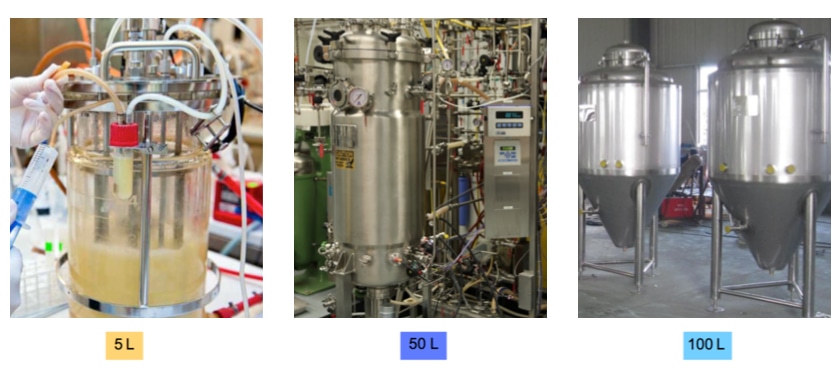
Comprehensive bioreactor capabilities, from bench-top systems to large-scale production units
Seamless transition from early feasibility to advanced preclinical production
Manufacturing capacity aligned with program timelines and material demand
Documentation and Regulatory Alignment
Well-defined manufacturing processes with appropriate controls and traceability
Documentation suitable for GLP-compliant studies and late-stage research
Reduced CMC risk through predictable execution and transparent process history
Capabilities and Specifications of Different Expression Systems
Expression System
Capabilities
Features
Bacteria
Fermentation culture up to 2000 L
i. Recombinant protein (>98% purity), suitable for crystallization.
ii. Protein yield up to several grams.
Yeast
Fermentation culture up to 2000 L
i. Recombinant protein (>98% purity), suitable for crystallization.
ii. Protein yields up to gram scale.
Insect/Baculovirus
Culture up to 2000 L
i. Recombinant protein (>98% purity), suitable for crystallization.
ii. High-titer recombinant baculovirus stock production.
iii. Protein yield up to hundreds of milligrams.
Mammalian Cells
Stable cell line culture up to 500 L
i. Protein yields up to milligram scale.
ii. Transient expression supported, producing up to 10 mg of protein.
From Bench-Top Fermenter to Bioprocess Scale-Up Facility
Improvements for Upstream and Downstream Technologies
Creation of Highly Productive Cell Lines
Modified gene vectors combined with optimized transfection and screening methods Engineered cell lines also improve protein characteristics Select highly productive clones
Fermentation Optimization
Improve media and feeding strategies Optimize growth and physicochemical conditions
Applications and Program Types Supported
Our large-scale protein production services support a wide range of development programs, including:
IND-enabling toxicology studies
Preclinical pharmacology programs
Analytical and assay development
Formulation and stability testing
Comparative studies requiring consistent protein batches
Research programs preparing for GMP transition
Protein types supported include enzymes, antigens, recombinant proteins, and other biologics used in regulated research contexts.
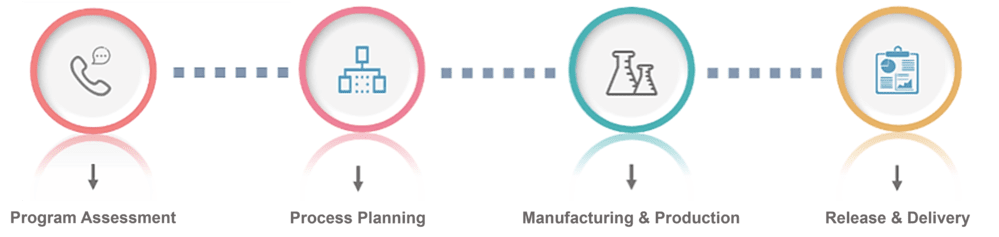
Typical Engagement Model
While each program is unique, most large-scale protein production projects follow a structured engagement model:
The following scenarios are representative examples illustrating how large-scale protein production programs are typically supported. They are provided for demonstration purposes only and do not reference specific clients or confidential projects.
Scenario 1: GLP-Grade Recombinant Protein Production to Support IND-Enabling Toxicology Studies
Program Stage: Late Discovery → IND-Enabling Preclinical Development
Program Objective:
To generate large quantities of high-purity recombinant protein under GLP-aligned conditions to support toxicology, formulation, and analytical studies, while minimizing CMC risk ahead of IND submission.
Key Program Challenges:
Scaling from bench-scale expression to multi-hundred or thousand-liter production without compromising protein quality
Ensuring batch-to-batch reproducibility suitable for GLP toxicology studies
Selecting an expression system that balances yield, structural fidelity, and timeline
Establishing robust documentation and traceability for regulatory review
Meeting aggressive material demand timelines tied to IND planning
Profacgen's Role:
Evaluation of target protein characteristics to select the optimal expression system (e.g., E. coli or yeast fermentation up to 2000 L)
Scale-up of upstream fermentation with defined process parameters and in-process controls
Development and execution of reproducible downstream purification workflows achieving >98% purity
Implementation of GLP-aligned batch records, deviation management, and documentation
Analytical characterization and release testing to support toxicology study requirements
Program Outcome:
Delivery of multi-gram quantities of highly purified recombinant protein suitable for GLP toxicology studies
Consistent product quality across batches, reducing downstream CMC risk
Well-documented manufacturing history ready to support IND-enabling submissions
A scalable production process positioned for future GMP transition (no heroics required later)
Scenario 2: Large-Scale Mammalian Protein Production for Late-Stage Preclinical Research
Program Stage: IND-Enabling → Late Preclinical Development
Program Objective:
To produce biologically relevant, mammalian-expressed protein material to support advanced pharmacology, formulation development, and bioanalytical assay qualification.
Key Program Challenges:
Requirement for native folding and post-translational modifications
Limited yield compared with microbial systems, increasing pressure on process efficiency
Need for consistent quality across multiple production runs
Coordination of protein supply with parallel formulation and analytical timelines
Maintaining GLP-compliant documentation while supporting evolving study needs
Profacgen's Role:
Development of a stable mammalian cell line and scale-up to 500 L culture volume
Execution of controlled upstream production and downstream purification under GLP-aligned conditions
Option for transient expression to rapidly generate up to 10 mg protein for early analytical work
Comprehensive in-process monitoring and batch documentation
Protein characterization to confirm identity, purity, and functional integrity
Program Outcome:
Reliable delivery of milligram-scale mammalian protein suitable for advanced preclinical studies
High-quality material with appropriate structural and functional attributes
Reduced risk of late-stage surprises in formulation or bioassay development
A controlled, reproducible production process aligned with regulatory expectations and program timelines
Q: Is this service suitable for IND-enabling studies?
A: Yes. The service is designed to support GLP-compliant preclinical programs and IND-enabling activities, with appropriate documentation and quality controls.
Q: Can you work with an existing expression system?
A: Yes. We regularly scale up client-provided constructs and expression systems, focusing on consistency rather than re-engineering unless necessary.
Q: How does this differ from GMP manufacturing?
A: This service supports regulated preclinical development but is not positioned as commercial GMP manufacturing. It is intended to bridge discovery and GMP phases while reducing downstream risk.
Q: What documentation is provided?
A: Documentation is defined at project initiation and typically includes batch records, production summaries, and quality-related records appropriate for GLP studies.
Q: How early should we engage for large-scale production planning?
A: Engaging during late discovery or early preclinical planning allows for better alignment with downstream studies and avoids last-minute scale-up challenges.
Online Inquiry
Fill out this form and one of our experts will respond to you within one business day.