
Enzymes are the molecular engines that power virtually every biochemical process in living organisms, from signal transduction and gene regulation to metabolism and immune defense. Given their central role in disease mechanisms, enzymes represent one of the most extensively pursued target classes in modern drug discovery. The identification of small-molecule modulators—whether activators that restore compromised enzymatic function or inhibitors that suppress pathological overactivity—is a cornerstone of therapeutic development. Profacgen provides comprehensive enzyme activator and inhibitor screening services that combine high-throughput screening (HTS) infrastructure, diverse assay formats, and expert data analysis to accelerate hit identification, validate lead compounds, and advance projects from target validation to preclinical candidate selection.
Profacgen offers an integrated screening platform designed to identify, characterize, and optimize small-molecule modulators of enzyme activity. Our services span the entire drug discovery continuum—from exploratory high-throughput screening of large compound libraries to focused optimization of lead series with defined structure–activity relationships.
Our HTS platform is equipped to screen hundreds of thousands to millions of compounds against validated enzyme targets in 384- or 1536-well microplate formats. Automated liquid handling, integrated detection systems, and robust assay miniaturization ensure rapid, cost-effective triage of expansive chemical libraries. Standard HTS campaigns include:
Effective hit identification requires more than statistical thresholding. Profacgen applies chemoinformatic filtering, structural clustering, and medicinal chemistry triage to prioritize chemically tractable, non-promiscuous hits with favorable physicochemical properties. Our deliverables include:
Once validated hits are identified, Profacgen supports lead optimization through iterative rounds of analog synthesis and biological evaluation. We design focused screening libraries around promising scaffolds, evaluate structure–activity relationships, and profile ADMET liabilities to identify development candidates with optimal potency, selectivity, and drug-like properties.
Illustration of Different Detection Modes
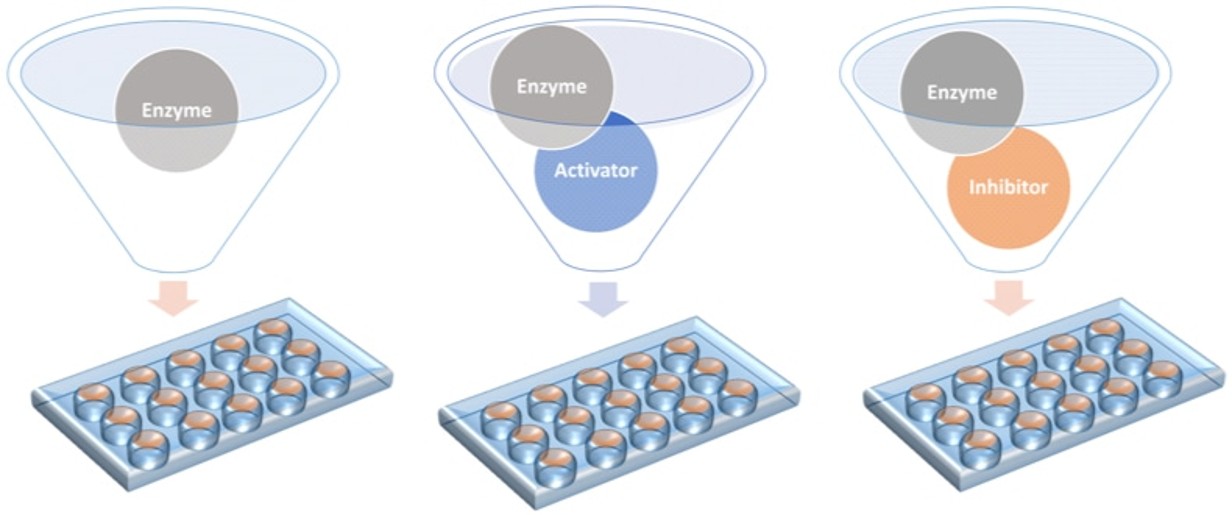
High-Throughput Screening
High-throughput screening is the foundation of our enzyme modulator discovery platform. We screen diverse compound collections—including synthetic small molecules, natural product extracts, fragment libraries, and proprietary client libraries—against purified or cell-based enzyme targets. Screening is performed under optimized assay conditions that maximize signal-to-background ratios while maintaining physiological relevance. Our HTS infrastructure supports:
Focused Library Screening
For targets with established pharmacology or known ligand classes, focused library screening offers a more efficient alternative to full-deck HTS. Profacgen curates targeted compound sets—including kinase inhibitor sets, protease inhibitor collections, epigenetic modulator libraries, and mechanism-based probe collections—to enrich for biologically relevant chemical matter. Focused screening is particularly valuable for:
Profacgen provides enzyme target screening services for kinases, phosphatases, proteases, methyltransferases, glycosyltransferases, acetyltransferases, and other enzyme families. Candidate molecules are selected or synthesized and immobilized on a solid surface, with detection performed after incubation with the target enzyme according to the specific experimental design. We support thousands of substrates from sources including human, rat, mouse, chicken, and cow, as well as specialized phosphorylation libraries containing sites for threonine, serine, or tyrosine recognition.
| Format | Principle | Best Suited For | Key Advantages |
|---|---|---|---|
| Fluorescence | Fluorogenic substrate cleavage or FRET-based signal generation; fluorescence intensity proportional to enzyme activity | Proteases, phosphatases, hydrolases; real-time kinetics; high-throughput screening | High sensitivity, homogeneous format, multiplexing capability, low background |
| Chemiluminescence | Coupled enzyme reactions (e.g., luciferase) convert the product of the target reaction into light emission | Kinases, ATPases, oxidoreductases; ultra-low background applications | Extremely wide dynamic range, excellent signal-to-noise ratio, miniaturization-friendly |
| Radiometric | Radioisotope-labeled substrates (e.g., [γ-32P]-ATP) enable direct quantification of product formation by scintillation counting | Kinases, methyltransferases, acetyltransferases; gold-standard validation | Highest sensitivity and accuracy, direct mechanistic readout, regulatory acceptance |
| Colorimetric | Chromogenic substrates produce colored products absorbable at defined wavelengths (e.g., pNPP for phosphatases) | Routine assays, educational settings, cost-sensitive projects | Low cost, no specialized detection equipment, straightforward interpretation |
| Mass Spectrometry (LC-MS/MS) | Direct quantification of substrate and product masses enables label-free detection with high specificity | Complex substrates, non-peptide molecules, metabolite identification | Label-free, definitive structural confirmation, multiplexed detection, regulatory-grade accuracy |
| Surface Plasmon Resonance (SPR) | Real-time monitoring of compound binding to immobilized enzyme without substrate turnover | Binding kinetics, fragment screening, allosteric inhibitor discovery | Direct binding measurement, kinetic resolution (Kon/Koff), no substrate required |
Robust data analysis transforms raw screening outputs into actionable medicinal chemistry insights. Profacgen employs validated statistical pipelines and cheminformatic tools to ensure data integrity and extract maximum value from every experiment:
Enzyme activator and inhibitor screening supports a wide range of research and development objectives:
Profacgen enables profiling of your target enzyme against thousands of substrate compounds or proteins, and supports the study of various protein modifications including phosphorylation, methylation, ubiquitination, SUMOylation, NEDDylation, and nitrosylation.
Background:
A pharmaceutical company sought to identify selective inhibitors of a newly validated kinase target implicated in solid tumor proliferation. The target lacked established chemical probes, necessitating a broad HTS campaign to discover novel pharmacophores.
Our Solution:
Profacgen developed a luminescence-based kinase assay (ADP-Glo™ format) and screened a diverse library of 120,000 small molecules at 10 µM in duplicate. Hits exceeding 50% inhibition were cherry-picked for 10-point IC50 determination, followed by counter-screening against 50 kinases to assess selectivity.
Final Results:
The campaign yielded 247 confirmed hits, including a novel pyrimidine series with sub-micromolar potency (IC50 = 180 nM) and >50-fold selectivity over the closest homolog. The lead compound demonstrated cellular activity in a Ba/F3 proliferation assay and was advanced to lead optimization.
Background:
A biotechnology startup required potent, isoform-selective inhibitors of histone deacetylase 6 (HDAC6) for a neurodegenerative disease program. Given the wealth of HDAC inhibitors in the literature, a focused library approach was chosen to expedite lead identification.
Our Solution:
Profacgen curated a focused library of 2,500 HDAC inhibitors and analogs, including hydroxamic acids, benzamides, and cyclic peptides. A fluorogenic HDAC6 assay was optimized for 384-well screening, and compounds were evaluated in parallel against HDAC1, HDAC2, and HDAC3 for selectivity profiling.
Final Results:
Three structurally distinct chemotypes with >100-fold HDAC6 selectivity over class I HDACs were identified. The most potent compound (IC50 = 8 nM for HDAC6) showed dose-dependent tubulin acetylation in neuronal cell lines and was nominated as a development candidate.
Fill out this form and one of our experts will respond to you within one business day.