
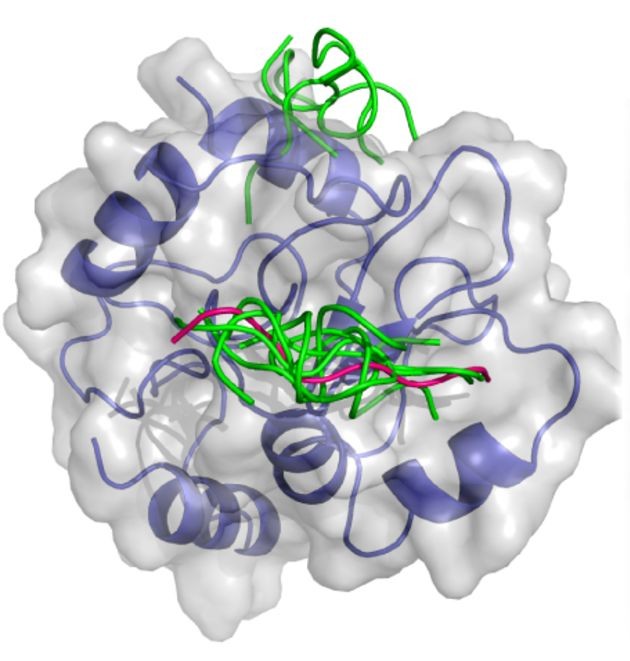
Protein–peptide interactions are fundamental to a vast array of biological processes, including cellular signaling, immune response, protein expression, and targeted protein degradation. These transient yet highly specific molecular recognition events govern critical regulatory mechanisms within cells, and their dysregulation is closely associated with numerous pathologies such as cancer, autoimmune disorders, and neurodegenerative diseases. Understanding the structural basis of protein–peptide binding is therefore essential for elucidating disease mechanisms and guiding rational drug design.
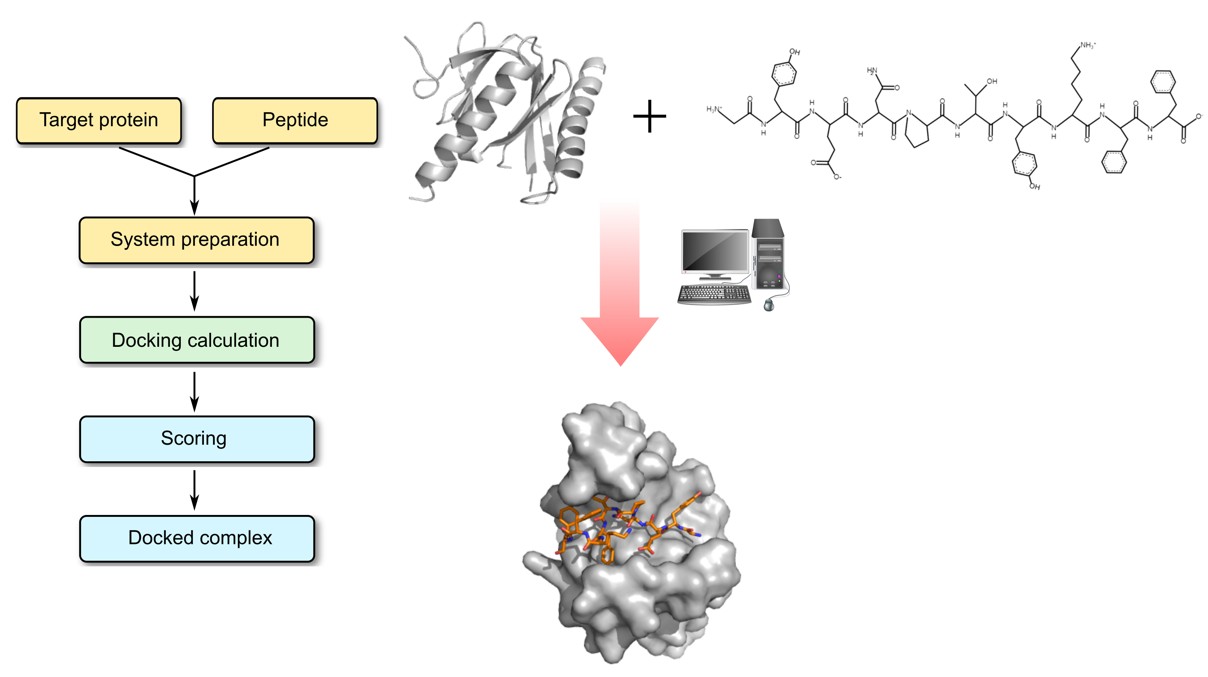
Profacgen offers Protein–Peptide Docking service, providing a state-of-the-art computational platform for modeling and predicting protein–peptide interactions with high accuracy and reliability. Our integrated workflow combines global binding site prediction with fully flexible local docking, enabling the simulation of peptide folding and conformational changes in both the receptor and the peptide ligand. Whether you are investigating signaling pathway mechanisms, designing peptide-based therapeutics, or studying substrate recognition specificity, our service delivers actionable structural insights to accelerate your research.
Protein–peptide interactions mediate an estimated 15–40% of all protein–protein interactions within the cell, yet they present unique computational challenges distinct from traditional protein–ligand or protein–protein docking. Peptides are inherently flexible molecules that often adopt multiple conformations in solution, and their binding to a target protein typically involves substantial induced-fit rearrangements in both partners. Conventional rigid-body docking approaches frequently fail to capture these dynamic processes, leading to inaccurate binding pose predictions.
Our protein–peptide docking methodology addresses these challenges through a sophisticated two-stage modeling framework. The first stage performs a global search to predict the most probable binding site on the protein receptor surface, employing blind docking strategies that require no prior knowledge of the interaction interface. When experimental or predicted binding site residue data are available, these constraints are seamlessly integrated to guide the search process. The second stage executes fully flexible local docking, where the peptide is allowed to sample its complete conformational space while the receptor side chains adjust to accommodate the ligand. The peptide folding process is explicitly simulated, ensuring that the predicted bound conformation reflects the true energy landscape of the interaction.
| Service Component | Description |
|---|---|
| Receptor Preparation & Binding Site Prediction |
|
| Peptide Modeling & Conformational Sampling |
|
| Global–Local Docking Protocol |
|
| Clustering, Scoring & Ranking |
|
| Structural Refinement & Delivery |
|
Background:
The MDM2/p53 protein–protein interaction is a validated oncology target, as MDM2 negatively regulates the tumor suppressor p53. A pharmaceutical research team sought to design stapled peptide inhibitors capable of disrupting this interaction with high affinity and specificity. However, the extended binding interface and conformational flexibility of the MDM2 cleft posed significant challenges for conventional docking approaches.
Our Solution:
Profacgen deployed the global–local docking protocol to model stapled peptide binding to the MDM2 N-terminal domain. Blind docking identified the known p53-binding cleft without requiring prior structural constraints. Fully flexible local refinement then sampled the conformational space of the stapled peptide, explicitly accounting for the hydrocarbon staple geometry and its effect on peptide helicity. Energy-based clustering and per-residue decomposition identified critical hot-spot residues contributing to binding.
Final Results:
Three lead stapled peptides were identified with predicted binding affinities in the low nanomolar range. The top-ranked candidate reproduced key interactions observed in co-crystal structures, including the critical triad of hydrophobic residues (Phe19, Trp23, Leu26) inserting into the MDM2 cleft. Two of the three peptides were subsequently validated by fluorescence polarization assays, confirming nanomolar binding and providing a strong foundation for lead optimization.
Background:
An academic research group studying phosphorylation site selectivity needed to understand how a specific serine/threonine kinase discriminates among hundreds of potential substrate sequences in the cellular proteome. The kinase's substrate recognition mechanism was poorly characterized, and the researchers required a systematic approach to predict which peptide motifs would be preferentially phosphorylated.
Our Solution:
We generated a structurally diverse peptide library spanning known and putative substrate sequences and docked each peptide against the kinase catalytic domain using the fully flexible docking protocol. The global search stage identified the substrate-binding groove, while local refinement modeled induced-fit rearrangements in both the kinase activation loop and peptide ligand. Post-translational modification support enabled accurate modeling of phosphorylated priming sites on certain substrate peptides.
Final Results:
The docking analysis revealed specificity determinants at the P+1 and P−3 positions that were not apparent from sequence alignment alone. Predicted specificity motifs were confirmed by site-directed mutagenesis and in vitro kinase assays, with excellent agreement between computational predictions and experimental measurements. The study provided a structural rationale for substrate selection and identified several novel putative substrates for further biological investigation.
References:
Fill out this form and one of our experts will respond to you within one business day.