We use cookies to understand how you use our site and to improve the overall user experience. This includes personalizing content and advertising. Read our
Privacy Policy
Profacgen's In Vitro Degrader Evaluation Services deliver comprehensive, stage-gated assessment of protein degrader candidates from binding through degradation, enabling rational optimization and rapid identification of lead compounds with superior efficacy, permeability, and developability.
Protein degrader technology, first proposed in 2001, has matured into a transformative therapeutic modality. Degraders not only inhibit target proteins but catalytically eliminate them, offering superior safety, reduced resistance, and broad application prospects. Despite this promise, significant challenges remain: the inability to evaluate degradation potency in large quantities and quickly, poor membrane permeability, and complex compound optimization requirements. Profacgen addresses these challenges through professional in vitro assessment services, providing sensitive high-throughput screening methods and multi-level comparative analysis to fully support target design, optimization, and transformation.
Overview
In vitro evaluation is critical for protein degrader development because the degrader mechanism involves multiple sequential steps, each of which must be optimized for overall efficacy:
Binding alone is insufficient: Degrader components must bind both target protein and E3 ligase with appropriate affinities, but binary binding does not guarantee productive ternary complex formation or cellular degradation
Ternary complex formation drives degradation: The transient, cooperative assembly of target-degrader-ligase ternary complexes is the mechanistic prerequisite for ubiquitination. Complex stability, geometry, and lifetime directly determine degradation efficiency
Ubiquitination precedes degradation: Efficient polyubiquitin chain formation on the target protein is required for proteasomal recognition. Chain topology, site specificity, and kinetics influence degradation rate and completeness
Cellular permeability impacts efficacy: Degraders must cross cellular membranes to engage intracellular targets and E3 ligases. Poor permeability is a major cause of in vitro-in vivo disconnect and requires early assessment
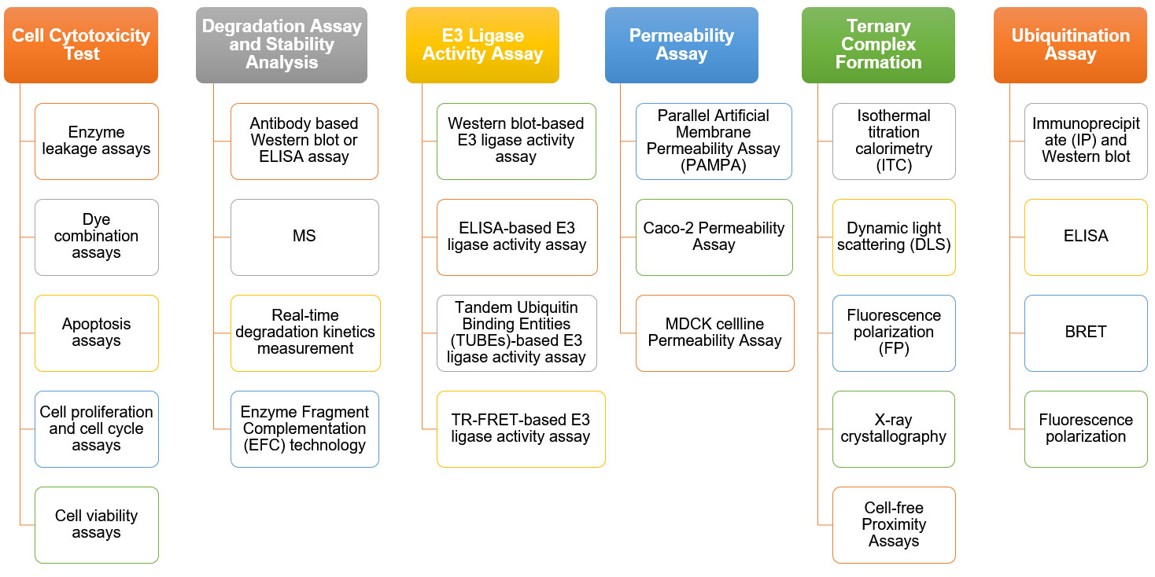
Quantitative assessment of target protein elimination following degrader treatment.
DC50 and Dmax determination: Dose-response characterization of degradation potency and maximal efficacy by quantitative Western blot, mass spectrometry, or high-content imaging
Time-course kinetics: Degradation onset, rate, and duration to understand mechanism and guide dosing strategies
Hook effect analysis: Evaluation of bell-shaped dose-response curves to identify optimal concentration windows and guide linker optimization
Early assessment of cellular uptake to predict in vivo efficacy and guide medicinal chemistry.
Parallel artificial membrane permeability (PAMPA): Rapid, cost-effective prediction of passive diffusion across lipid membranes
Caco-2 and MDCK cell monolayers: Cell-based permeability with active transport and efflux assessment
Cellular uptake assays: Fluorescent or radiolabeled degrader quantification in intact cells by flow cytometry or imaging
Evaluation Workflow
Profacgen implements a systematic, stage-gated workflow that progresses from compound characterization through mechanistic validation:
Applications
Our in vitro degrader evaluation platform supports diverse drug discovery applications:
PROTAC development: Stage-gated assessment of heterobifunctional degraders from hit validation through lead optimization, with iterative feedback between binding, ternary complex, and cellular degradation data
Molecular glue discovery: Mechanistic confirmation of glue-induced neosubstrate recruitment, ubiquitination, and degradation with rigorous controls for direct binding versus induced proximity
E3 ligase recruiter optimization: Comparative profiling of ligase variants, ligands, and conjugation strategies to identify recruiters with optimal activity, selectivity, and permeability profiles
Lead candidate selection: Multi-parameter scoring integrating potency, efficacy, mechanism, and developability to prioritize candidates for in vivo pharmacokinetic and pharmacodynamic studies
Why Choose Our In Vitro Degrader Evaluation?
Integrated Multi-Step Assessment: Systematic evaluation from binding through permeability within a single platform, eliminating handoff inefficiencies and enabling mechanistic correlation across assay stages.
High-Throughput Capabilities: Sensitive, automated screening formats for rapid evaluation of large compound libraries, addressing the bottleneck of low-throughput degrader assessment.
Experienced Scientific Team: Deep expertise in degrader pharmacology, biophysics, and cell biology ensures rigorous experimental design, accurate data interpretation, and actionable optimization recommendations.
Comprehensive Mechanistic Dissection: Quantitative analysis of each degrader cascade step enables precise identification of limiting factors and targeted optimization strategies.
Representative Program Scenarios
Scenario 1: Stage-Gated PROTAC Optimization
Program Context:
A PROTAC program possessed a target warhead with sub-micromolar affinity but observed poor cellular degradation. The team needed to identify whether the limitation resided in ternary complex formation, ubiquitination efficiency, or cellular permeability.
Objective:
To systematically evaluate each step of the degrader cascade and identify the mechanistic bottleneck for targeted optimization.
Approach:
Profacgen executed the full evaluation workflow: binary binding confirmed retained warhead affinity; SPR ternary complex analysis revealed weak cooperativity suggesting suboptimal linker length; ubiquitination assays showed efficient chain formation when ternary complex was forced; and PAMPA indicated moderate permeability. A linker-optimized analog with improved ternary complex stability was synthesized and re-evaluated.
Outcome:
The optimized PROTAC demonstrated 10-fold improved ternary complex cooperativity, translating to enhanced cellular degradation with DC50 improved from >10 µM to 150 nM. The stage-gated approach precisely identified the bottleneck, avoiding iterative synthesis of off-target improvements and accelerating lead candidate identification.
A phenotypic screen identified small molecules inducing target protein loss, but whether the mechanism was direct degradation, translational inhibition, or off-target toxicity was unknown. Rapid mechanistic triage was required for 50 active compounds.
Objective:
To implement a high-throughput workflow distinguishing true glue-mediated degradation from non-specific mechanisms, with confirmation of ubiquitin-proteasome dependence and E3 ligase requirement.
Approach:
Profacgen developed a tiered screening cascade: cell-based target level quantification by high-content imaging; proteasome inhibitor co-treatment to confirm dependence; gene editing-mediated E3 ligase knockout to establish specificity; and SPR-based ternary complex reconstitution for mechanistic validation. Active compounds were ranked by degradation potency, selectivity, and mechanism confidence.
Outcome:
The screen identified 8 compounds with confirmed glue-like degradation mechanism, 15 compounds with non-specific cytotoxicity, and 27 compounds with alternative mechanisms. Two lead glues progressed to structural studies and medicinal chemistry optimization, with the tiered workflow reducing time-to-decision by 60% compared to sequential assay approaches.
Q: Why is binding affinity alone insufficient for predicting degrader efficacy?
A: Degraders require formation of a productive ternary complex between target, degrader, and E3 ligase. High binary affinity does not guarantee favorable ternary complex geometry, cooperativity, or cellular permeability. Our stage-gated workflow evaluates each mechanistic step to identify true bottlenecks.
Q: What is the hook effect and how do you assess it?
A: The hook effect is a bell-shaped dose-response where high degrader concentrations inhibit degradation by forming non-productive binary complexes. We assess it by full dose-response degradation curves with extended concentration ranges, identifying the optimal therapeutic window and guiding linker optimization.
Q: Can you evaluate degraders with novel or uncharacterized E3 ligases?
A: Yes. We support evaluation with established ligases (VHL, CRBN, MDM2, cIAP) and emerging candidates. For novel ligases, we provide expression, purification, and activity validation as part of the evaluation workflow, ensuring full mechanistic characterization.
Q: How do you distinguish molecular glue mechanism from direct inhibition?
A: We employ multiple criteria: proteasome dependence confirmed by inhibitor co-treatment; E3 ligase requirement verified by knockout or knockdown; ternary complex formation demonstrated by SPR or co-immunoprecipitation; and ubiquitination detection on the target protein. True glues satisfy all criteria.
Q: What throughput can you achieve for degrader screening?
A: Binding and permeability assays support thousands of compounds in 384-well format. Ternary complex and ubiquitination assays are typically medium-throughput (hundreds of compounds). Degradation assays with high-content imaging enable hundreds to thousands of compounds depending on automation level. We tailor workflow depth to program needs.
Q: How does in vitro evaluation predict in vivo performance?
A: In vitro data establishes mechanistic confidence and identifies development liabilities. Permeability and metabolic stability assays predict oral bioavailability. Cellular degradation potency correlates with in vivo target engagement. We integrate these parameters with pharmacokinetic modeling to prioritize candidates with highest probability of in vivo success.
Jochem M, Schrempf A, Wagner LM, et al. Degradome analysis to identify direct protein substrates of small-molecule degraders. Cell Chemical Biology. 2025;32(1):192-200.e6. doi:10.1016/j.chembiol.2024.10.007
Online Inquiry
Fill out this form and one of our experts will respond to you within one business day.

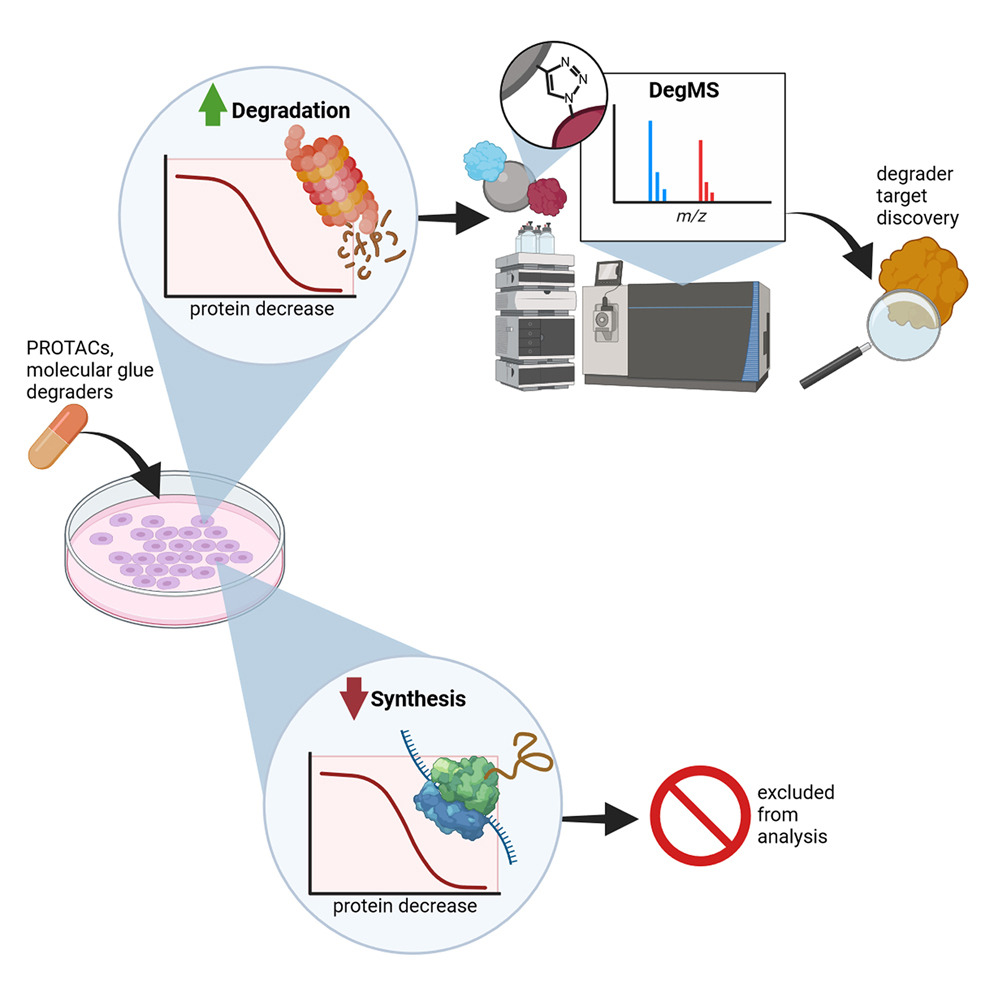
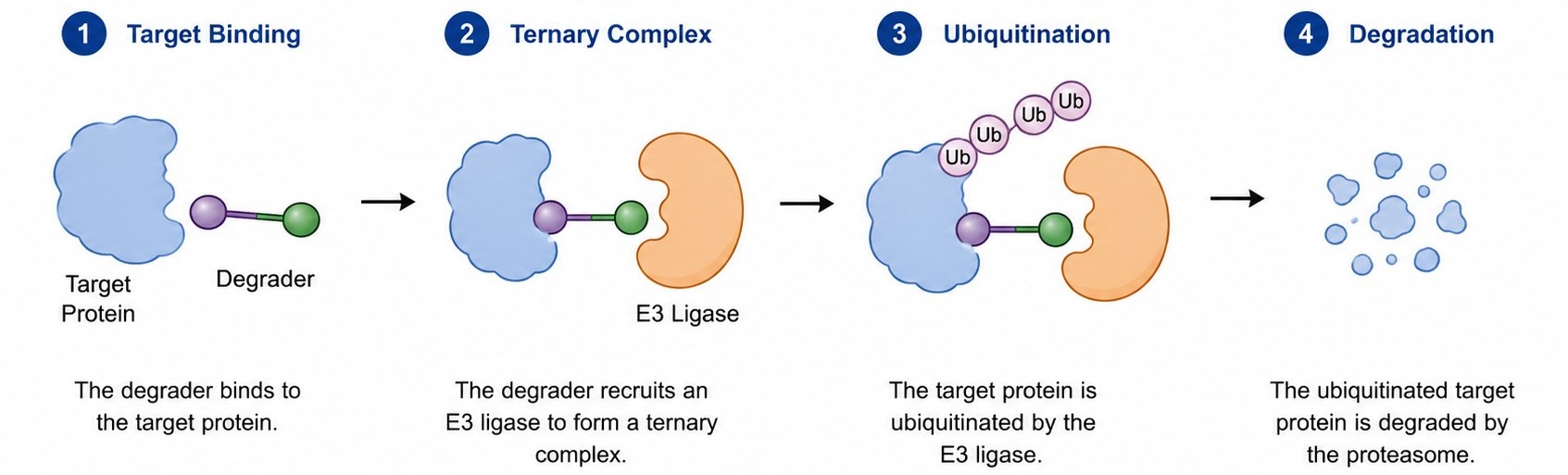 Figure 1. In vitro degrader evaluation workflow: Target Binding → Ternary Complex → Ubiquitination → Degradation.