
Lactic acid bacteria (LAB) fermentation is a cornerstone technology in food, nutraceutical, and industrial biotechnology, enabling the efficient production of organic acids, bioactive compounds, and functional ingredients. With their well-established safety profile, metabolic flexibility, and ability to produce a wide range of valuable metabolites, LAB systems are increasingly used in both traditional fermentation and advanced engineered bioprocesses.
Profacgen offers Lactic Acid Bacteria Fermentation services that integrate strain selection, metabolic engineering, process optimization, and industrial-scale production. Our customizable platform supports applications ranging from food-grade fermentation to high-value biochemical production, delivering high yield, reproducibility, and scalability. With fermentation capacity up to 10 metric tons and end-to-end technical support, we help clients translate microbial potential into commercial success.
Lactic acid bacteria (LAB), also known as members of the order Lactobacillales, are industrially important microorganisms widely used in a variety of fermentation processes, particularly in the food industry.
LAB play a central role in fermentation due to their ability to convert carbohydrates into lactic acid under anaerobic or microaerophilic conditions. This metabolic activity contributes not only to product preservation but also to enhanced organoleptic and nutritional properties.
LAB are widely used in:
Beyond traditional applications, LAB have shown strong potential in metabolic engineering and synthetic biology, making them attractive platforms for producing both natural and engineered compounds.
Their contribution in fermentation processes primarily originates from:
LAB are capable of metabolizing a wide range of mono- and disaccharides, making them versatile for different feedstocks and industrial processes.
LAB are capable of producing a diverse array of industrially relevant metabolites, either naturally or through metabolic engineering.
Key Product Categories:
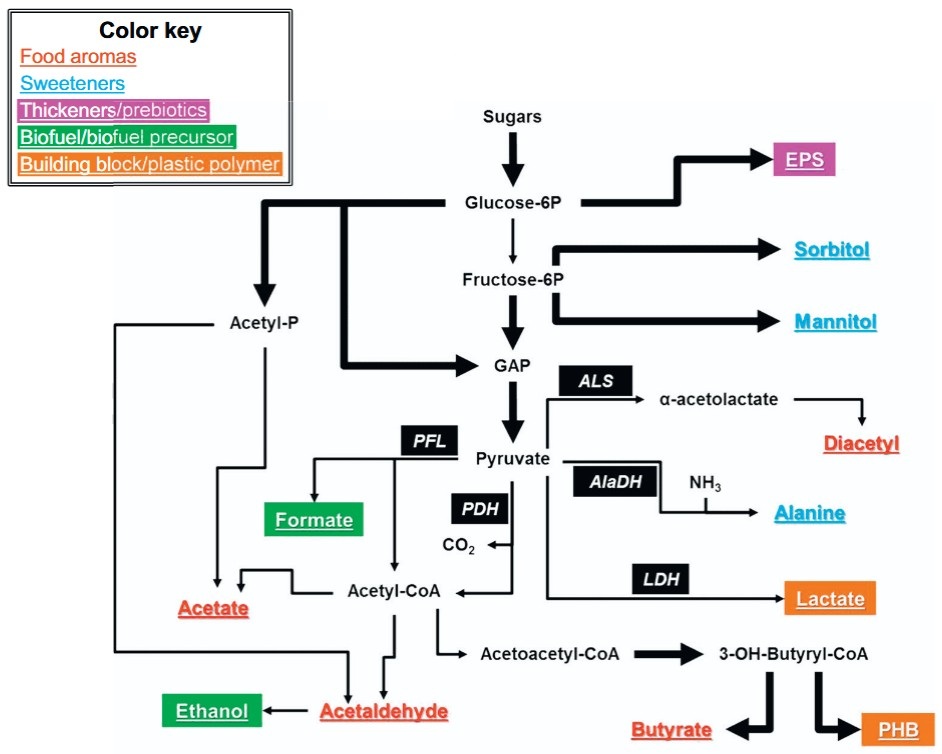 Figure 1. Schematic overview of the metabolic pathways enabling LAB to produce some of the most industrially desired molecules by sugar fermentation. (Mazzoli et al., 2014)
Metabolic engineering is often applied to:
Among LAB species, Lactococcus lactis is the most extensively studied, along with other important strains such as Lactobacillus plantarum, Lactobacillus brevis, and Lactobacillus panis.
Profacgen provides comprehensive, industry-scale lactic acid bacteria fermentation services, covering the entire workflow from strain development to large-scale production and downstream processing.
Strain Selection and Evaluation
Identification and optimization of high-performing lactic acid bacteria strains based on productivity, stability, and suitability for your target application.
Genetic Modification and Metabolic Engineering
Targeted engineering of LAB strains to enhance yield, expand metabolic pathways, and enable efficient production of desired compounds.
Growth Condition Optimization
Systematic optimization of culture conditions—including nutrients, pH, temperature, and metabolic balance—to maximize cell growth and product expression.
Fermentation Process Development
Design and refinement of fermentation strategies, including batch and fed-batch systems, to ensure efficient, stable, and contamination-controlled production.
Large-Scale Fermentation
Scalable fermentation solutions with capacity up to 10 metric tons, ensuring consistent performance from pilot to industrial production.
Downstream Processing and Characterization
Comprehensive purification, analytical testing, and quality evaluation to ensure product integrity, consistency, and application readiness.
Challenge:
A client required cost-effective, large-scale production of lactic acid for biodegradable plastic applications. Existing strain performance and process inefficiencies resulted in suboptimal yields, limiting commercial viability for sustainable packaging materials.
Approach:
Profacgen selected a high-performing lactic acid bacteria (LAB) strain through rigorous screening for productivity and acid tolerance. Carbon source composition and feeding strategies were optimized to maximize substrate utilization while minimizing by-product formation. A fed-batch fermentation process was developed to maintain optimal growth conditions and prevent product inhibition throughout the production cycle.
Outcome:
Achieved a significant increase in lactic acid yield compared to baseline processes, with substantially improved fermentation efficiency. A scalable industrial process was successfully established, enabling the client to transition to commercial production of biodegradable plastics with enhanced cost-effectiveness and consistent product quality.
Challenge:
A client sought high-level production of antimicrobial peptides (bacteriocins) for food safety applications. Conventional fermentation methods yielded insufficient titers, limiting the feasibility of natural preservative development for commercial food products.
Approach:
Profacgen performed genetic enhancement of the LAB strain to overexpress target bacteriocin pathways while suppressing competing metabolic fluxes. Fermentation conditions including pH, temperature, and aeration were systematically optimized to maximize peptide production. Downstream processing methods were developed for efficient product purification and comprehensive characterization of antimicrobial activity.
Outcome:
Achieved high-level bacteriocin production with significantly enhanced antimicrobial activity against foodborne pathogens. The purified product met food-grade specifications, providing the client with a scalable fermentation platform for natural food preservation solutions.
Consult Our Experts on Your Project
References:
Fill out this form and one of our experts will respond to you within one business day.