
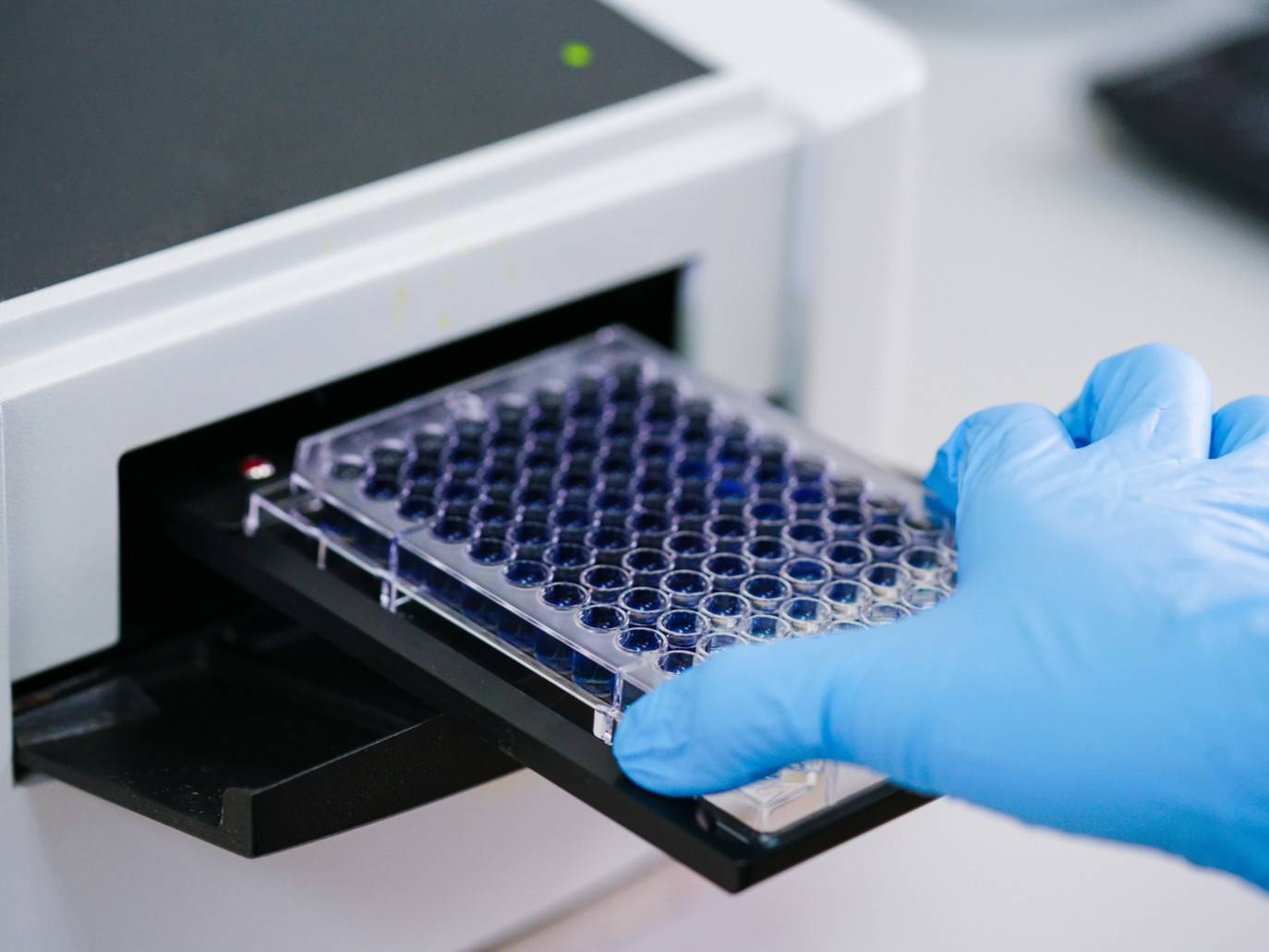
Enzyme-linked immunosorbent assay (ELISA) is a plate-based immunoassay used to detect or quantify an analyte through specific molecular recognition and an enzyme-generated signal. Depending on the assay format, the measured analyte may be a protein, peptide, antibody, glycoprotein, hormone, or other molecule for which suitable binding reagents and controls are available. ELISA can support exploratory research, candidate characterization, biomarker studies, pharmacokinetic and immunogenicity assessments, and targeted protein quantification.
Profacgen provides custom ELISA assay development, optimization, fit-for-purpose qualification, and sample testing. Each project begins with a review of the analyte, sample matrix, available antibodies or other affinity reagents, expected concentration range, required throughput, and intended use of the data. The assay format and level of qualification are then tailored to the scientific question rather than applying a single workflow to every target.
In an ELISA, an antigen or capture reagent is immobilized on a microplate, either by direct adsorption or through a defined capture interaction. After blocking and sample incubation, bound analyte is detected using an enzyme-conjugated reagent or an enzyme-linked secondary reagent. Addition of a compatible substrate produces a measurable signal, commonly absorbance, fluorescence, or luminescence. Within the assay's validated working range, signal is related to analyte amount through a calibration curve or a defined relative-response model.
ELISA was established independently in the early 1970s as a nonradioactive immunoassay approach. Modern ELISA workflows include several configurations, and the appropriate format depends on analyte size, epitope accessibility, reagent availability, matrix composition, and the required sensitivity and specificity.
| ELISA Format | General Configuration | Typical Use | Key Consideration |
|---|---|---|---|
| Direct ELISA | Plate-bound antigen is detected with an enzyme-labeled primary antibody. | Antigen detection, reagent comparison, and selected binding studies | Simple workflow, but direct labeling may affect antibody performance and provides limited signal amplification. |
| Indirect ELISA | Plate-bound antigen is recognized by a primary antibody and an enzyme-linked secondary antibody. | Antibody detection, seroreactivity studies, and relative antibody measurement | Secondary-antibody cross-reactivity and sample background must be evaluated. |
| Sandwich ELISA | A capture antibody and a noncompeting detection antibody bind distinct accessible epitopes on the analyte. | Protein and biomarker quantification in complex matrices | Requires a compatible antibody pair and can be affected by epitope masking or hook effects. |
| Competitive ELISA | Sample analyte or test reagent competes with a labeled or immobilized binding partner. | Small analytes, inhibition studies, relative potency, and blocking assessments | Signal is often inversely related to analyte concentration and requires application-specific interpretation. |
For detailed ligand-displacement, antibody-blocking, epitope-competition, or inhibition-curve studies, visit our Competitive Binding ELISA Assay Services page. The present page focuses on general ELISA development and quantitative sample testing.
 Figure 1. Schematic presentation of basic types of ELISA (enzyme-linked immunosorbent assay): a direct, b indirect, c sandwich, d competitive; Ag antigen, Ab antibody, E enzyme, S substrate. (Boguszewska et al., 2019)
Assay Feasibility and Format Selection
Early evaluation of whether available reagents and samples can support an interpretable ELISA.
Antibody Pair Screening
Empirical selection of compatible capture and detection reagents for sandwich assays.
ELISA Development and Optimization
Optimization of the variables that determine assay sensitivity, range, precision, and robustness.
Fit-for-Purpose Qualification
Performance assessment aligned with the project stage and intended use of the data.
Biological Sample Testing
Testing of qualified matrices using the developed method and predefined controls.
Method Transfer and Troubleshooting
Support for existing assays that require adaptation, performance review, or transfer readiness.
ELISA performance depends on the interaction between the reagents, analyte, matrix, and analytical range. The parameters selected for evaluation should reflect whether the assay is intended for exploratory ranking, quantitative research, longitudinal sample comparison, or another defined purpose.
| Parameter | What It Evaluates | Practical Interpretation |
|---|---|---|
| Calibration range | The concentration interval over which standards support the selected response model. | Samples outside the qualified range may require dilution, reanalysis, or reporting with an appropriate limitation. |
| Sensitivity | The lowest signal or concentration that can be reliably distinguished and, when required, quantified. | Detection and quantification limits depend on the matrix, reagents, model, and acceptance criteria. |
| Precision | Agreement among replicate measurements within a run or across runs. | Acceptance criteria should be defined according to assay purpose and project stage. |
| Accuracy or recovery | Agreement between measured and expected analyte after controlled spiking. | Spike recovery does not by itself establish accuracy for endogenous analyte in every sample. |
| Dilution linearity | Whether measured concentration remains consistent after accounting for sample dilution. | Helps identify matrix effects, nonparallel behavior, or results outside the working range. |
| Parallelism | Similarity between the dilution response of study samples and the reference calibration material. | Particularly useful when reference material and endogenous analyte may differ. |
| Selectivity and specificity | The ability to measure the intended analyte in the presence of matrix components or related molecules. | Cross-reactivity, isoforms, complexes, fragments, and heterophilic interference may require targeted testing. |
| Robustness | Tolerance to small, controlled variations in assay conditions. | Supports routine use and helps identify critical procedural variables. |
Common matrices include serum, plasma, cell-culture supernatant, clarified cell lysate, tissue extract, purified-protein preparation, and formulated research sample. Matrix compatibility is not assumed. Endogenous background, proteases, soluble receptors, binding proteins, detergents, salts, anticoagulants, hemolysis, lipemia, and sample-processing conditions can alter analyte recovery or antibody recognition.
During project planning, we review sample collection, storage temperature, freeze-thaw history, minimum volume, expected concentration, dilution requirements, and any relevant biosafety information. Matrix-matched calibrators and controls are used when feasible. Where a fully matched blank matrix is unavailable, alternative calibration and normalization strategies can be assessed and their limitations documented.

Biomarker and Cytokine Analysis
Quantification of soluble proteins or other defined analytes in qualified biological matrices for exploratory, translational, or longitudinal research.
Pharmacokinetic and Exposure Studies
Measurement of a biologic or surrogate analyte using a project-specific ligand-binding assay, with suitable standards, controls, and matrix evaluation.
Antibody and Immunogenicity Research
Detection of total or target-reactive antibodies and support for screening, confirmation, or characterization strategies when scientifically appropriate.
Protein Expression and Secretion
Comparison of target protein abundance in supernatants, lysates, or purified fractions during cell-line, expression, or process-development studies.
Target Protein Degradation
Endpoint quantification of selected endogenous targets after degrader treatment, including concentration-response or discrete time-course studies.
Reagent and Process Comparability
Relative measurement of antigen, antibody, host-cell protein, or another defined attribute across lots or process conditions using an appropriately qualified assay.
ELISA can provide antibody-based endpoint quantification of an untagged endogenous protein when a suitable antibody pair, reference material, and sample matrix are available. In a degrader study, matched samples may be collected across compound concentrations or treatment times to estimate relative target reduction, apparent DC50, and Dmax. These parameters are conditional on the cell model, treatment duration, assay range, normalization method, and curve coverage.
A lower ELISA signal does not, by itself, prove productive ubiquitination or a particular degradation pathway. Epitope masking, target cleavage, altered solubility, cytotoxicity, or sample loss can also affect the result. Appropriate cell-health controls, pathway perturbations, and orthogonal measurement should be considered. For proteome-wide selectivity, real-time kinetics, or homogeneous plate-based target quantification, explore our Mass Spectrometry-Based Protein Degradation Analysis, and Real-Time Protein Degradation Kinetics Measurement.
Deliverables are defined during project scoping and may include:
Project Need:
A research team needed to compare a low-abundance soluble protein across control and treated cell-culture samples. Several commercially available antibodies recognized the purified analyte, but their suitability as a sandwich pair in conditioned medium was unknown.
Study Approach:
Candidate antibodies were evaluated in a pairwise matrix, followed by optimization of capture concentration, detection reagent, blocking condition, sample dilution, and calibration range. Spike recovery, dilution behavior, within-run precision, and matrix background were assessed before study samples were analyzed.
Outcome:
The project delivered a fit-for-purpose method with a defined working range and documented matrix limitations, enabling consistent comparison of the study groups. This scenario illustrates a possible workflow; final designs and performance depend on target, reagents, and matrix.
Project Need:
A discovery program required an antibody-based endpoint assay to confirm changes in an untagged cellular target after compound treatment.
Study Approach:
Lysate preparation, total-protein input, antibody pair, calibration strategy, and treatment conditions were optimized. Concentration-response samples were tested with vehicle, pathway, and cell-health controls. Selected results were compared with an orthogonal target measurement.
Outcome:
The assay supported relative target-abundance profiling and conditional estimation of degradation parameters at a specified time point, while the report separated abundance measurements from mechanistic conclusions. This scenario is illustrative and does not guarantee performance for every target.
References:
Fill out this form and one of our experts will respond to you within one business day.