We use cookies to understand how you use our site and to improve the overall user experience. This includes personalizing content and advertising. Read our
Privacy Policy
Profacgen's Custom Peptide and Compound Synthesis Service delivers high-quality peptides, small molecules, linkers, and degrader intermediates with rigorous quality control, supporting targeted protein degradation programs from discovery through lead optimization.
Peptide and compound synthesis is the crucial step in designing ligands for E3 ligase or target protein in protein degradation assays. Profacgen provides specific peptides and new chemical compounds through professional scientific teams and stable platforms to meet diverse needs including purity levels, modifications, and formats.
Overview
Custom synthesis underpins every stage of targeted protein degradation discovery, providing the molecular building blocks required for degrader assembly and biological evaluation:
Peptides: Custom peptide ligands for E3 ligase recruitment, target binding, and cell-penetrating delivery vectors, synthesized with precise sequence fidelity and optional modifications
Small molecules: Degrader warheads, E3 ligase recruiters, and screening hits with defined purity and analytical characterization for reliable biological testing
Linkers: Alkyl, PEG, and heterofunctional linkers with controlled lengths and compositions to optimize ternary complex geometry and cellular permeability
Building blocks: Functionalized intermediates, protected amino acids, and novel scaffolds to support medicinal chemistry programs and library construction
Figure 1. General scheme of solid-phase peptide synthesis (SPPS). (Duro-Castano et al., 2014)
Our Synthesis Services
Profacgen offers comprehensive synthesis capabilities tailored to the diverse chemical requirements of degrader programs:
Custom Peptide Synthesis
High-fidelity solid-phase peptide synthesis (SPPS) with extensive modification options.
SPPS technology: Peptides anchored to insoluble resin supports with stepwise amino acid coupling, enabling high-speed, versatile, and automated assembly
Length range: 2–150 amino acids with 100% sequence accuracy and purities from crude to >98%
Format flexibility: Lyophilized powders, solutions, or array formats for screening and validation
Small Molecule Synthesis
Custom synthesis of degrader components and screening libraries.
Hit compounds: Synthesis of validated screening hits and analog series for SAR exploration
Warhead optimization: Scale-up of target ligands and E3 recruiters from milligram to gram quantities
Scaffold diversification: Novel chemical building blocks and intermediates for library expansion
Linker Synthesis
Specialized synthesis of conjugation elements for heterobifunctional degrader construction.
Alkyl linkers: Variable carbon chain lengths with terminal functional groups for orthogonal conjugation
PEG linkers: Hydrophilic polyethylene glycol spacers to improve solubility and reduce aggregation
Heterofunctional linkers: Asymmetric connectors with distinct chemistries for selective two-point attachment
Degrader Molecule Synthesis
Full assembly of PROTACs, molecular glues, and peptide-based degraders.
PROTAC assembly: Conjugation of target warheads, linkers, and E3 ligase recruiters with controlled stoichiometry
Molecular glue synthesis: Construction of small molecules designed to induce novel protein-protein interactions
Peptide degraders: Synthesis of bifunctional peptides and stapled constructs with cell-penetration modifications
Modification Options
Profacgen provides extensive chemical modifications to enhance compound properties and enable advanced applications:
Fluorescent labeling: FITC, Cy3, Cy5, and Alexa Fluor conjugation for imaging, binding assays, and cellular uptake studies
Biotinylation: Biotin attachment for streptavidin capture, pull-down assays, and surface immobilization in biosensor applications
PEGylation: Polyethylene glycol modification to improve solubility, reduce immunogenicity, and extend circulating half-life
Functional group introduction: Azide, alkyne, thiol, and amine handles for click chemistry, cyclization, and further derivatization
Quality Control
Every synthesized compound undergoes rigorous analytical validation to ensure identity, purity, and quality:
HPLC analysis: Reverse-phase high-performance liquid chromatography for purity assessment, impurity profiling, and batch consistency verification
LC-MS characterization: Liquid chromatography-mass spectrometry for molecular weight confirmation, sequence verification, and modification integrity
Purity verification: Quantitative purity determination with threshold reporting (crude, >70%, >85%, >95%, >98%) to match application requirements
Standard QC reports include amino acid sequence, purity and quantity information, modification and conjugation details, and MS and HPLC profiles. Additional analyses available upon request include qualitative amino acid analysis (AAA), nuclear magnetic resonance (NMR), residual solvent determination (DMF, ACN), moisture determination, bacterial endotoxin determination, ion chromatography analysis (TFA, HAC), and water content analysis.
Applications
Our custom synthesis capabilities support diverse targeted protein degradation applications:
PROTAC development: Synthesis of warheads, E3 recruiters, linkers, and full PROTAC assemblies for structure-activity relationship studies and cellular validation
Ligand discovery: Production of screening libraries, fragment collections, and hit compounds for biophysical and biochemical evaluation
Assay development: Supply of labeled probes, reference compounds, and assay controls for binding assays, degradation assays, and mechanistic studies
Mechanistic studies: Synthesis of tool compounds, mutant analogs, and mechanistic probes for dissecting degradation pathways and ternary complex behavior
Proven SPPS Platform: Established solid-phase peptide synthesis technology with high success rates, fast delivery, and unlimited modification scope.
Comprehensive QC Integration: Every compound tested and validated at each stage via LC-MS, MALDI-MS, or HPLC to ensure fidelity before delivery.
Flexible Scale and Format: From milligram-scale discovery quantities to gram-scale lead supplies, with customizable purity grades and formulation options.
TPD-Specific Expertise: Deep understanding of degrader chemistry requirements, including linker compatibility, conjugation chemistries, and stability considerations.
Representative Program Scenarios
Scenario 1: PROTAC Synthesis for a Kinase Degrader Program
Program Context:
A kinase degrader program required rapid synthesis of a PROTAC series with varying linker lengths to optimize cellular degradation potency. The team needed consistent quality across analogs to ensure reliable SAR interpretation.
Objective:
To synthesize a panel of 12 PROTAC variants with alkyl and PEG linkers of different lengths, maintaining >95% purity and confirmed conjugation integrity.
Approach:
Profacgen synthesized the target warhead and VHL ligand components separately, then assembled PROTACs through orthogonal coupling chemistries. Each linker variant was synthesized with defined terminal functional groups and conjugated under controlled conditions. Products were purified by preparative HPLC and characterized by LC-MS for molecular weight confirmation and HPLC for purity verification.
Outcome:
All 12 PROTAC variants were delivered at >95% purity with full analytical documentation. The consistent quality enabled reliable cellular SAR analysis, identifying an optimal linker length that maximized degradation potency. The synthesis platform was subsequently scaled to gram quantities for advanced pharmacokinetic studies.
Scenario 2: Modified Peptide Synthesis for E3 Ligase Recruitment
Program Context:
A peptide-based degrader program required a VHL-binding peptide with enhanced plasma stability and cell permeability. Standard linear peptides degraded rapidly in biological fluids, precluding cellular activity.
Objective:
To synthesize a cyclized, stapled VHL peptide with confirmed binding affinity, improved proteolytic stability, and validated cellular uptake.
Approach:
Profacgen designed a hydrocarbon-stapled peptide based on the HIF-1α binding motif, incorporating non-natural amino acids at strategic positions. The peptide was synthesized by SPPS with on-resin stapling, then cyclized through head-to-tail amide bond formation. The product was characterized by LC-MS for correct mass and HPLC for purity, followed by SPR binding validation and plasma stability assessment.
Outcome:
The stapled peptide achieved >50-fold improvement in plasma half-life compared to the linear analog, with retained VHL binding affinity. Cellular uptake was confirmed by fluorescence microscopy using a FITC-labeled variant. The modified peptide was successfully incorporated into a functional degrader that induced target degradation, validating the synthesis and modification strategy.
A: SPPS is a widely used method where the peptide is anchored to an insoluble resin support. Amino acids are added stepwise from C-terminus to N-terminus through repeated cycles of coupling and deprotection. This approach enables high-speed, automated synthesis with excellent purity control and straightforward purification by simple washing steps.
Q: What purity levels do you offer?
A: We offer purity grades from crude to >98%, selected based on application requirements. Crude or >70% purity suffices for screening and preliminary assays. >95% purity is standard for biological validation. >98% purity is recommended for in vivo studies, regulatory submissions, and critical mechanistic experiments.
Q: Can you synthesize peptides with non-natural amino acids?
A: Yes. We incorporate D-amino acids, N-methylated residues, unnatural side chains, and specialty building blocks to enhance proteolytic stability, binding affinity, or cell permeability. Each non-natural residue is selected based on structural requirements and synthetic feasibility.
Q: What is the typical delivery time for custom synthesis?
A: Standard peptide synthesis (2–30 amino acids) typically delivers within 2–3 weeks. Complex peptides with multiple modifications or cyclization require 3–4 weeks. Small molecule and linker synthesis timelines vary based on complexity, generally 2–6 weeks. Rush services are available for urgent projects.
Q: Do you provide endotoxin-free peptides for cell-based assays?
A: Yes. We offer endotoxin testing and endotoxin-free synthesis upon request. Bacterial endotoxin determination is available as an additional analysis, ensuring peptide suitability for sensitive cell-based degradation assays and in vivo applications.
Q: Can you scale from milligram to gram quantities?
A: Yes. Our platform supports seamless scale-up from milligram discovery quantities to gram-scale supplies for advanced studies. Synthetic routes are optimized during initial synthesis to ensure reproducibility and efficiency at larger scales without compromising purity or quality.
References:
Duro-Castano A, Conejos-Sánchez I, Vicent M. Peptide-based polymer therapeutics. Polymers. 2014;6(2):515-551. doi:10.3390/polym6020515
Online Inquiry
Fill out this form and one of our experts will respond to you within one business day.

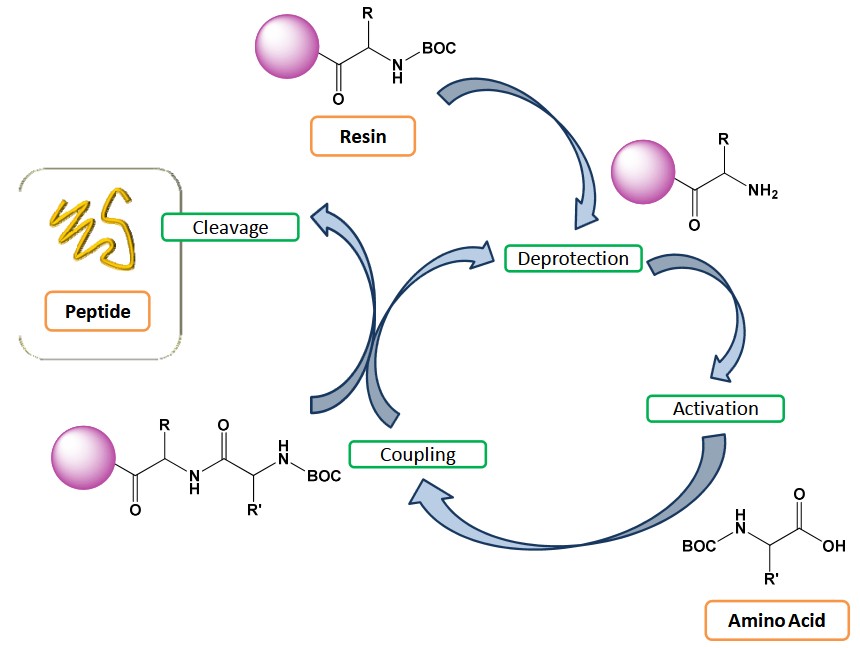 Figure 1. General scheme of solid-phase peptide synthesis (SPPS). (Duro-Castano et al., 2014)