We use cookies to understand how you use our site and to improve the overall user experience. This includes personalizing content and advertising. Read our
Privacy Policy
Profacgen offers Ligand Discovery and Design Service, delivering tailored ligand identification and optimization solutions for targeted protein degradation (TPD), supporting both small molecule-based and peptide-based degrader programs from target assessment to validated lead candidates.
Molecular targeting of specific proteins by small molecules is one of the key challenges in biological research. Such small molecules and peptides may serve as valuable reagents for mechanistic studies or form the foundation for early-stage drug discovery. Recently, small compound-based and peptide-based protein degradation approaches have been increasingly applied across diverse disease research areas.
Profacgen provides ligand discovery and design services for both small compound-based and peptide-based protein degradation. Leveraging our extensive compound libraries and advanced virtual screening capabilities, we identify and optimize small molecule ligands through molecular docking. Based on structural databases, we design and optimize peptide ligands for E3 ligase recruiters or target proteins.
Why Ligands Matter in Protein Degraders
Effective targeted protein degradation depends on high-quality ligands that enable precise target recognition and efficient E3 ligase recruitment. Each component of a heterobifunctional degrader requires optimized ligand binding:
Warheads: Target-binding ligands that confer selectivity and affinity for the protein of interest. Warhead quality directly determines degrader potency, selectivity, and the ability to engage challenging targets including transcription factors, kinases, and scaffold proteins
E3 Ligands: Recruiter molecules that bind specific E3 ubiquitin ligases (VHL, CRBN, IAP, and others) to initiate the ubiquitination cascade. E3 ligand selection influences tissue specificity, degradation kinetics, and the therapeutic window of the degrader
Linkers: Connective elements that spatially orient the warhead and E3 ligand to promote productive ternary complex formation. Linker composition, length, and flexibility critically impact cooperativity, cellular permeability, metabolic stability, and the hook effect profile
Figure 1. The workflow of virtual screening for small compound ligand discovery. (Liu et al., 2020)
Our ligand discovery platform integrates computational modeling, biophysical screening, and medicinal chemistry to generate novel molecules with desirable target profiles and accelerate drug discovery programs.
Our Services
Profacgen offers specialized ligand discovery and design modules tailored to diverse target classes, degrader modalities, and program objectives:
High-quality synthesis and analytical characterization of designed ligands and degrader intermediates.
Peptide synthesis: Solid-phase peptide synthesis (SPPS) of linear, cyclic, and modified peptides with purity >95%
Small molecule synthesis: Custom synthesis of screening hits, analog libraries, and lead compounds
Analytical characterization: LC-MS, NMR, HPLC purity verification, and stability assessment
Scale-up support: Gram-scale synthesis for advanced in vitro and in vivo studies
Screening Technologies
Our multi-modal screening platform combines computational and experimental approaches to maximize ligand discovery success:
Virtual Screening: Structure-based molecular docking, pharmacophore modeling, and AI-driven ligand prediction against proprietary and public compound databases. Homology modeling supports receptor and ligand systems lacking experimental structures
Biophysical Screening: Surface plasmon resonance (SPR), isothermal titration calorimetry (ITC), nuclear magnetic resonance (NMR), and bio-layer interferometry (BLI) for quantitative binding affinity determination and fragment detection
Functional Screening: Cell-based assays, reporter systems, and degradation-specific readouts to validate ligand engagement and functional activity in physiologically relevant contexts
Optimization Strategy
Profacgen employs systematic optimization strategies to transform initial hits into development-ready ligands:
Structure-based optimization: Co-crystal structures and molecular modeling guide rational modification of binding interactions, linker attachment points, and exit vectors
Binding site determination: Comprehensive mapping of druggable pockets, allosteric sites, and protein-protein interaction interfaces to identify optimal ligand binding locations
Conformational analysis: Preparation of ligand conformation databases and ensemble docking to account for receptor flexibility and induced-fit effects
Results analysis and evaluation: Multi-parameter scoring integrating binding affinity, selectivity, ligand efficiency, synthetic accessibility, and IP landscape assessment
Deliverables
Profacgen provides structured, decision-ready documentation aligned with your ligand discovery objectives:
Parameter
Description
Virtual Screening Report
Docking scores, hit ranking, binding mode analysis, and structural rationale for prioritized compounds
Biophysical Binding Data
Kd, Ki, or IC50 values with experimental conditions and quality metrics
Hit Compound Characterization
Chemical structure, purity verification, analytical data (LC-MS, NMR), and stability assessment
Optimization Summary
SAR analysis, affinity improvement trajectory, selectivity profile, and developability assessment
Case Study 1: Virtual Screening for Kinase Warhead Identification
Program Context:
A targeted protein degradation program required a selective kinase inhibitor warhead with an appropriate exit vector for PROTAC linker attachment. The target kinase shared high sequence homology with multiple family members, demanding exceptional selectivity.
Objective:
To identify and optimize a small molecule warhead with sub-nanomolar affinity, >50-fold selectivity over closest homologs, and a solvent-exposed vector compatible with linker conjugation.
Approach:
Profacgen performed homology modeling of the target kinase to generate a reliable binding site model for virtual screening. A library of 2.5 million compounds was docked against the modeled active site, followed by pharmacophore filtering and MM-GBSA rescoring. Top-ranked hits were evaluated by SPR for binding confirmation and by differential scanning fluorimetry for selectivity profiling. A lead series was optimized through iterative structure-based design, resulting in a candidate with confirmed co-crystal structure and validated linker compatibility.
Outcome:
The optimized warhead achieved a Ki of 0.3 nM against the target kinase with >80-fold selectivity over the closest homolog. The co-crystal structure confirmed the predicted binding mode and identified an optimal linker attachment point. The warhead was successfully incorporated into a PROTAC that demonstrated potent cellular degradation, supporting progression to lead optimization.
Case Study 2: Peptide-Based Degrader for Alpha-Synuclein
Program Context:
A neurodegenerative disease program sought to degrade alpha-synuclein aggregates, a pathological hallmark of Parkinson's disease. Traditional small molecule approaches had failed to achieve selective engagement of aggregated species.
Objective:
To design a cell-permeable peptide-based degrader that selectively recognizes pathological alpha-synuclein conformers and recruits the cellular degradation machinery for aggregate clearance.
Approach:
Profacgen designed a bifunctional peptide incorporating a cell-penetrating peptide (CPP) sequence, an alpha-synuclein-binding motif derived from conformation-specific antibodies, and a VHL-recruiting peptide ligand. The construct was optimized through cyclization to enhance proteolytic stability and cellular uptake. Binding specificity was validated by SPR and immunoprecipitation against monomeric, oligomeric, and fibrillar alpha-synuclein species. Cellular degradation was assessed in a neuronal cell model with pathological aggregate formation.
Outcome:
The optimized peptide degrader demonstrated selective binding to oligomeric and fibrillar alpha-synuclein with negligible monomer engagement. Cell-based assays confirmed dose-dependent reduction of intracellular aggregates and rescue of neuronal viability markers. The peptide exhibited favorable stability in human plasma and crossed an in vitro blood-brain barrier model, supporting its potential as a novel therapeutic modality for synucleinopathies.
Q: What is the difference between small molecule and peptide-based degrader ligands?
A: Small molecule ligands offer favorable drug-like properties, oral bioavailability, and established medicinal chemistry optimization pathways. They are typically preferred for intracellular targets and E3 ligase recruiters with defined binding pockets. Peptide-based ligands excel at engaging protein-protein interaction surfaces, recognizing specific conformational states, and targeting proteins lacking druggable pockets. Peptide ligands often require cell-penetration strategies but can achieve exceptional specificity. Profacgen supports both approaches and can recommend the optimal modality based on your target biology and program objectives.
Q: Can you work with targets lacking experimental structures?
A: Yes. Our platform includes robust homology modeling capabilities for both target proteins and ligands lacking experimental structures. We employ state-of-the-art template selection, loop modeling, and refinement protocols to generate reliable models for virtual screening and molecular docking. Model quality is validated through cross-validation, molecular dynamics stability assessment, and retrospective enrichment studies. This approach has successfully supported ligand discovery for multiple challenging targets.
Q: What compound libraries are available for virtual screening?
A: We maintain access to diverse compound collections including commercial libraries (Enamine, ChemDiv, ZINC), focused fragment libraries, and proprietary collections. Library sizes range from specialized sets of 10,000–50,000 fragments to ultra-large virtual libraries exceeding billions of compounds. We can also curate custom libraries based on target class, desired physicochemical properties, or structural motifs. All libraries are pre-processed for docking readiness, including protonation state assignment, tautomer enumeration, and conformational sampling.
Q: How do you ensure peptide stability and cell permeability?
A: We employ multiple strategies to enhance peptide drug-like properties: cyclization and stapling to constrain conformation and resist proteolysis; N-methylation and unnatural amino acid incorporation to improve metabolic stability; conjugation to cell-penetrating peptides (CPPs) or lipid moieties to enhance cellular uptake; and formulation optimization for sustained delivery. Each strategy is selected based on the peptide sequence, target localization, and intended application. We provide stability assessment in biological fluids and cellular uptake validation as standard deliverables.
Q: What information do I need to provide to initiate a ligand discovery project?
A: To initiate a project, we typically require: (1) target identity and biological context; (2) available structural information (PDB structures, homology models, or sequence data); (3) known ligands or inhibitors (if any); (4) desired affinity and selectivity criteria; (5) intended degrader modality (PROTAC, molecular glue, peptide degrader); and (6) any specific constraints (IP considerations, synthetic accessibility, preferred chemotypes). We offer complimentary consultation to assess target feasibility and recommend the optimal discovery strategy.
Q: How does ligand discovery integrate with your Protein Degrader Discovery Services?
A: Our Ligand Discovery and Design Service serves as the foundational module for Protein Degrader Discovery Services. Identified and optimized ligands are directly transferred to degrader assembly, where we design linkers, characterize ternary complexes, and validate cellular degradation. This integrated workflow eliminates handoff delays, ensures ligand properties are optimized for downstream degrader requirements, and provides a single accountability point from target assessment to lead candidate.
References:
Liu Y, Lei Y, Guo S, Zuo Z. Ensemble-based virtual screening in discovering potent inhibitors targeting Von Hippel-Lindau (Vhl) E3 ubiquitin ligase. Life Sciences. 2020;262:118495. doi:10.1016/j.lfs.2020.118495
Online Inquiry
Fill out this form and one of our experts will respond to you within one business day.

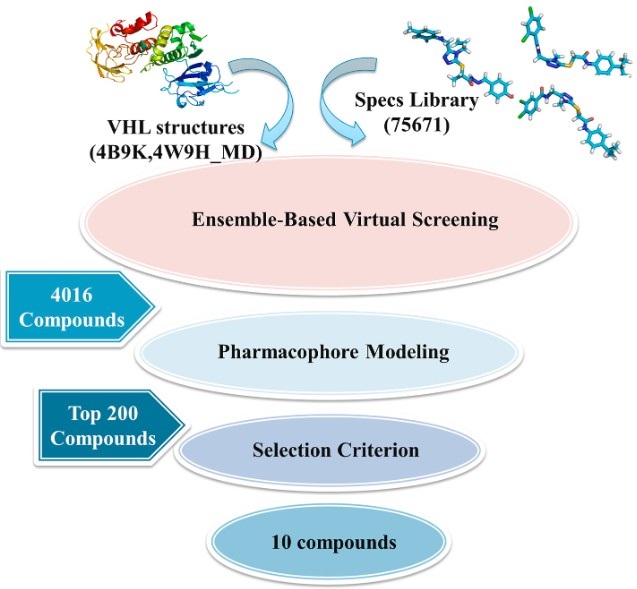 Figure 1. The workflow of virtual screening for small compound ligand discovery. (Liu et al., 2020)