We use cookies to understand how you use our site and to improve the overall user experience. This includes personalizing content and advertising. Read our
Privacy Policy
Fc fusion proteins are engineered molecules in which a therapeutic peptide or protein is genetically linked to the Fc domain of an immunoglobulin. This combination retains the biological activity of the functional domain while imparting the benefits of antibodies, including prolonged plasma half-life, reduced immunogenicity, enhanced solubility, and streamlined purification options. At Profacgen, we provide a comprehensive, end-to-end Fc fusion protein production service, from rational construct design and gene synthesis to expression, purification, and functional validation. Our platform supports research, preclinical studies, and early therapeutic development, ensuring high-quality protein with optimized stability and functionality.
Background: Benefits and Applications of Fusion Proteins
Fc-based fusion proteins are typically homodimers, in which the Fc domain of an antibody is covalently linked to another protein, peptide, receptor, or ligand. This architecture allows the resulting fusion molecule to combine the therapeutic properties of the functional domain with the antibody-like characteristics of the Fc domain.
Figure 1. Fc-fusions are homodimers in which an Fc domain of an antibody is covalently linked to another protein. (Czajkowsky et al., 2012)
Key Benefits of Fc Fusion Proteins
Prolonged Circulation and Reduced Clearance: The Fc domain engages with the neonatal Fc receptor (FcRn), enabling recycling of the fusion protein and preventing lysosomal degradation. This mechanism significantly extends the protein's half-life in vivo, which is particularly valuable for therapeutic peptides and cytokines that would otherwise be rapidly cleared.
Reduced Immunogenicity: Using a human Fc fragment minimizes immune recognition and antibody responses, improving safety for both preclinical and clinical applications.
Enhanced Solubility and Stability: Fc fusion increases the molecular weight of the therapeutic protein, reducing glomerular filtration and aggregation tendencies. Dimeric Fc fusions also improve structural stability.
Facilitated Purification: The Fc domain allows for straightforward purification using affinity chromatography (Protein A or Protein G), reducing downstream processing complexity and costs.
Flexible Engineering Options: Fc fusion proteins can be designed as monomeric or dimeric constructs, N-terminal or C-terminal fusions, and can include optimized linkers to maintain proper folding and activity. These options enable tailored solutions for diverse therapeutic, diagnostic, or research applications.
Applications of Fc Fusion Proteins
Fc fusion proteins are widely used across research and therapeutic areas:
Therapeutic Development: Cytokines, growth factors, and receptor antagonists for immunotherapy and other indications.
Functional Assays: In vitro activity testing, receptor binding studies, and protein-protein interaction analyses.
Immunoassays and Detection Platforms: Flow cytometry, immunohistochemistry, ELISA, and protein microarrays.
Drug Delivery Studies: Fusion of therapeutic peptides with Fc domains to enhance pharmacokinetics and tissue targeting.
Our Service Offerings
At Profacgen, we provide a comprehensive, one-stop Fc fusion protein production platform, benchmarked against top protein-expression providers. Our service offerings cover every stage of the protein production pipeline and are tailored to meet the needs of both research and preclinical therapeutic programs.
Rational Fc Fusion Design
N-terminal or C-terminal Fc fusions depending on the functional requirements of the target protein.
Monomeric or dimeric Fc constructs using precise genetic engineering.
Optimization of linkers (flexible, rigid, or cleavable) to preserve folding, activity, and solubility.
Structural modeling and in silico stability analysis to predict expression outcomes.
Fusion partner selection based on desired half-life, immunogenicity profile, and downstream applications.
Gene Synthesis and Cloning
Codon optimization for mammalian, insect, yeast, or bacterial expression systems.
Seamless cloning into Fc-compatible vectors for efficient expression.
Multi-fragment assembly for complex or multi-domain fusion proteins.
Optional inclusion of affinity or solubility tags for difficult-to-express proteins.
Protein Expression
Expression in CHO, HEK293, insect, yeast, or bacterial systems, selected based on protein complexity and desired post-translational modifications.
Pilot-scale expression to assess yield, solubility, and folding.
Rapid scale-up for larger research or preclinical production needs.
Optimization of expression conditions, including temperature, media, and induction parameters, to maximize yield and minimize aggregation.
Protein Purification
Affinity purification using Protein A or Protein G to exploit the Fc domain.
Secondary purification methods including ion exchange chromatography, size-exclusion chromatography, and hydrophobic interaction chromatography.
Tag removal and polishing steps for applications requiring tag-free proteins.
Endotoxin removal for sensitive functional assays and preclinical studies.
Quality Control and Functional Validation
SDS-PAGE, Western blotting, and mass spectrometry to confirm full-length expression and correct dimerization.
Biophysical characterization (e.g., dynamic light scattering, circular dichroism) to assess folding and aggregation.
Functional assays to verify bioactivity, receptor binding, or enzyme activity.
Stability studies under varying buffer conditions and storage temperatures.
Batch-to-batch consistency checks to ensure reproducibility.
Optional Advanced Services
Conjugation with chemical moieties (e.g., fluorescent dyes, PEGylation) for extended applications.
Design of bispecific or multivalent Fc fusion constructs for complex therapeutic strategies.
Support for preclinical and GMP-ready production upon client request.
Consultation on assay development, in vitro pharmacokinetics, and drug delivery studies.
High Yield & Solubility: Optimized systems and screening strategies for difficult targets
Rapid Turnaround: Streamlined processes for faster delivery without compromising quality
Cost-Effective: Competitive pricing with superior quality
Research & Preclinical Support: Applicable to functional studies, drug delivery research, and therapeutic development
Advanced Analytical Support: Structural, functional, and stability characterization available
Representative Case Studies
Case 1: Prolonged Circulation of a Cytokine
Client Requirements:
A pharmaceutical company was developing a recombinant cytokine therapeutic but faced a critical challenge with its rapid renal clearance, resulting in a short half-life unsuitable for in vivo studies. The client required an engineered cytokine variant with extended circulation time while fully preserving its receptor-binding specificity and biological activity.
Our Solution:
Our team designed a C-terminal Fc fusion construct incorporating an optimized flexible linker to ensure proper independent folding of both cytokine and Fc domains. The gene was codon-optimized for high-yield expression in CHO cells, followed by stable transfection and clonal selection. Purification was performed using a two-step process incorporating Protein A affinity chromatography to capture the Fc tag, followed by polishing size-exclusion chromatography.
Final Results:
The final product was a properly folded, disulfide-linked dimeric Fc fusion protein with high purity and yield. Stability studies demonstrated extended shelf life under standard storage conditions, and surface plasmon resonance confirmed retained receptor binding.
Case 2: Fc Fusion for Antigen Targeting
Client Requirements:
A research institute needed to generate an Fc-fusion protein displaying a specific tumor antigen for immunotherapy studies. The client required a properly folded, bioactive protein that could reliably present the antigen in its native conformation to support immune cell activation assays and subsequent preclinical evaluation in animal models.
Our Solution:
We constructed a mammalian expression vector encoding the antigen fused to a human IgG Fc domain via a flexible linker to preserve conformational integrity. The construct was transiently transfected into HEK293 cells for rapid production, enabling quick turnaround. Fc-fusion proteins were captured by Protein A affinity chromatography and polished to remove aggregates and impurities.
Final Results:
Purified Fc-fusion antigen demonstrated high structural integrity with proper disulfide-linked dimer formation. ELISA-based binding studies confirmed the antigen retained full recognition by its specific antibody. The client received milligram quantities of bioactive material ready for immunization studies and preclinical immunotherapy testing, accelerating their research timeline significantly.
Q: What types of Fc fusion proteins can you produce?
A: We produce N- or C-terminal fusions, both monomeric and dimeric constructs. Our portfolio includes peptides, enzymes, antigens, receptors, ligands, and cytokines to meet diverse research needs.
Q: Which expression systems do you support?
A: We support mammalian (CHO, HEK293), yeast, insect, and bacterial systems. Selection is based on your protein's complexity, required post-translational modifications, and functional requirements.
Q: Can you improve solubility and stability for difficult proteins?
A: Yes. Through design optimization, linker engineering, and systematic expression condition screening, we ensure delivery of soluble, properly folded, and stable fusion proteins.
Q: Do you provide functional validation?
A: Absolutely. We develop and execute customized assays to verify biological activity, receptor binding affinity, or enzymatic function tailored to your specific protein.
Q: What is the typical project timeline?
A: Turnaround depends on protein complexity and scale, but our integrated workflow from gene synthesis to purified protein ensures rapid delivery compared to industry standards.
References:
Czajkowsky DM, Hu J, Shao Z, Pleass RJ. Fc-fusion proteins: new developments and future perspectives. EMBO Mol Med. 2012;4(10):1015-1028. doi:10.1002/emmm.201201379
Online Inquiry
Fill out this form and one of our experts will respond to you within one business day.

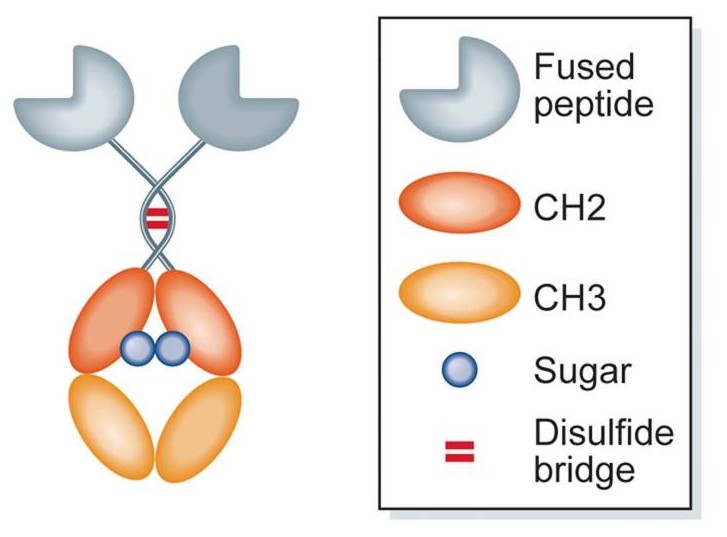 Figure 1. Fc-fusions are homodimers in which an Fc domain of an antibody is covalently linked to another protein. (Czajkowsky et al., 2012)