
Profacgen's Fusion Protein Modeling services deliver high-quality three-dimensional structural models of fusion proteins, supporting construct design, linker optimization, and functional engineering through advanced computational approaches.
Fusion proteins are a class of proteins where two or more protein domains (or segments of sequences) are fused and integrated into one entity. In laboratories, fusion proteins are routinely constructed by researchers using recombinant DNA technology to label the protein of interest, facilitate affinity-based protein purification, improve protein solubility and stability, enhance consecutive enzyme reaction rates, and create innovative therapeutic proteins. The addition of extra modules confers new functions and often results in a fusion protein with distinct overall structure.
However, the three-dimensional structure of fusion proteins is not always available in the Protein Data Bank (PDB), which hinders the structure-function studies as well as rational engineering of these proteins. The lack of structural data is mostly due to the relatively large size of fusion proteins (except proteins fused with small tags) and the intrinsic structural heterogeneity at the interface or inter-domain linking region, which prevents the whole protein from being crystallized. Fortunately, in many cases, the structure of individual fusion partner is well known and this structural information can be used to direct computational modeling process.
Profacgen takes advantage of computational modeling methods to help customers predict the three-dimensional structure of fusion proteins of interest. We have extensive experience with computational protein modeling techniques, always ensuring that the fusion partners are physiochemical compatible and the predictions testable in laboratory experiments. The resultant models are all quality verified and can be used in downstream computational simulation, as well as for the design and engineering of novel fusion proteins with desired functionalities.
Computational fusion protein modeling addresses unique architectural challenges that distinguish these constructs from single-domain proteins:
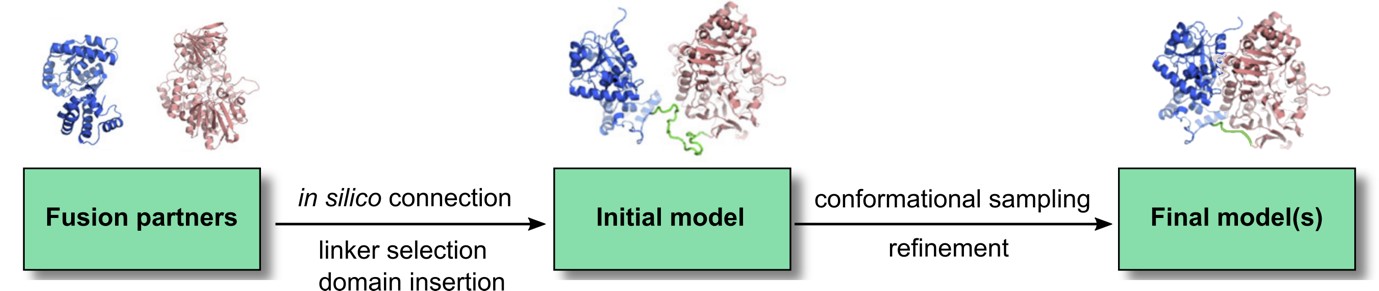 Figure 1. Workflow for predicting the structure of fusion proteins: from component modeling through linker sampling to final refinement.
Our structure modeling procedures begin with selection of the two protein components to be fused, whose structures are either known or can be computationally modelled using properly selected templates. The connection of two fusion partners with linkers or domain insertion strategies are then employed to create an initial fusion model. After that, final models are generated by computationally sampling the conformations of regions that bridge the fusion partners, allowing the protein domains to move, rotate and interact to reach a stable conformation.
Our fusion protein modeling platform encompasses four specialized service modules, each addressing critical aspects of multi-domain construct design:
Fusion Construct Modeling
Complete structural prediction of fusion proteins from individual component structures.
Linker Design Evaluation
Optimization of inter-domain linkers for flexibility, stability, and function.
Domain Orientation Analysis
Determination of optimal spatial arrangement for functional synergy.
Stability Assessment
Prediction and validation of fusion protein structural stability.
Our Fusion Protein Modeling services support a broad spectrum of applications across biotechnology and pharmaceutical development:
Profacgen provides structured, analysis-ready documentation aligned with your fusion protein design requirements:
| Deliverable | Description |
|---|---|
| Structural Models | PDB-format coordinate files for complete fusion protein models, including both fusion partners, linker regions, and any bound ligands or cofactors |
| Linker Analysis Reports | Evaluation of linker flexibility, conformational sampling results, optimal linker length recommendations, and physicochemical property predictions |
| Stability Predictions | Energy profiles, clash scores, packing quality metrics, and molecular dynamics stability assessments for selected construct designs |
Program Context:
A biotechnology company sought to engineer a bifunctional enzyme fusion to enhance consecutive reaction rates in a metabolic pathway. The two enzymes had known individual structures but the optimal linker length and domain orientation for substrate channeling were unknown.
Objective:
To generate structural models of alternative fusion constructs with varying linker lengths and domain arrangements, and identify the design with optimal inter-domain distance for substrate channeling.
Approach:
Profacgen modeled the individual enzyme structures and generated fusion constructs with linkers ranging from 5 to 20 amino acids. Extensive conformational sampling identified optimal domain orientations for each design. The active site distance and substrate tunnel geometry were evaluated computationally.
Outcome:
A construct with a 12-residue flexible linker and a specific domain orientation was predicted to position active sites within 15 Å for efficient substrate channeling. Experimental validation confirmed 3-fold improvement in consecutive reaction rates compared to the free enzyme mixture.
Program Context:
A pharmaceutical company developed an Fc-fusion therapeutic protein that exhibited aggregation and reduced bioactivity during preclinical development, suggesting suboptimal domain orientation and linker design.
Objective:
To generate structural models of the Fc-fusion protein, identify the structural basis of aggregation, and design an improved construct with enhanced stability and preserved biological activity.
Approach:
Profacgen modeled the Fc domain and therapeutic partner structures, then generated fusion models with alternative linkers and domain orientations. Aggregation-prone regions were identified through surface analysis, and designs were ranked by predicted stability and activity-preserving domain geometry.
Outcome:
The optimized design replaced the original rigid linker with a flexible glycine-serine linker of optimal length, eliminating aggregation hotspots while maintaining the bioactive domain orientation. The improved construct showed 90% monomeric purity and comparable activity in preclinical assays.
Fill out this form and one of our experts will respond to you within one business day.