
At Profacgen, our reagent-based crosslinking services provide versatile, efficient, and highly customizable bioconjugation solutions using a comprehensive selection of homobifunctional, heterobifunctional, and multispecific reagents. Chemical crosslinking remains the most widely adopted strategy for protein modification due to its broad applicability, well-understood reaction mechanisms, extensive catalog of commercially available reagents, and straightforward scalability from analytical experiments to manufacturing-scale production.
Our team of experienced biological and organic chemists assists customers with precisely adapted solutions, serving either specific research objectives or as a full-service partnership from concept development through process troubleshooting to final delivery. Whether your project requires simple protein-protein conjugation, antibody-drug conjugate construction, surface functionalization, or complex multi-step modification with site-specific control, Profacgen delivers contract research and process development with premium quality and demonstrable added value.
Chemical crosslinking utilizes bifunctional or multifunctional small molecules that contain two or more reactive groups capable of forming covalent bonds with specific amino acid side chains or functional groups on proteins. The chemistry of crosslinker reactivity is founded on the nucleophilic substitution and addition reactions between electrophilic groups on the crosslinker and nucleophilic groups on the protein surface.
Amine-reactive chemistries target the ε-amino group of lysine residues and the α-amino group at the N-terminus. N-Hydroxysuccinimide (NHS) esters are the most commonly used amine-reactive groups, reacting at mildly alkaline pH (7.5–9.0) to form stable amide bonds with release of NHS as a leaving group. The reaction rate increases with pH as the proportion of deprotonated amine increases, but excessively high pH (>9) can promote competing hydrolysis of the NHS ester. Imidoesters represent an alternative amine-reactive chemistry that forms amidine linkages; unlike NHS esters, the resulting amidine retains the positive charge characteristic of primary amines, which can be advantageous for preserving electrostatic interactions. Carbonyl-diimidazole (CDI) and aldehydes (for reductive amination) provide additional amine-reactive options with distinct reaction profiles.
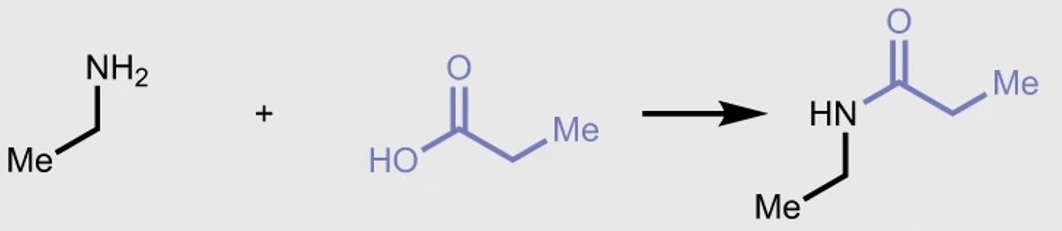 Figure 1. Amide coupling reaction. (Zhang, et al., 2024)
Thiol-reactive chemistries target the sulfhydryl group of cysteine residues. Maleimides react specifically with thiols at near-neutral pH (6.5–7.5) to form stable thioether bonds that are resistant to cleavage under physiological conditions. At higher pH (>8.5), maleimides can react with amines, so careful pH control is essential. Pyridyldithiol (e.g., SPDP) reagents form cleavable disulfide bonds that can be reversed by reducing agents such as dithiothreitol (DTT) or tris(2-carboxyethyl)phosphine (TCEP), enabling controlled release applications. Iodoacetyl and bromoacetyl reagents provide alternative thiol-specific chemistries that form stable thioether linkages.
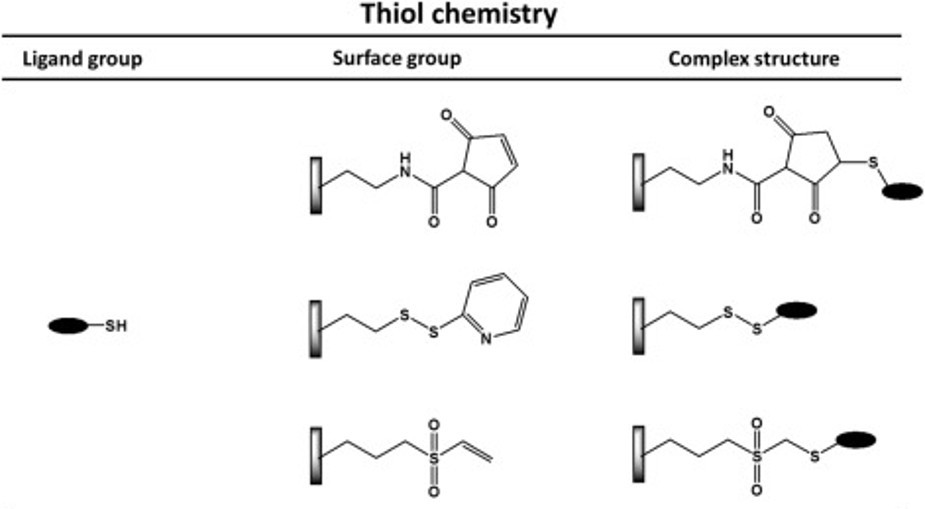 Figure 2. Thiol chemistry on maleimide-, disulfide-, and vinyl sulfone-derived surfaces. (Huang, 2019)
Heterobifunctional crosslinkers combine two different reactive groups, enabling directed conjugation between distinct functional classes. The most common architecture combines an NHS ester (amine-reactive) with a maleimide (thiol-reactive), allowing sequential conjugation in a defined order: first, the NHS ester reacts with the amine-containing protein; second, after removal of excess crosslinker, the maleimide reacts with the thiol-containing partner. This two-step approach minimizes homodimerization and provides superior control over conjugation orientation compared to homobifunctional strategies.
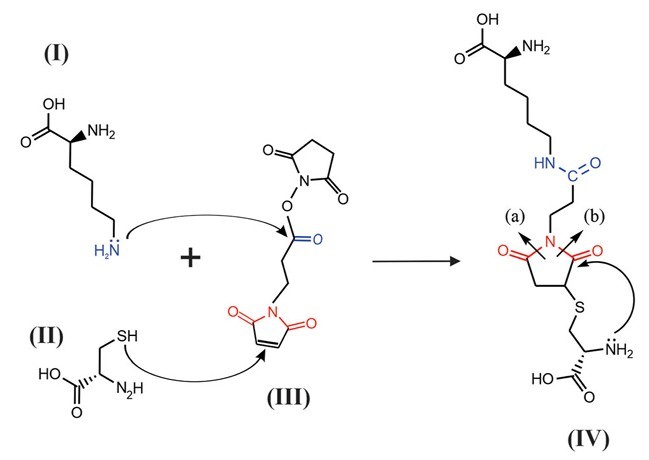 Figure 3. Crosslinking reaction between lysine (I) and cysteine (II) residues mediated by the heterobifunctional crosslinking reagent BMPS (III) to yield a thiosuccinimide linker (IV). (Ramos‐Bermúdez, et al., 2024)
The selection of an appropriate crosslinking strategy depends on multiple factors: the identity, abundance, and accessibility of target functional groups; the required spacer length, flexibility, and composition; the need for cleavable versus permanent linkages; aqueous solubility requirements; compatibility with protein stability and downstream applications; and the scale of production.
Profacgen provides a comprehensive range of chemical crosslinking services organized by target functional group chemistry:
Amine-to-Amine Crosslinking
Amine-specific crosslinkers react with primary amines on lysine side chains and protein N-termini. These reagents are broadly applicable due to the abundance of surface-exposed lysines on most proteins.
Thiol-to-Thiol Crosslinking
Thiol-reactive crosslinkers target cysteine residues, offering greater site specificity due to the lower abundance of surface-exposed cysteines, enabling more controlled modification and defined conjugation stoichiometry.
Thiol-to-Amine Crosslinking
Heterobifunctional crosslinkers enable conjugation between different functional groups, providing superior control over crosslinking orientation and minimizing homodimerization compared to homobifunctional approaches.
Thiol/Amine-to-Carbohydrate Crosslinking
Carbohydrate-directed crosslinking enables site-specific modification at glycosylation sites, particularly valuable for antibody Fc region conjugation and glycoprotein functionalization.
Our chemical crosslinking services support diverse research and development programs:
Background:
An immuno-oncology company required a bispecific antibody targeting two distinct tumor antigens simultaneously. Genetic approaches (knobs-into-holes, CrossMab) had failed due to mispairing and low expression yields. Chemical conjugation of purified Fab' fragments was selected as an alternative strategy.
Approach:
Profacgen generated Fab' fragments from the two parental antibodies by pepsin digestion followed by mild reduction of the hinge disulfides to expose free thiol groups. A heterobifunctional NHS-PEG4-maleimide crosslinker was first reacted with an engineered cysteine on the Fc region of an aglycosylated Fc scaffold at pH 7.5. After removal of excess crosslinker by desalting, the two Fab' fragments were added sequentially and reacted with the terminal maleimide groups at pH 6.5. The conjugation stoichiometry was controlled by the Fab'-to-scaffold molar ratio.
Outcome:
The resulting bispecific conjugate exhibited >90% purity by SEC-HPLC with the intended 2 Fab' + 1 Fc architecture. Both antigen-binding sites retained nanomolar affinity (KD = 2.1 nM and 4.8 nM for the two targets, respectively). In vitro functional assays demonstrated simultaneous binding to dual-antigen-positive cells and potent redirected T cell cytotoxicity (EC50 = 0.5 nM). The chemical conjugation approach bypassed the expression challenges of genetic formats and enabled rapid generation of bispecific constructs for proof-of-concept studies.
Background:
A drug discovery team developing a surface plasmon resonance (SPR) assay for a membrane receptor needed to immobilize the receptor on a sensor chip with defined orientation, preserving its ligand-binding activity. Random amine coupling resulted in heterogeneous orientation and significant activity loss due to active site occlusion.
Approach:
Profacgen introduced a unique surface cysteine into the receptor extracellular domain at a position distal from the ligand-binding site. The cysteine-engineered receptor was expressed in HEK293 cells, purified by affinity chromatography, and treated with TCEP to ensure a free thiol. A heterobifunctional NHS-PEG6-maleimide linker was first coupled to amine-functionalized sensor chip surfaces, followed by reaction with the receptor thiol to generate a site-specific, oriented immobilization.
Outcome:
Oriented immobilization yielded a 5-fold increase in ligand-binding capacity compared to random amine coupling, with binding kinetics (ka = 1.2 × 10⁶ M-1s-1, kd = 2.3 × 10⁻³ s-1) matching solution-phase measurements. The sensor surface was stable for >200 binding-regeneration cycles with <10% activity loss. This oriented immobilization approach was subsequently adopted as the standard method for the receptor family and enabled screening of over 500 small-molecule compounds.
Request a Quote for Chemical Crosslinking
References:
Fill out this form and one of our experts will respond to you within one business day.