
Isothermal titration calorimetry (ITC) is a gold-standard physical technique for determining the complete thermodynamic profile of biomolecular interactions in solution. Operating as a label-free method, ITC measures the precise heat exchange—either absorbed or evolved—during sequential titration of a ligand into a macromolecular binding partner. Unlike spectroscopic or surface-based techniques, ITC requires no chemical modification, fluorescent labeling, or immobilization of either reactant, and it imposes no limitations on molecular weight or optical properties. This direct thermodynamic approach enables simultaneous determination of the equilibrium association constant (Ka), reaction stoichiometry (n), enthalpy change (ΔH), and entropy change (ΔS) from a single automated experiment. Profacgen offers advanced Isothermal Titration Calorimetry (ITC) services powered by state-of-the-art instrumentation and deep expertise in physical chemistry and structural biology, delivering quantitative binding characterization for drug discovery, protein engineering, and mechanistic studies.
ITC operates on the fundamental principle of heat measurement during reversible binding equilibria. The instrument maintains identical temperatures between a sample cell containing the macromolecule and a reference cell filled with buffer, measuring the differential power required to compensate for thermal events occurring upon ligand injection.
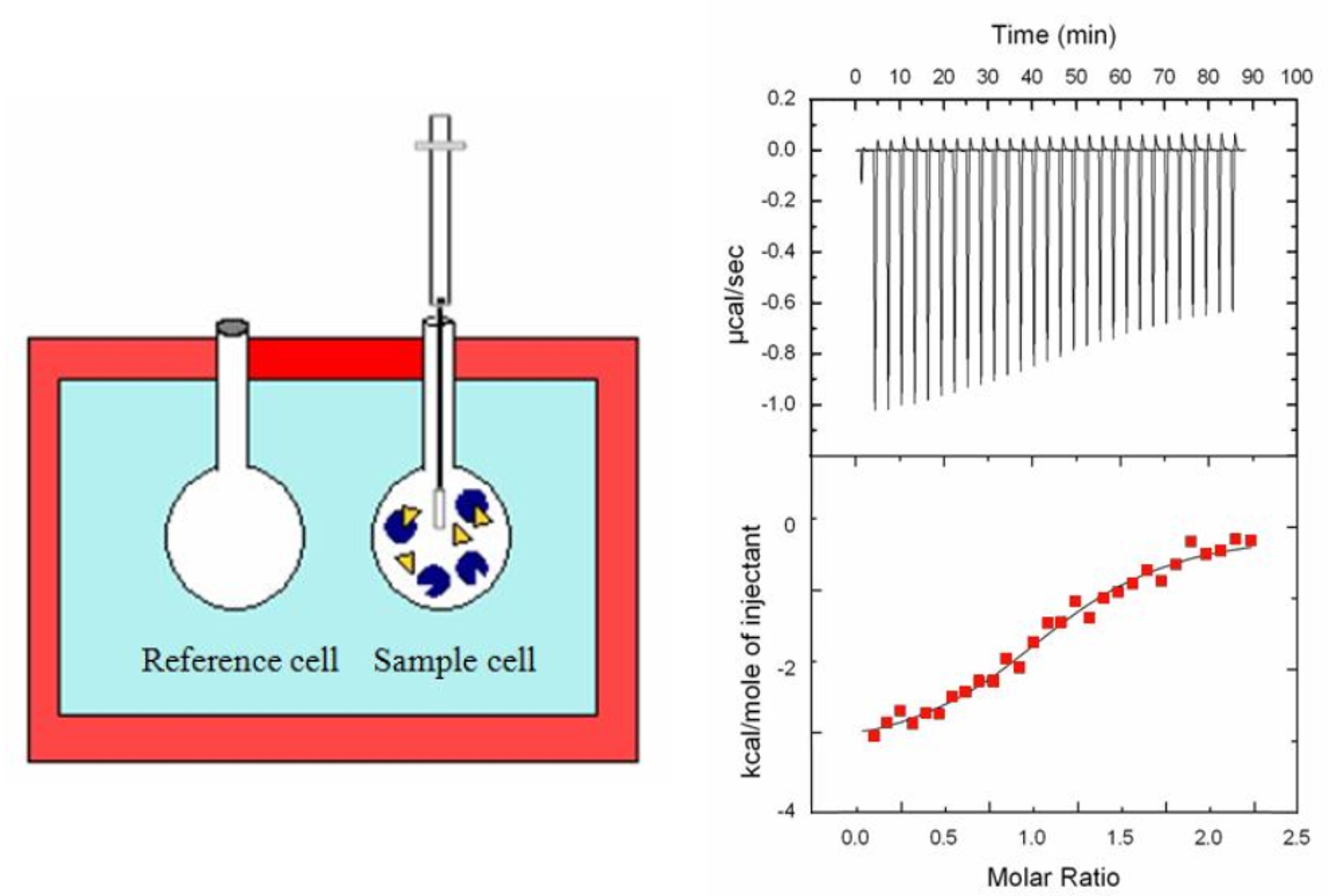 Figure 1. Configuration of an ITC reaction cell and a typical ITC experiment. The differential power signal reflects heat absorbed or released upon sequential ligand injection, yielding integrated heat data for thermodynamic analysis. (Atri et al., 2015)
The MicroCal iTC200 system employed at Profacgen features a tandem cell design with precise temperature control and nanocalorimetric sensitivity:
During a typical ITC experiment, the ligand is titrated in discrete aliquots into the sample cell containing the target macromolecule. Each injection generates a heat pulse proportional to the fractional saturation achieved at that stoichiometric point:
ITC uniquely provides the complete thermodynamic signature of an interaction through direct measurement of equilibrium binding parameters without assumptions about mechanism or model:
| Parameter | Symbol | Physical Meaning | Information Content |
|---|---|---|---|
| Equilibrium Association Constant | Ka | The concentration-dependent affinity describing the ratio of bound to free species at equilibrium; directly related to Gibbs free energy through ΔG° = –RT ln Ka | Quantitative measure of binding strength; enables comparison across ligand series and mutational variants |
| Reaction Stoichiometry | n | The molar ratio of ligand binding sites per macromolecule; determined from the inflection point of the binding isotherm | Reveals oligomeric state, active site number, and potential cooperativity or heterogeneity in the interaction |
| Enthalpy Change | ΔH | The total heat released (exothermic, ΔH < 0) or absorbed (endothermic, ΔH > 0) upon complex formation, reflecting the net change in non-covalent bonding and solvation | Indicates the balance of hydrogen bonding, van der Waals interactions, and electrostatic contributions; temperature dependence yields heat capacity change (ΔCp) |
| Entropy Change | ΔS | The change in disorder upon binding, derived from the relationship ΔG° = ΔH – TΔS; reflects solvent reorganization, conformational restriction, and translational/rotational degrees of freedom | Distinguishes enthalpy-driven (favorable bonds, unfavorable entropy) from entropy-driven (hydrophobic effect, favorable desolvation) binding mechanisms |
The relationship ΔG° = ΔH – TΔS = –RT ln Ka governs all biomolecular interactions. ITC is the only technique that experimentally determines both ΔH and Ka, thereby calculating ΔS without empirical assumptions. This decomposition enables mechanistic interpretation: enthalpy-optimized interactions typically feature extensive hydrogen bonding networks and charged contacts, while entropy-driven binding often involves large hydrophobic surface burial and release of ordered water molecules.
ITC serves as an indispensable analytical tool across fundamental research and pharmaceutical development, providing quantitative thermodynamic data that guide molecular design and mechanistic understanding.
Protein-Ligand Interaction Characterization
Quantitative assessment of small molecule, metal ion, drug candidate, and enzyme inhibitor binding to protein targets. ITC reveals not only affinity but also the enthalpic and entropic contributions driving recognition, enabling structure-thermodynamic relationship optimization in lead optimization campaigns.
Protein-Protein and Protein-Nucleic Acid Interactions
Thermodynamic profiling of domain-domain associations, hormone-receptor complexes, antibody-antigen recognition, antibody-receptor binding, and membrane fusion events. Stoichiometric analysis distinguishes 1:1, 2:1, and higher-order assembly mechanisms essential for understanding signaling complexes.
Self-Association and Aggregation Studies
Characterization of micellization parameters for surfactants, oligomerization equilibria of therapeutic proteins, and aggregation propensity assessment under formulation-relevant conditions. ITC detects concentration-dependent self-association invisible to bulk biophysical methods.
Drug Discovery and Development
Lead compound ranking beyond IC50 values, selectivity profiling against off-target proteins, buffer and excipient optimization for biologics formulation, and biosimilar comparability assessment through thermodynamic fingerprint matching.
Enzyme Kinetics and Inhibitor Mechanism
Direct measurement of substrate binding thermodynamics and competitive inhibitor displacement enthalpies. ITC distinguishes competitive, non-competitive, and allosteric inhibition modes through stoichiometry and enthalpy signature analysis.
Biophysical Process Characterization
Investigation of protonation events coupled to binding, metal ion coordination thermodynamics, lipid-peptide membrane insertion, and other chemical and physical processes central to biomedical research and therapeutic mechanism elucidation.
Profacgen delivers comprehensive ITC services encompassing experimental design, sample preparation, instrument operation, data analysis, and mechanistic interpretation. Our workflow ensures reproducible, publication-quality thermodynamic data.

Background:
A pharmaceutical client developing inhibitors of a cytokine-receptor interaction observed that lead compounds with comparable IC50 values exhibited markedly different pharmacokinetic profiles and target residence times. Standard binding assays could not explain these discrepancies, as affinity alone failed to capture the molecular forces governing complex stability.
Our Solution:
Profacgen performed ITC characterization of the top six lead compounds against the cytokine-binding domain. For each compound, we determined Kd, stoichiometry, ΔH, and –TΔS contributions. Compounds were ranked not by affinity alone but by enthalpy-entropy profiles: enthalpy-optimized candidates with large negative ΔH values were hypothesized to form more extensive hydrogen bond networks and exhibit slower off-rates.
Final Results:
ITC analysis revealed that the two most enthalpy-driven compounds (ΔH = –18.4 and –21.2 kcal/mol) indeed displayed 10-fold longer target residence times in surface plasmon resonance kinetic assays and superior efficacy in a rheumatoid arthritis synovial explant model. The client prioritized these compounds for back-up series development, accelerating candidate selection by approximately six months.
Background:
A biotechnology company engineered an Fc region variant intended to enhance neonatal Fc receptor (FcRn) binding for extended serum half-life. Preliminary SPR data suggested increased affinity but anomalous sensorgram shapes that hinted at multivalent binding or aggregation artifacts. The true binding stoichiometry and mechanism remained unresolved.
Our Solution:
Profacgen conducted ITC titrations of the wild-type and engineered Fc variants into FcRn at pH 6.0 (endosomal binding condition) and pH 7.4 (physiological release condition). The solution-based, label-free approach eliminated surface immobilization artifacts. We determined binding stoichiometry (n), enthalpy, and affinity under both pH conditions to assess pH-dependent switching behavior.
Final Results:
ITC revealed that the engineered variant bound FcRn with 2:1 stoichiometry at pH 6.0 versus 1:1 for wild-type, indicating engineered avidity enhancement through secondary binding site engagement. At pH 7.4, both variants showed weakened affinity consistent with physiological release, but the engineered variant maintained measurable residual binding that correlated with extended half-life in cynomolgus monkey PK studies. These insights guided final variant selection and informed regulatory CMC documentation.
References:
Fill out this form and one of our experts will respond to you within one business day.