
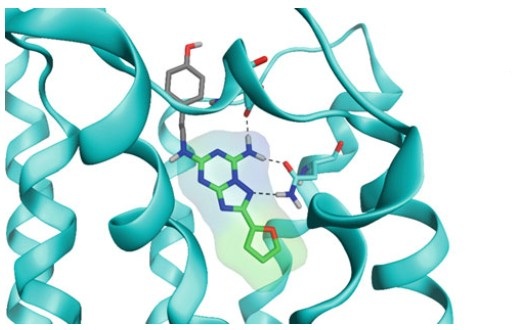
 Figure 1. Hybrid screening example: The core fragment of A2A ligand ZM241385 (green) mediates key receptor interactions. (Anighoro and Bajorath, 2018)
Profacgen's Hybrid Virtual Screening service provides an integrated solution for small-molecule hit identification by combining the complementary strengths of ligand-based and structure-based virtual screening (VS) methods. Hybrid approaches leverage all available chemical and biological information about a target, enhancing the predictive power of each individual method while mitigating their respective limitations. By integrating evolution-based ligand-binding information with global structural similarity and binding pocket similarity, our platform delivers enriched hit lists with higher true-positive rates than single-strategy workflows.
In a hybrid virtual screening campaign, structural and ligand information is not applied sequentially in isolation, but combined into a standalone method that simultaneously interrogates the chemical and geometric features of a binding event. Protein-ligand pharmacophores are constructed from experimental structures or homology models of protein-ligand complexes, while excluded volumes restrict filtered compounds to the size and shape of the binding pocket. Profacgen offers flexible deployment strategies—including hierarchical, parallel, and fully hybrid approaches—so that the workflow can be tailored to the information content available for each target.
Single-method virtual screening campaigns often suffer from either high false-positive rates (ligand-based methods when little SAR data is available) or limited chemical-space coverage (structure-based methods when the binding pocket is ambiguous or highly flexible). Hybrid virtual screening resolves these issues by treating ligand knowledge and structural knowledge as mutually reinforcing inputs rather than alternative workflows. The approach is particularly powerful for emerging targets where only a few actives are known, or for targets with shallow, featureless pockets where scoring functions alone are unreliable.
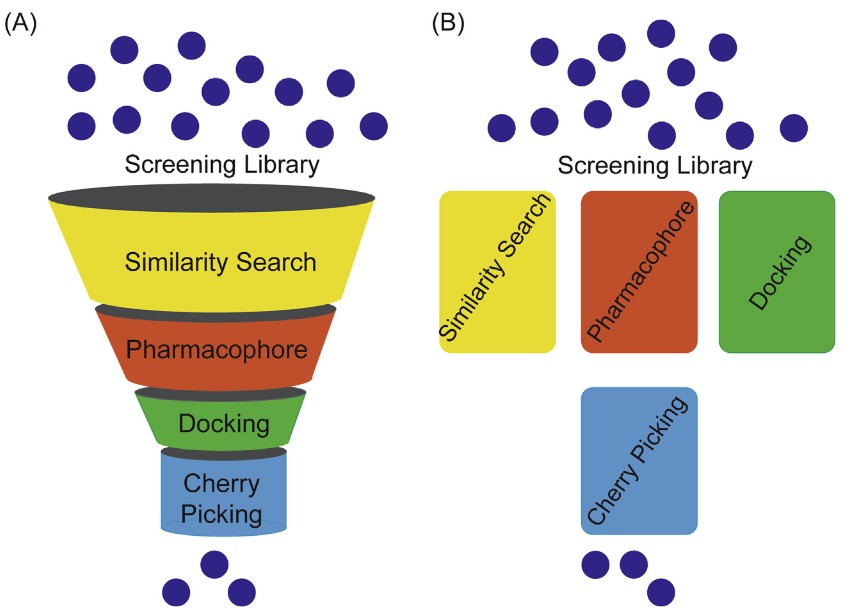 Figure 2. Integration of ligand and structure-based approaches. (A) Hierarchical virtual screening (HLVS). (B) Parallel virtual screening (PVS). (Kumar and Zhang, 2014)
| Service Component | Description |
| Library Preparation & Compound Curation | Acquisition of commercial and proprietary compound libraries, filtering by drug-likeness (Lipinski, Veber, lead-like rules), removal of Pan-Assay Interference Compounds (PAINS), and enumeration of tautomeric and protonation states to ensure chemically sensible input for downstream screening. |
| Ligand-Based Initial Filtering | Cost-effective first-pass triage using 2D/3D similarity search, ligand-based pharmacophore matching, and shape-based screening (ROCS-style) against known actives, reducing the library to a focused subset enriched in plausible chemotypes. |
| Structure-Based Docking & Scoring | High-throughput molecular docking into the receptor binding site, binding mode prediction, and consensus scoring across multiple scoring functions to rank compounds by predicted affinity and pose quality. |
| Pharmacophore Refinement & Excluded Volume Application | Construction of protein-ligand pharmacophores from experimental or homology-modeled complexes, application of excluded-volume constraints to enforce pocket shape complementarity, and fusion of ligand- and receptor-derived features into a single selective query. |
| Visual Selection & Hit List Delivery | Expert visual inspection of top-ranked poses, integration of literature and SAR knowledge, elimination of chemically implausible or non-drug-like scaffolds, and delivery of a ranked hit list with annotated binding modes and prioritization rationale. |
Background:
A client requested the identification of novel ATP-competitive inhibitors for an understudied serine/threonine kinase. The client provided a high-resolution crystal structure of the kinase domain and a small set of known type-I inhibitors, but no extensive SAR data was available. The objective was to deliver validated chemical matter suitable for hit-to-lead optimization.
Our Solution:
We deployed a hierarchical virtual screening (HLVS) workflow on a 2-million-compound commercial library. The cascade began with 2D/3D similarity search and ligand-based pharmacophore matching against the known inhibitors, reducing the set to approximately 80,000 compounds. Structure-based docking into the ATP pocket followed by consensus scoring further narrowed the pool to 4,000 candidates. A protein-ligand pharmacophore built from the co-crystal structure, augmented with excluded volumes lining the hinge and DFG motif, was applied to refine the list to 200 compounds. Final expert visual inspection prioritized 40 compounds for experimental testing.
Final Results:
Of the 40 compounds selected, 15 showed measurable inhibition in the enzymatic assay (37.5% hit rate), and 3 of these exhibited sub-micromolar IC50 values. The three lead series displayed novel chemotypes distinct from the client's existing IP, providing a clear path for hit-to-lead optimization.
Background:
A biotech partner sought inhibitors disrupting a challenging protein-protein interaction (PPI) interface. The target pocket was shallow, flexible, and druggability was uncertain. Only two weak tool compounds (~50 µM) were known, and the binding mode was ambiguous. A conventional sequential workflow was deemed unsuitable because over-reliance on either ligand similarity or docking alone would have excluded potentially valuable chemotypes.
Our Solution:
We implemented a parallel virtual screening (PVS) strategy on a curated library of 500,000 compounds. Ligand-based methods (similarity search and shape-based screening against the two known tool compounds) and structure-based methods (ensemble docking into multiple receptor conformations to account for pocket flexibility) were executed independently and in parallel. The two ranked lists were then fused using a consensus ranking algorithm, and the top 300 compounds were subjected to pharmacophore filtering, excluded-volume refinement, and visual inspection. Twenty compounds were ordered and tested.
Final Results:
The combined ranking identified eight novel chemotypes that had not been prioritized by either individual method alone. Four of these displayed micromolar activity in the AlphaScreen confirmation assay, validating the PPI as druggable and delivering first-in-class chemical matter for the client's lead discovery program.
References:
Fill out this form and one of our experts will respond to you within one business day.