We use cookies to understand how you use our site and to improve the overall user experience. This includes personalizing content and advertising. Read our
Privacy Policy
Profacgen offers Post-Translational Modification (PTM) Modeling services deliver accurate structural models of modified proteins, supporting functional studies, drug discovery, and mechanistic research through advanced computational approaches that predict PTM sites and model their structural consequences.
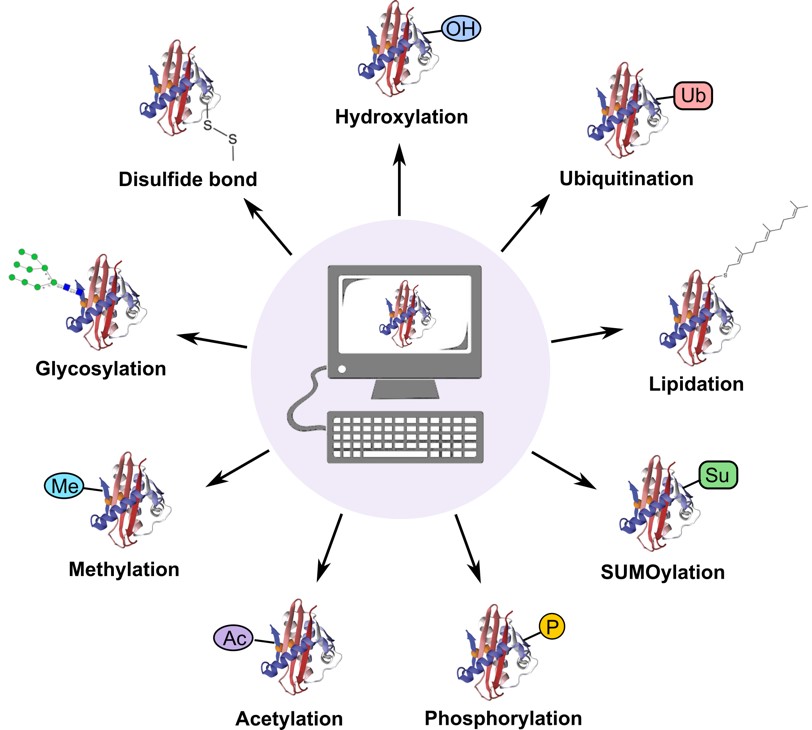
Post-translational modification (PTM) are covalent modifications that expand protein functional diversity by introducing new chemical groups, altering enzyme activity, ligand affinity, interactions, and stability. Over 350 PTM types have been identified, highlighting their regulatory importance.
While MS/MS enables experimental PTM site identification, computational modeling offers a fast, accurate, and convenient alternative. Profacgen leverages algorithms trained on PDB-derived PTM data to predict modification sites and model resulting side-chain and main-chain conformational changes.
Our service aids in understanding PTM effects on structure, dynamics, and binding, facilitating rational PTM regulation design and supporting structure-based therapeutic development targeting modified protein systems.
Overview of PTM Modeling
Computational PTM modeling addresses the structural and functional consequences of protein modifications that expand proteomic diversity:
Phosphorylation: Modeling of serine, threonine, and tyrosine phosphorylation to predict conformational changes, allosteric effects, and regulatory switch mechanisms that control enzyme activity and signaling cascades
Glycosylation: Structural prediction of N-linked and O-linked glycans, including glycan conformational sampling and impact on protein folding, stability, and recognition by glycan-binding receptors
Acetylation: Modeling of lysine acetylation effects on histone tails and non-histone proteins, including charge neutralization consequences and protein-protein interaction interface alterations
Ubiquitination: Structural analysis of ubiquitin conjugation sites, polyubiquitin chain topology, and recognition by ubiquitin-binding domains for proteasomal targeting and signaling
Profacgen takes advantage of computational modeling capabilities to predict potential PTM sites and model the structural consequences of modifications, facilitating rational design of PTM regulation and structure-based therapeutic development.
Our Modeling Capabilities
Our PTM modeling platform encompasses four specialized service modules, each addressing critical aspects of modified protein structure and function:
PTM Site Modeling
Accurate prediction and structural modeling of modification sites across the protein sequence.
Sequence and structure-based prediction of PTM sites using trained algorithms
Side chain conformation modeling for phosphorylation, acetylation, methylation, and ubiquitination
Main chain manipulation for disulfide bridge formation and proteolytic cleavage sites
Multi-site modification modeling for complex PTM patterns and crosstalk
Structural Impact Analysis
Evaluation of conformational changes induced by post-translational modifications.
Energy-based refinement of modified protein structures to optimize local geometry
Comparison of modified and unmodified conformations to identify structural perturbations
Allosteric pathway mapping for distant conformational effects of PTMs
Secondary and tertiary structure assessment upon modification
Protein Stability Evaluation
Prediction of thermodynamic and kinetic stability changes resulting from modifications.
Prediction of physical properties including stability, solubility, and aggregation propensity
Comparison with unmodified protein to quantify modification-induced stability shifts
Energy decomposition analysis to identify key stabilizing or destabilizing interactions
Dynamic behavior assessment through molecular dynamics simulation of modified proteins
Interaction Analysis
Modeling of PTM effects on protein-protein, protein-ligand, and protein-nucleic acid interactions.
Binding affinity prediction for modified proteins with partners, substrates, and inhibitors
Interface remodeling upon PTM-induced conformational changes
Inclusion of ligands, cofactors, and water in the modified protein model
Specificity and selectivity assessment for PTM-dependent recognition events
Applications
Our PTM Modeling services support a broad spectrum of applications across biomedical research and therapeutic development:
Functional Studies: Structural interpretation of PTM-mediated regulatory mechanisms, including kinase activation, phosphatase inhibition, and signaling cascade propagation through conformational switch modeling
Drug Discovery: Design of inhibitors targeting PTM-modified protein states, including phospho-mimetic and phospho-resistant mutant modeling for drug resistance prediction and selective inhibitor development
Protein Engineering: Rational design of PTM-mimetic variants with constitutive activity or PTM-resistant mutants for improved stability, and engineering of degrons for targeted protein degradation
Mechanistic Research: Atomic-level understanding of PTM crosstalk, including competitive modification site analysis, hierarchical phosphorylation modeling, and PTM-dependent protein complex assembly
Deliverables
Profacgen provides structured, analysis-ready documentation aligned with your PTM modeling and functional analysis requirements:
Deliverable
Description
Modified Protein Models
PDB-format coordinate files for PTM-modified proteins, including optimized side chain conformations, main chain adjustments, and any bound ligands or cofactors
Structural Comparison Reports
Comparative analysis of modified and unmodified structures, including RMSD values, local perturbation maps, secondary structure changes, and allosteric effect identification
Functional Insights
PTM site prediction confidence scores, stability change predictions, interaction affinity shifts, and mechanistic interpretation of modification effects on protein function
PDB-Trained Algorithms: Our PTM site prediction and structural modeling algorithms are trained using existing modifications observed in the Protein Data Bank, ensuring accuracy and biological relevance.
Comprehensive Modification Coverage: We model both side chain modifications (phosphorylation, glycosylation, acetylation, ubiquitination) and main chain changes (disulfide bridges, proteolytic cleavage) with appropriate geometric and energetic treatment.
Energy-Based Refinement: All modified structures undergo energy-based refinement to eliminate steric clashes and optimize local geometry, ensuring physically realistic conformations suitable for downstream analysis.
Customizable Service Delivery: We provide fully customizable PTM modeling services tailored to your specific research questions, whether focused on single-site analysis, multi-site crosstalk, or large-scale PTM profiling.
A research group studying a kinase involved in cancer signaling required structural understanding of how activating phosphorylation at two distal sites induced the active conformation, to guide inhibitor design against the phosphorylated state.
Objective:
To model the doubly phosphorylated kinase structure, compare it with the unphosphorylated inactive state, and identify the allosteric pathway connecting phosphorylation sites to the active site.
Approach:
Profacgen predicted the phosphorylation sites using structure-based algorithms and modeled the phosphoserine side chains with optimized rotamer conformations. The modified structure was refined through energy minimization and molecular dynamics simulation. Comparative analysis with the unphosphorylated structure revealed the allosteric network.
Outcome:
The model revealed that phosphorylation at the activation loop induced a helix repositioning that propagated through a hydrophobic spine to the ATP-binding site, explaining the 50-fold activity increase. The structural insights guided design of a type-II inhibitor selective for the phosphorylated active state.
Scenario 2: Glycosylation Impact on Therapeutic Antibody Stability
Program Context:
A biotechnology company observed that different glycoforms of their therapeutic antibody exhibited variable thermal stability and effector function, suggesting that glycosylation patterns at the conserved Fc N-glycan site influenced conformational dynamics.
Objective:
To model representative glycoforms (G0, G1, G2, sialylated) at the Fc N-glycan site and predict their structural and dynamic consequences for stability and FcγR binding.
Approach:
Profacgen built models of each glycoform with realistic glycan conformations sampled from the PDB glycan database. The modified Fc structures were refined and subjected to molecular dynamics simulation to assess conformational flexibility and CH2 domain orientation.
Outcome:
The models revealed that increasing galactosylation progressively stabilized the CH2 domain closed conformation, correlating with higher thermal stability. Sialylation introduced additional hydrogen bonding that reduced FcγRIIIa binding affinity by 30%, explaining the observed effector function differences and informing glycoengineering strategy.
A: We model phosphorylation, glycosylation, acetylation, ubiquitination, methylation, disulfide bridges, and proteolytic cleavage. Multi-site and crosstalk modeling is also supported.
Q: Do you predict PTM sites or only model known modifications?
A: Both. We predict potential PTM sites using sequence and structure-based algorithms, and we model known modifications from experimental data such as MS/MS results.
Q: Can you model glycan structures?
A: Yes. We model N-linked and O-linked glycans with realistic conformations sampled from glycan databases, including complex, hybrid, and high-mannose glycoforms.
Q: How do you validate modified structure models?
A: We use energy-based refinement, stereochemical checks, and comparison with experimentally determined modified structures from the PDB to validate model quality.
Q: Can you predict stability changes upon modification?
A: Yes. We predict physical properties including stability, solubility, and aggregation propensity changes, comparing modified and unmodified protein models.
Q: What input do you need to start a PTM modeling project?
A: We need the protein sequence or structure and the modification type of interest. Known PTM sites or MS/MS data can improve accuracy but are not required.
Online Inquiry
Fill out this form and one of our experts will respond to you within one business day.