We use cookies to understand how you use our site and to improve the overall user experience. This includes personalizing content and advertising. Read our
Privacy Policy
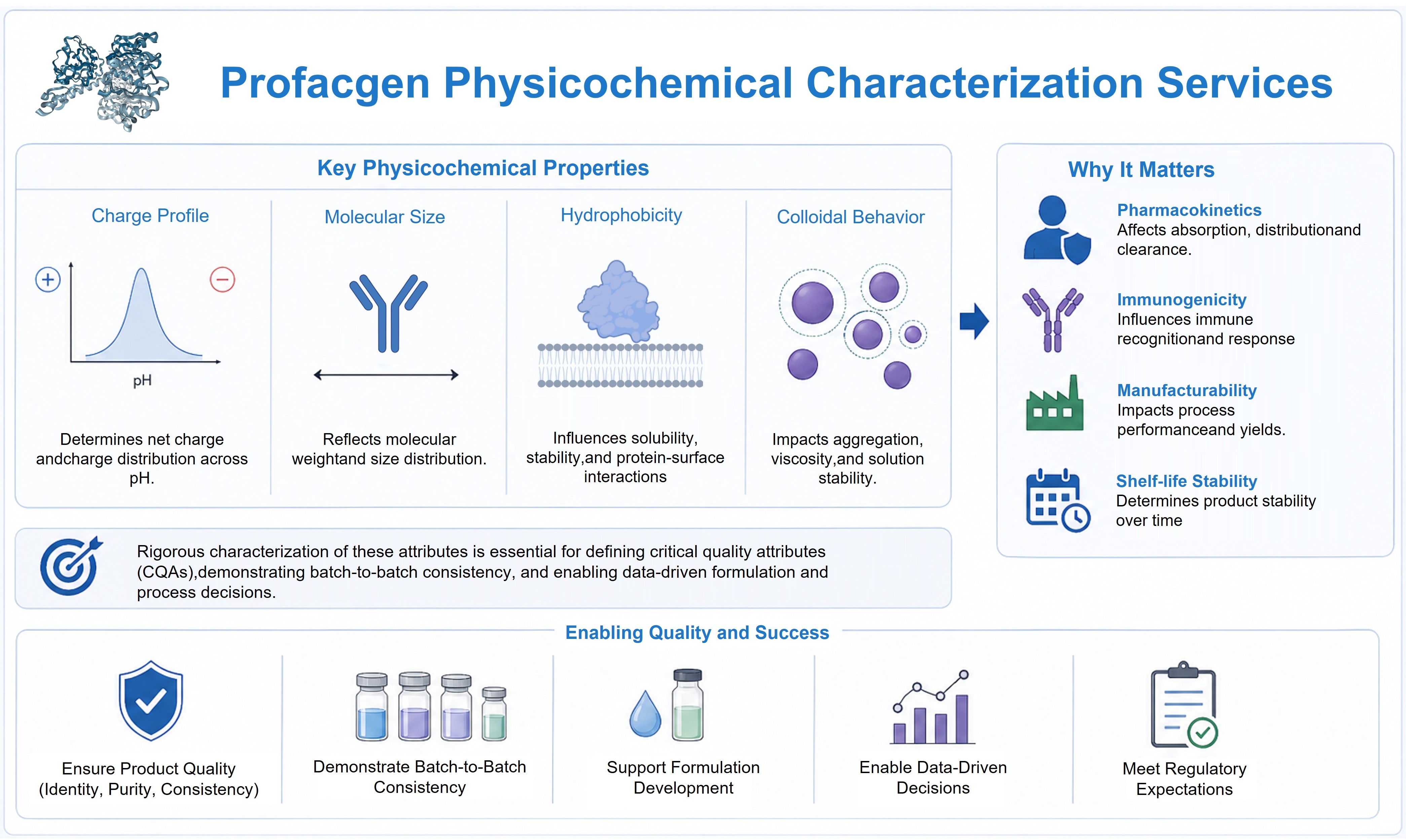
Profacgen's Physicochemical Characterization service provides comprehensive analytical assessment of the physical and chemical properties of protein and peptide therapeutics, delivering the data required to ensure product quality, support formulation development, and satisfy regulatory expectations for identity, purity, and consistency.
Physicochemical properties—including charge profile, molecular size, hydrophobicity, and colloidal behavior—directly influence pharmacokinetics, immunogenicity, manufacturability, and shelf-life stability. Rigorous characterization of these attributes is essential for defining critical quality attributes (CQAs), demonstrating batch-to-batch consistency, and enabling data-driven formulation and process decisions.
Background: Why Physicochemical Characterization?
The physicochemical profile of a biologic therapeutic is a cornerstone of its quality and performance. Regulatory agencies require comprehensive data on charge heterogeneity, molecular size distribution, aggregation propensity, and particulate burden as part of IND, BLA, and biosimilar submissions. These attributes not only define product identity and purity but also predict in vivo behavior, immunogenic potential, and storage stability.
Changes in physicochemical properties—such as shifts in isoelectric point, increases in aggregate content, or emergence of subvisible particles—can signal process drift, formulation instability, or degradation. Profacgen's platform addresses these requirements through orthogonal analytical techniques that interrogate charge, size, hydrophobicity, and particulate burden with high precision and regulatory relevance.
Charge heterogeneity and isoelectric point (pI) by icIEF and cIEF
Molecular size, aggregation, and oligomeric state by SEC, DLS, and AUC
Hydrophobicity and conformational stability by HIC and DSC
Subvisible and visible particle assessment by light obscuration and microscopy
These analyses establish a quantitative physicochemical fingerprint that supports release testing, comparability studies, and formulation optimization.
What We Offer: Physicochemical Characterization Services
Our Physicochemical Characterization platform integrates orthogonal analytical methodologies to deliver comprehensive, stage-appropriate property assessment. We tailor technique selection and reporting depth to your regulatory pathway, from early candidate screening through formal release testing and biosimilar comparability.
Accurate molecular weight determination is fundamental to confirming protein identity and structural integrity. Our Intact Mass & Subunit Analysis service uses high-resolution mass spectrometry to measure the intact protein and its individual subunits under native and reduced conditions. This approach enables precise detection of sequence variants, truncations, and post-translational modifications, providing critical insight into product heterogeneity and consistency.
Protein purity and size distribution directly impact therapeutic efficacy, safety, and stability. Our Purity & Size Variant Analysis service integrates orthogonal techniques such as SEC, CE-SDS, and SDS-PAGE to quantify monomers, aggregates, and degradation products. These analyses support robust quality control, enabling clear assessment of product integrity and batch-to-batch consistency.
Charge heterogeneity is a key indicator of protein micro-variants that can influence stability, activity, and immunogenicity. Our Charge Variant & Isoform Analysis service employs high-resolution methods such as icIEF and ion-exchange chromatography to separate and characterize charge isoforms. This allows precise profiling of variants arising from modifications like deamidation or glycosylation, supporting comprehensive quality evaluation and comparability studies.
Analytical Methods Overview
Profacgen employs multiple complementary techniques to ensure comprehensive physicochemical profiling. Method selection is guided by molecule characteristics, regulatory stage, and specific project objectives.
Imaged Capillary Isoelectric Focusing (icIEF): icIEF separates charge variants based on isoelectric point with high resolution, enabling quantification of acidic and basic species that arise from deamidation, sialylation, or C-terminal lysine truncation.
Size-Exclusion Chromatography (SEC): SEC separates species by hydrodynamic volume, providing quantitative assessment of monomer, dimer, and higher-order aggregate content. Coupling with multi-angle light scattering (MALS) yields absolute molecular weight independent of column calibration.
Dynamic Light Scattering (DLS): DLS measures time-dependent fluctuations in scattered laser light to determine hydrodynamic radius, polydispersity index, and temperature-dependent aggregation trends in a label-free, non-destructive manner.
Analytical Ultracentrifugation (AUC): AUC subjects samples to centrifugal force and monitors sedimentation in real time, providing rigorous determination of molecular weight, stoichiometry, and self-association constants under native solution conditions.
When to Consider Physicochemical Characterization
IND and BLA submissions requiring physicochemical CQAs for product characterization
Biosimilar development programs demanding analytical similarity assessment of charge, size, and stability
Formulation development and screening to identify optimal buffer, pH, and excipient conditions
Post-process or post-formulation change comparability to demonstrate physicochemical equivalence
Orthogonal Analytical Platform: We integrate icIEF, SEC-MALS, DLS, AUC, DSC, and particle analysis into a unified program that eliminates single-method limitations and delivers comprehensive physicochemical evidence with high confidence.
Regulatory-Aligned Methodologies: Our assays are designed and executed to meet ICH Q6B, USP, and EP expectations for physicochemical characterization, ensuring your data package supports IND, BLA, and biosimilar submissions without regulatory gaps.
Formulation and Process Integration: Beyond standalone testing, we correlate physicochemical data with formulation composition and process parameters, enabling root-cause investigation and data-driven optimization rather than isolated reporting.
Stage-Appropriate Flexibility: From rapid screening for early candidates to fully validated, GMP-ready release methods with predefined acceptance criteria, we tailor analytical scope and documentation to your development milestones.
Representative Case Studies
Case 1: Biosimilar Charge Heterogeneity Comparability
Program Context:
A biosimilar developer required detailed charge heterogeneity data to demonstrate analytical similarity between their candidate monoclonal antibody and the reference product. Regulatory expectations mandated high-resolution charge profiling with quantitative comparison of acidic and basic variant distributions.
Objective:
To generate a comprehensive charge heterogeneity comparability package using icIEF and cIEF, performed side-by-side under identical conditions with statistical evaluation of profile equivalence.
Approach:
Profacgen analyzed both the biosimilar and reference product by icIEF with whole-column imaging detection, resolving charge variants into distinct peaks. Acidic and basic species were quantified as percentages of total peak area, and profiles were compared by overlay analysis and relative peak area difference calculations.
Outcome:
The biosimilar demonstrated a charge variant profile statistically equivalent to the reference, with acidic and basic species differing by less than 1.5% in relative abundance. The icIEF overlay showed superimposable peak patterns. The data supported successful regulatory submission of the analytical similarity package and progression to clinical comparability studies.
Case 2: Aggregation Root-Cause Investigation During Formulation Development
Program Context:
A biotechnology company observed elevated aggregate levels in a lead antibody formulation during accelerated stability studies, threatening program timelines. The team needed to identify the physicochemical mechanism driving aggregation and select a stabilizing formulation.
Objective:
To characterize the size distribution, thermal stability, and hydrophobicity profile across formulation candidates to identify the root cause of aggregation and guide reformulation.
Approach:
We subjected the antibody to orthogonal physicochemical profiling across four formulations using SEC-MALS for absolute aggregate quantification, DLS for hydrodynamic radius and polydispersity trends, DSC for thermal stability, and HIC for surface hydrophobicity. Temperature stress and freeze-thaw cycling were applied as accelerated challenges.
Outcome:
SEC-MALS and DLS revealed a pH-dependent increase in soluble aggregates correlating with reduced thermal stability by DSC and increased surface hydrophobicity by HIC. A reformulated buffer at optimal pH with added stabilizing excipient restored monomer content above 98%, increased Tm by 3.8°C, and eliminated aggregate growth during 12-week accelerated stability testing.
A: Physicochemical characterization is the comprehensive analytical evaluation of a biologic's physical and chemical properties—including molecular size, charge profile, hydrophobicity, aggregation propensity, and thermal stability. These attributes are classified as critical quality attributes (CQAs) by regulatory agencies because they directly influence therapeutic efficacy, safety, pharmacokinetics, and manufacturability. Rigorous characterization ensures batch-to-batch consistency and provides the foundational data required for IND, BLA, and biosimilar submissions.
Q: What techniques assess charge heterogeneity?
A: Charge heterogeneity is assessed by orthogonal techniques including imaged capillary isoelectric focusing (icIEF), capillary isoelectric focusing (cIEF), and ion-exchange chromatography (IEX). These methods separate protein variants based on differences in surface charge, which often arise from post-translational modifications such as deamidation, sialylation, C-terminal lysine clipping, or oxidation. Quantitative charge profiling is essential for lot release, biosimilar comparability, and detecting process-related changes that may impact stability or immunogenicity.
Q: How is protein aggregation detected?
A: Protein aggregation is monitored by a combination of size-exclusion chromatography (SEC) for routine quantification of soluble aggregates, dynamic light scattering (DLS) for hydrodynamic radius and polydispersity assessment, and analytical ultracentrifugation (AUC) for high-resolution determination of oligomeric states and association constants. These orthogonal methods distinguish reversible self-association from irreversible aggregates, detect subvisible particles, and support formulation development, stability protocols, and regulatory compliance for injectable biologics.
Q: What is the isoelectric point (pI)?
A: The isoelectric point (pI) is the specific pH at which a protein carries no net electrical charge. It is experimentally determined by icIEF or cIEF and serves as a fundamental physicochemical identifier. The pI directly influences solubility, colloidal stability, and formulation behavior; proteins formulated near their pI are prone to precipitation and increased viscosity. Accurate pI determination supports formulation buffer selection, process development, and comparability assessment across manufacturing changes.
Q: Why is physicochemical testing required?
A: Physicochemical testing is required by regulatory guidelines to define critical quality attributes, demonstrate manufacturing consistency, and establish release specifications. These data support process validation, forced degradation studies, and comparability protocols for process changes or biosimilar development. Without robust physicochemical evidence, regulatory submissions risk queries, delays, or rejection due to insufficient product characterization and quality assurance.
Q: How long does analysis take?
A: A standard physicochemical profiling package—including charge, size, and stability assessments—typically requires 2–4 weeks. More comprehensive programs involving method development, forced degradation kinetics, or extensive biosimilar comparability studies may extend to 5–7 weeks depending on sample throughput and regulatory documentation requirements. We provide detailed project timelines during initial consultation and offer expedited services for time-critical regulatory submissions.
Online Inquiry
Fill out this form and one of our experts will respond to you within one business day.