We use cookies to understand how you use our site and to improve the overall user experience. This includes personalizing content and advertising. Read our
Privacy Policy
Accurate molecular mass determination at the intact protein and subunit levels is a foundational requirement for biopharmaceutical identity confirmation, critical quality attribute (CQA) monitoring, and regulatory compliance. Profacgen's Intact Mass & Subunit Analysis services integrate high-resolution accurate-mass (HRAM) mass spectrometry with optimized sample preparation workflows—including non-reducing and reducing conditions, enzymatic subunit generation via IdeS, and native mass spectrometry—to deliver precise molecular weight confirmation and comprehensive post-translational modification (PTM) profiling. From routine lot-release testing to complex antibody–drug conjugate (ADC) drug-to-antibody ratio (DAR) determination, our platform provides the speed, sensitivity, and documentation required at every stage of biotherapeutic development.
Background: Why Intact Mass & Subunit Analysis?
Regulatory agencies mandate intact mass analysis as a primary identity test under ICH Q6B guidelines. Measuring the molecular weight of the undigested protein confirms that the expressed product matches the expected mass and provides a global snapshot of major PTMs such as N-linked glycosylation, C-terminal lysine clipping, and N-terminal pyroglutamylation. However, intact analysis of large proteins (>100 kDa) can be limited by spectral complexity, charge-state envelope overlap, and reduced mass accuracy when multiple modifications co-occur.
Profacgen overcomes these limitations through a combined intact and subunit strategy. Subunit analysis—often called middle-up analysis—employs the cysteine protease IdeS (Immunoglobulin G-degrading enzyme of Streptococcus pyogenes) to cleave IgG antibodies below the hinge region, generating F(ab′)2 and Fc fragments. Subsequent reduction yields three approximately 25 kDa polypeptides (light chain, Fd′, and scFc) that are ideally suited for high-resolution LC-MS. This approach preserves PTM localization to specific structural domains, resolves glycoforms with monoisotopic precision, and enables rapid batch-to-batch comparability assessment. For non-mAb proteins, we apply analogous reduction or limited proteolysis strategies to generate analytically tractable subunits.
Figure 1. LC-ES-TOF mass spectrometry of (A) a recombinant intact IgG produced in NS0, (B) the same antibody submitted to PNGase F digestion, (C) the light chain and the heavy chain obtained after reduction, alkylation and chromatographic separation. (Beck et al., 2008)
Our Intact Mass & Subunit Analysis Service Offerings
Profacgen provides comprehensive molecular mass characterization solutions tailored to research, development, and quality control applications. Our offerings include:
Service Component
Description
Intact Mass Analysis (Reduced & Non-Reduced)
Denaturing reversed-phase LC-MS on Orbitrap or Q-TOF platforms in High Mass Range (HMR) mode
Non-reduced intact mass for confirmation of interchain disulfide bond integrity and global molecular weight
Reduced intact mass (heavy chain and light chain) for resolution of chain-specific modifications
ReSpect deconvolution for isotopically unresolved large proteins; Xtract for isotopically resolved subunits
IdeS Subunit Analysis (Middle-Up)
Specific hinge-region cleavage by IdeS (FabRICATOR) to generate F(ab′)2 and Fc/2 fragments
Reduction with TCEP or DTT to yield three approximately 25 kDa subunits: light chain (LC), Fd′, and scFc
Baseline chromatographic separation of subunits with monoisotopic mass resolution for confident glycoform assignment
Quantitative glycosylation profiling (G0F, G1F, G2F, etc.) and C-terminal lysine variant determination on Fc/2
Native Mass Spectrometry
Native MS under nondenaturing conditions to preserve noncovalent interactions and oligomeric states
Direct observation of intact IgG charge-state envelopes and associated proteoforms
Antibody–drug conjugate (ADC) analysis for drug-to-antibody ratio (DAR) distribution without chromatographic separation
Gas-phase collisional activation for subunit ejection and top-down structural interrogation
Specialized Modality Analysis
Bispecific antibody heterodimer confirmation and heavy/light chain pairing verification
Fc-fusion protein intact and subunit mass determination to assess linker integrity and domain stoichiometry
Peptide N-glycosidase F (PNGase F) deglycosylation for backbone molecular mass confirmation
Carboxypeptidase B digestion for C-terminal lysine removal and backbone mass refinement
Dual-level resolution: Intact mass confirms global identity; subunit analysis localizes PTMs to specific domains with isotopic resolution
Rapid turnaround: IdeS digestion and reduction can be completed in under two hours, enabling same-day LC-MS analysis
Comprehensive PTM profiling: Detection of glycosylation, C-terminal lysine variants, pyroglutamylation, oxidation, and sequence variants
Advanced deconvolution: ReSpect and Xtract algorithms resolve closely related proteoforms with <3 ppm mass accuracy
Regulatory-grade documentation: Full compliance with ICH Q6B, FDA CMC guidance, and biosimilar comparability requirements
Representative Case Studies
Case 1: Biosimilar Intact and Subunit Mass Comparability for a Trastuzumab Candidate
Background:
A biosimilar developer required comprehensive intact and subunit mass data to demonstrate analytical similarity between their trastuzumab candidate and the EU reference product. Higher-order structure and biological activity data had already shown equivalence, but the regulatory agency requested additional orthogonal evidence at the intact proteoform level to confirm that glycosylation and C-terminal processing were statistically indistinguishable.
Our Solution:
Profacgen performed both intact mass analysis under denaturing conditions and IdeS-mediated subunit analysis. Intact mass was acquired on a Q Exactive Plus in HMR mode with ReSpect deconvolution. For subunit analysis, the biosimilar and reference products were digested with IdeS, reduced with TCEP, and analyzed by reversed-phase LC-MS in Protein mode at 240,000 resolution, enabling isotopic resolution of the approximately 25 kDa fragments. Glycoforms were assigned using BioPharma Finder 3.0 with theoretical mass matching within ±3 ppm.
Final Results:
Intact mass deconvolution revealed identical major proteoforms for both products, with the predominant species corresponding to G0F glycosylation and C-terminal lysine truncation. Subunit analysis resolved 13 Fc/2 glycoforms, with G0F as the most abundant (>50 %), followed by G1F and G2F. Relative glycoform abundances matched within 2 % between biosimilar and reference. C-terminal lysine variants (Fc/2K) were quantified at 18 % in both samples. The regulator accepted the data as definitive evidence of analytical similarity, and the client proceeded to Phase III without additional mass spectrometry studies.
Case 2: C-Terminal Lysine Variant Investigation During Process Scale-Up
Background:
A biopharmaceutical company observed an unexpected increase in basic charge variants during cation-exchange chromatography of their Phase III monoclonal antibody after scaling production from 2,000 L to 10,000 L bioreactors. The change threatened to invalidate established release specifications. The team needed to rapidly identify whether the shift was due to altered C-terminal lysine processing, glycosylation changes, or a new sequence variant.
Our Solution:
Profacgen executed a tiered mass analysis strategy. Intact mass under non-reducing conditions showed a +128 Da mass shift in the scaled-up batch relative to the historical standard, consistent with additional C-terminal lysine retention. To localize the modification, we performed IdeS digestion followed by subunit LC-MS. The Fc/2 fragment from the scaled-up batch exhibited a clear +128 Da variant corresponding to Fc/2K, while the F(ab′)2 and light chain masses were unchanged. Parallel carboxypeptidase B digestion of the intact antibody removed the excess mass, confirming lysine as the source.
Final Results:
The scaled-up batch contained 42 % C-terminal lysine variant (Fc/2K) compared to 15 % in the historical batches. The increase was traced to reduced carboxypeptidase activity in the new cell culture harvest protocol, which extended residence time before clarification. The client adjusted harvest time and implemented a hold-time limit, restoring lysine truncation to historical levels.
Q: What is the difference between intact mass analysis and subunit analysis?
A: Intact mass analysis measures the molecular weight of the whole, undigested protein, providing a global confirmation of identity and a composite view of all post-translational modifications. It is rapid and requires minimal sample preparation but can be limited by spectral complexity in proteins >100 kDa. Subunit analysis—also called middle-up analysis—uses enzymatic cleavage (e.g., IdeS) and/or reduction to generate smaller fragments (typically 25–50 kDa) that are analyzed by LC-MS. These fragments retain domain-specific modifications, enabling precise localization of glycosylation, C-terminal lysine variants, and oxidation to the Fc, Fab, or light chain regions with significantly higher mass resolution and sensitivity.
Q: Why is IdeS digestion used for subunit analysis?
A: IdeS (Immunoglobulin G-degrading enzyme of Streptococcus pyogenes) is a highly specific cysteine protease that cleaves IgG antibodies below the hinge region at a single, conserved site. This generates F(ab′)2 and Fc fragments; subsequent reduction yields three approximately 25 kDa polypeptides (light chain, Fd′, and scFc) that are ideally sized for high-resolution mass spectrometry. The specificity of IdeS eliminates nonspecific cleavage artifacts, and the entire workflow—from digestion to LC-MS—can be completed in under two hours, making it a rapid, robust, and regulatory-accepted platform for routine mAb characterization and batch release.
Q: What post-translational modifications can intact and subunit mass analysis detect?
A: Intact and subunit mass analysis detects modifications that produce a measurable mass shift. These include N-linked glycosylation (major glycoforms: G0F, G1F, G2F, G0, Man5), C-terminal lysine clipping (+128 Da when present), N-terminal pyroglutamylation (−17 Da), methionine oxidation (+16 Da), asparagine deamidation (+0.984 Da), glycation (+162 Da per hexose), and cysteine alkylation artifacts. At the subunit level, these modifications are localized to specific domains—for example, glycosylation is confined to the Fc/2 fragment, while C-terminal lysine variants and N-terminal modifications are assigned to their respective chains. Sequence variants resulting in amino acid substitutions are also detectable if the mass difference is resolvable.
Q: What is native mass spectrometry, and when is it used?
A: Native mass spectrometry analyzes proteins under nondenaturing, near-physiological conditions (typically volatile ammonium acetate buffer at neutral pH). Unlike denaturing LC-MS, which unfolds the protein and generates broad charge-state distributions, native MS preserves noncovalent interactions, compact tertiary structure, and oligomeric assemblies. This results in narrow, well-resolved charge-state envelopes at higher m/z values. Native MS is particularly valuable for antibody–drug conjugates (ADCs), where it directly resolves drug-to-antibody ratio (DAR) species without chromatographic separation, and for bispecific antibodies, where it confirms correct heterodimer assembly and stoichiometry.
Q: How does subunit analysis support biosimilar development?
A: Subunit analysis is central to biosimilar analytical similarity assessment because it provides high-resolution, domain-specific comparison of the biosimilar candidate and the reference product. By resolving glycoform profiles, C-terminal lysine levels, and oxidation states at the Fc and Fab level, subunit analysis detects subtle differences that intact mass methods might miss. Regulatory agencies expect head-to-head subunit mass data as part of the totality-of-evidence approach. Profacgen's validated subunit workflows include automated glycoform quantitation, statistical equivalence testing, and batch-to-batch trend analysis to support biosimilar IND and BLA submissions.
Q: What are the typical sample requirements and turnaround times?
A: For intact mass analysis, we typically require 50–100 µg of purified protein at 1–10 mg/mL in a volatile buffer (e.g., ammonium acetate for native MS; PBS or Tris for denaturing analysis). Subunit analysis requires 20–50 µg for IdeS digestion and LC-MS. Native MS can be performed with as little as 10 µg. Standard turnaround is 3–5 business days for intact mass, 5–7 business days for subunit analysis, and 5–7 business days for native MS. Rush services are available for time-critical regulatory submissions or in-process testing needs.
References:
Beck A, Wagner-Rousset E, Bussat MC, Lokteff M, Klinguer-Hamour C, Haeuw JF, Goetsch L, Wurch T, Van Dorsselaer A, Corvaïa N. Trends in glycosylation, glycoanalysis and glycoengineering of therapeutic antibodies and Fc-fusion proteins. Curr Pharm Biotechnol. 2008 Dec;9(6):482-501. doi: 10.2174/138920108786786411
Online Inquiry
Fill out this form and one of our experts will respond to you within one business day.

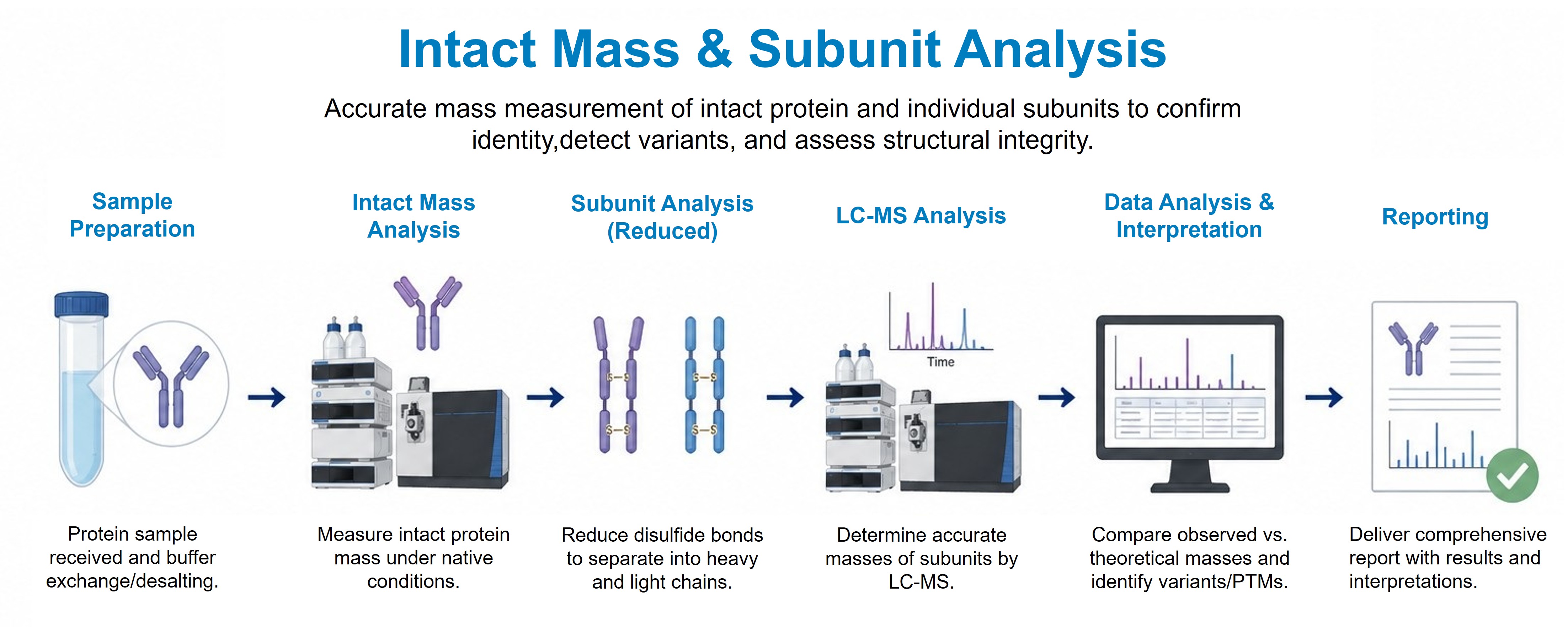
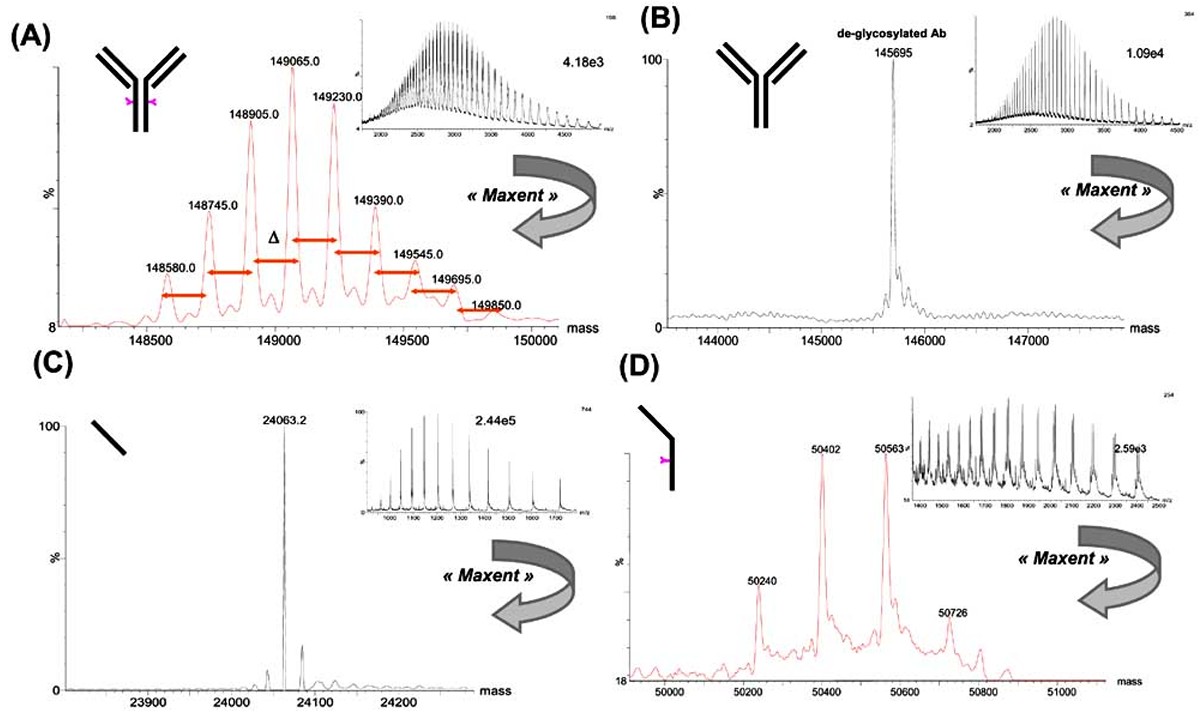 Figure 1. LC-ES-TOF mass spectrometry of (A) a recombinant intact IgG produced in NS0, (B) the same antibody submitted to PNGase F digestion, (C) the light chain and the heavy chain obtained after reduction, alkylation and chromatographic separation. (Beck et al., 2008)