We use cookies to understand how you use our site and to improve the overall user experience. This includes personalizing content and advertising. Read our
Privacy Policy
Protein degraders represent a transformative modality in drug discovery, enabling the selective elimination of disease-associated proteins rather than merely inhibiting their activity. By harnessing the endogenous ubiquitin–proteasome system, these bifunctional molecules—commonly referred to as proteolysis-targeting chimeras (PROTACs)—offer unique advantages in targeting "undruggable" proteins and overcoming resistance mechanisms associated with traditional small-molecule inhibitors.
At Profacgen, we provide a comprehensive, end-to-end protein degrader development platform, integrating rational design, chemical synthesis, biological evaluation, and translational optimization. Our services are tailored to support clients from early discovery through preclinical validation, delivering efficient, data-driven solutions for targeted protein degradation programs.
Background
The Concept of Protein Degraders
A protein degrader molecule is composed of two covalently interconnected ligands:
One ligand binds specifically to the target protein
The other recruits an E3 ubiquitin ligase
These are connected via a linker, typically consisting of 5–15 atoms (commonly carbon-based chains)
This bifunctional architecture enables proximity-induced ubiquitination of the target protein, marking it for degradation by the endogenous proteasome system.
Figure 1. Degradation pathway for proteolysis targeting chimeras. (Liu et al., 2020)
Mechanistic Advantages Over Traditional Inhibitors
Unlike conventional small-molecule inhibitors that block enzymatic activity or receptor binding, protein degraders function catalytically by eliminating the target protein entirely. This results in several key advantages:
Sustained pharmacological effect due to protein removal rather than transient inhibition
Lower required dosage owing to catalytic turnover
Ability to target non-enzymatic or scaffold proteins, traditionally considered "undruggable"
Potential to overcome drug resistance caused by protein overexpression or mutation
Importantly, protein degraders may exhibit favorable absorption, distribution, metabolism, and elimination (ADME) properties and do not necessarily interfere with normal cellular proliferation pathways in the same way as classical inhibitors.
Challenges in Protein Degrader Development
Despite their promise, protein degraders present unique development challenges:
Need for extensive in vitro and in vivo validation, including toxicity, pharmacokinetics, and efficacy
As a result, successful development requires integrated expertise across medicinal chemistry, structural biology, cell biology, and pharmacology.
Our Service Offerings
At Profacgen, we offer a one-stop solution for protein degrader development, supported by a robust and scalable platform. Our services span the full lifecycle of degrader discovery and optimization.
Rational Design of Protein Degraders
Target selection and validation support
Identification of suitable binding ligands for target proteins
Integrated and Comprehensive Platform: We provide a fully integrated platform combining chemistry, biology, and pharmacology, enabling seamless project execution without fragmentation.
Expert Scientific Team: Our multidisciplinary team includes experts in medicinal chemistry, protein biology, and drug development, ensuring scientifically rigorous and innovative solutions.
Customized Project Design: Each project is tailored based on target biology, client objectives, and downstream application, ensuring optimal outcomes.
Robust and Diverse Assay Systems: We employ multiple complementary analytical methods to ensure accurate and reproducible evaluation of degrader performance.
Cost-Effective Solutions: We offer competitive pricing without compromising quality, maximizing value for our clients.
Close Client Collaboration: We work closely with clients throughout the project lifecycle, ensuring transparency, flexibility, and alignment with project goals.
Representative Case Studies
Case 1: Degradation of a Difficult Oncology Target
Challenge:
A client sought to target a non-enzymatic scaffold protein implicated in tumor progression. Traditional inhibitors had failed due to the absence of a catalytic site, rendering conventional drug discovery approaches ineffective for this oncology target.
Approach:
Profacgen first identified a weak-binding ligand for the target protein to serve as a warhead. A series of proteolysis-targeting chimera (PROTAC) degraders were designed using a CRBN-recruiting ligand, with systematic optimization of linker length, composition, and attachment geometry to achieve optimal ternary complex formation.
Outcome:
Achieved over 85% target degradation in cancer cell lines with potent and selective activity. The lead candidate demonstrated significant inhibition of tumor cell proliferation and favorable preliminary pharmacokinetic properties, advancing a viable therapeutic strategy for this previously undruggable target.
Case 2: Overcoming Drug Resistance via Target Degradation
Challenge:
A kinase inhibitor program encountered resistance due to acquired point mutations in the target protein, rendering existing therapies ineffective and limiting treatment options for patients.
Approach:
Profacgen designed novel degraders capable of binding both wild-type and clinically relevant mutant variants of the target kinase. Degradation efficiency was evaluated across multiple cell models, including isogenic lines expressing resistance mutations, to assess potency and selectivity.
Outcome:
Successfully degraded both wild-type and resistant mutant proteins, effectively circumventing mutation-driven resistance. Degrader treatment restored therapeutic efficacy in resistant cell lines where conventional inhibitors had failed, providing a promising strategy to overcome this critical drug resistance mechanism.
Q: What types of targets are suitable for protein degrader development?
A: Protein degraders are particularly effective for proteins that are difficult to inhibit through traditional approaches, including transcription factors, scaffold proteins, and non-enzymatic regulator
Q: Which E3 ligases do you support?
A: We support a wide range of E3 ligases, including CRBN, VHL, MDM2, and IAP, and can evaluate the most suitable ligase for your specific target.
Q: How do you confirm that degradation is proteasome-dependent?
A: We use multiple validation approaches, including proteasome inhibitors, ubiquitination assays, and pathway-specific analyses to confirm mechanism of action.
Q: Can you support early-stage discovery as well as advanced programs?
A: Yes, our platform supports projects from initial concept through preclinical development.
Q: How do you address cell-type variability in degrader activity?
A: We evaluate degrader performance across multiple cell lines and conditions to ensure robust and translatable results.
Q: What is the typical timeline for a degrader development project?
A: Timelines vary depending on project scope, but initial hit identification and validation can typically be achieved within a few months.
References:
Liu X, Zhang X, Lv D, Yuan Y, Zheng G, Zhou D. Assays and technologies for developing proteolysis targeting chimera degraders. Future Med Chem. 2020;12(12):1155-1179. doi:10.4155/fmc-2020-0073
Online Inquiry
Fill out this form and one of our experts will respond to you within one business day.

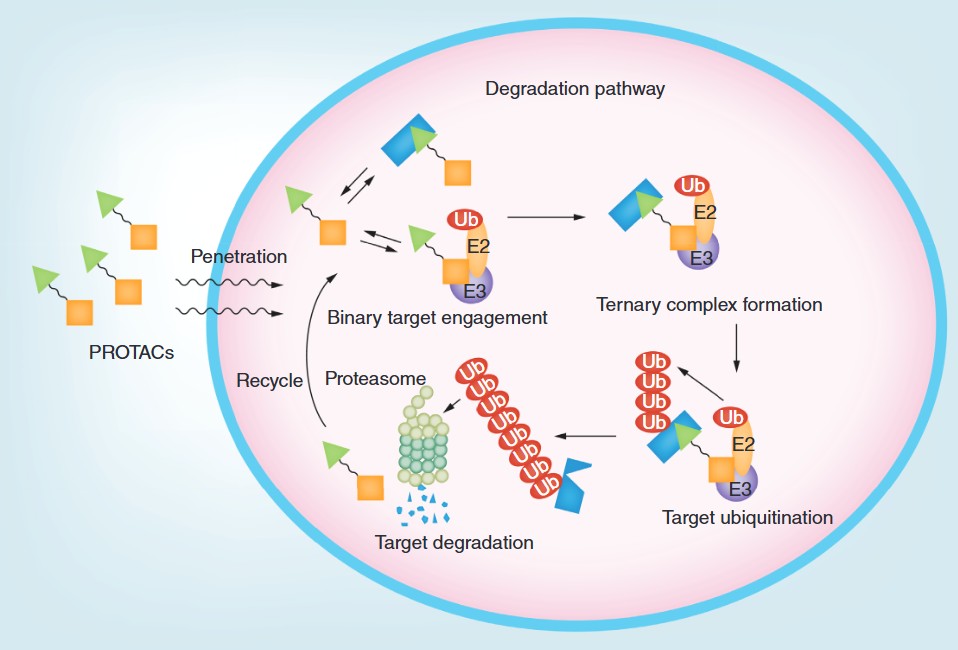 Figure 1. Degradation pathway for proteolysis targeting chimeras. (Liu et al., 2020)