We use cookies to understand how you use our site and to improve the overall user experience. This includes personalizing content and advertising. Read our
Privacy Policy
Protein aggregates and fragments are among the most critical product-related impurities in biopharmaceutical development. These species can compromise therapeutic efficacy, alter pharmacokinetic profiles, and—most importantly—trigger unwanted immunogenicity or adverse safety events. Under ICH Q6B and ICH Q5C, sponsors must demonstrate robust control over soluble and subvisible aggregates, as well as clipped or reduced fragments, from early process development through commercial release.
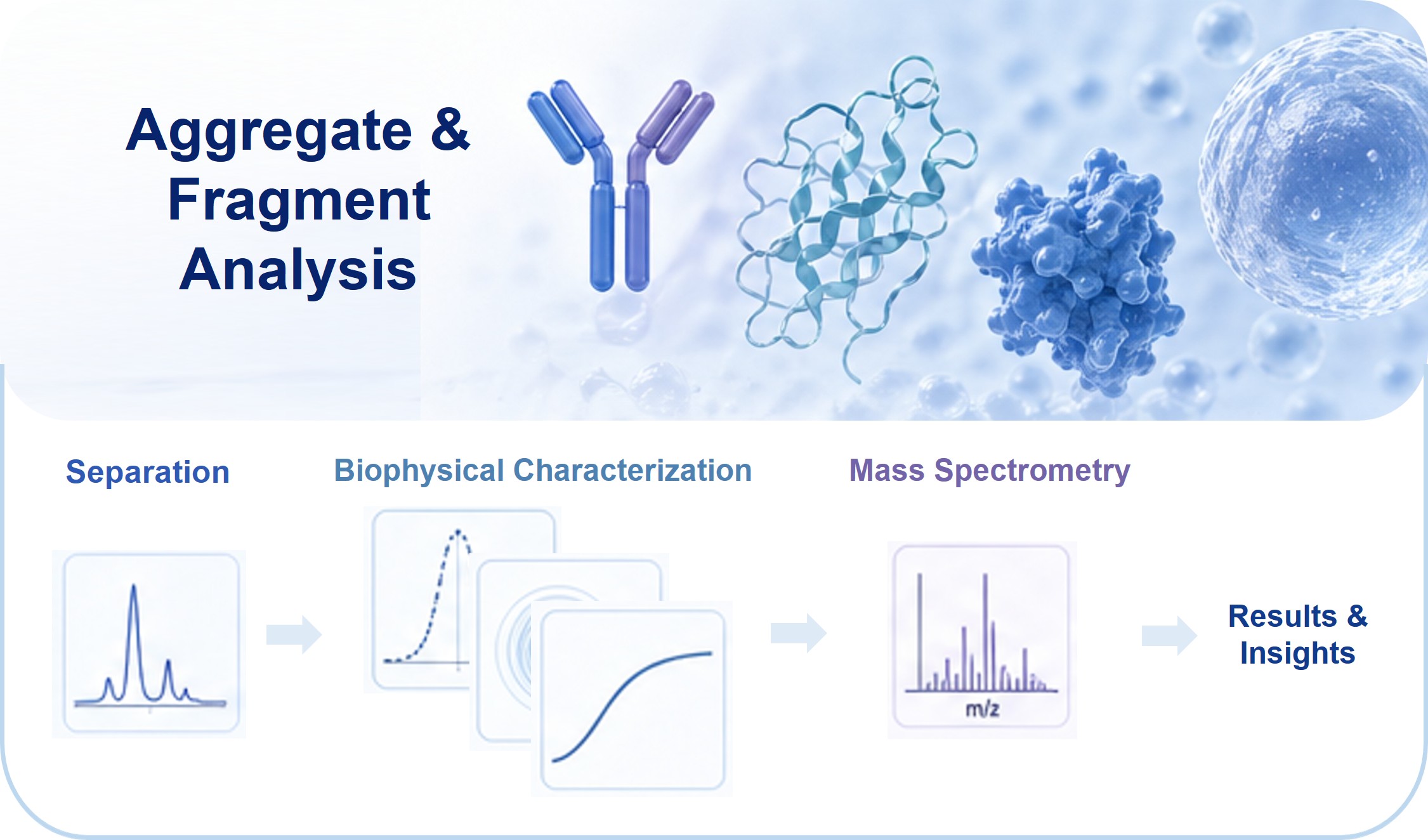
At Profacgen, our Aggregate & Fragment Analysis platform delivers a comprehensive, phase-appropriate analytical strategy combining high-resolution separation science, biophysical characterization, and mass spectrometry to quantify, identify, and monitor these impurities with regulatory-grade rigor. Whether you are developing monoclonal antibodies, antibody-drug conjugates (ADCs), or viral vector-based gene therapies, our integrated approach will ensure that its quality profile meets the expectations of regulatory agencies.
Background: What Challenges Do We Solve?
Biologics are inherently susceptible to physical and chemical degradation pathways that generate aggregates and fragments. Aggregates—ranging from reversible oligomers to irreversible subvisible and visible particles—pose immunogenicity risks and are subject to tightening regulatory scrutiny. Fragments, including free light chains, heavy chains, and hinge-region clips, can reduce potency and complicate purity calculations. Profacgen addresses the full spectrum of analytical and regulatory challenges associated with these product-related impurities:
Immunogenicity Risk Assessment: Subvisible and soluble aggregates are correlated with immune responses in preclinical and clinical settings; regulators expect quantitative data linking aggregate levels to patient safety
Method Selection & Orthogonal Validation: No single technique captures all aggregate or fragment species; SEC-HPLC misses reversible oligomers, while CE-SDS cannot detect non-covalent aggregates—orthogonal method design is essential
Low-Abundance Fragment Detection: Minor clipped species (e.g., 0.1–1.0% pre-peaks in CE-SDS) can be clinically relevant for high-dose therapeutics, requiring high-sensitivity detection and accurate quantification
Forced Degradation & Stability Indication: ICH Q1A(R2) and Q5C stress studies require methods that can resolve and track aggregate and fragment formation under thermal, oxidative, acidic, and photolytic stress conditions
Complex Biologic Architectures: ADCs, bispecific antibodies, and viral vectors introduce unique aggregate/fragment profiles (e.g., drug-load-dependent aggregation, AAV empty capsids versus full aggregates) that demand customized analytical strategies
Regulatory Specification Justification: Setting clinically relevant acceptance criteria for aggregates and fragments requires statistical trending, clinical batch correlation, and toxicological qualification—documentation that Profacgen structures for CTD Module 3 inclusion
Our Core Platforms
Profacgen deploys a suite of orthogonal analytical platforms to characterize aggregates and fragments across the full size range—from small peptide clips to subvisible particulates. Each method is developed, qualified, or validated according to ICH Q2(R1) principles and tailored to your molecule’s structural class and development phase.
Analytical Platform
Capabilities & Deliverables
SEC-HPLC / SEC-MALS
Size-exclusion chromatography with UV, RI, or multi-angle light scattering (MALS) detection for soluble aggregate quantification (high-molecular-weight species, HMWS) and molar mass determination
Method development and ICH Q2(R1) validation for release testing and stability monitoring
Detection of reversible and irreversible oligomers, dimer/trimer quantification, and hydrodynamic radius estimation
CE-SDS (Reduced & Non-Reduced)
Capillary electrophoresis with SDS for high-resolution fragment profiling: free light chain, free heavy chain, half-antibody, and non-glycosylated heavy chain quantification
Reduced CE-SDS for subunit molecular weight confirmation and purity assessment
Non-reduced CE-SDS for intact molecule purity, clip detection, and disulfide-scramble assessment
Analytical Ultracentrifugation (AUC)
Sedimentation velocity (SV-AUC) and sedimentation equilibrium (SE-AUC) for aggregate detection without column-based matrix artifacts
Ideal for validating SEC-HPLC results and detecting reversible aggregates that dissociate upon column dilution
Stoichiometry and oligomeric state determination for complex biologics and viral vectors
Dynamic Light Scattering (DLS) & MALS
Bulk and online DLS for hydrodynamic radius, polydispersity index (PDI), and thermal stability screening (Tm onset of aggregation)
SEC-MALS coupling for absolute molar mass determination of monomer, dimer, and higher-order species independent of retention time calibration
Batch-mode MALS for submicron particle sizing in formulation development
Subvisible Particle Analysis
Micro-flow imaging (MFI) and light obscuration (LO) per USP <788> / USP <129> for particle counting in the 1–100 µm range
Particle morphology classification (proteinaceous vs. extrinsic) and root-cause investigation
Correlation of subvisible particle counts with aggregate formation kinetics under accelerated stability conditions
Mass Spectrometry (Intact & Subunit)
Native MS and subunit analysis (IdeS or DTT reduction followed by LC-MS) for exact mass confirmation of intact and fragmented species
Peptide mapping with high-resolution MS/MS to localize cleavage sites (e.g., hinge clipping, C-terminal lysine truncation, deamidation adjacent to labile bonds)
Quantitative mass spectrometry for low-abundance fragment species below CE-SDS detection limits
Orthogonal Method Portfolio: SEC-HPLC, CE-SDS, AUC, DLS/MALS, MFI/LO, and mass spectrometry are all available under one program, ensuring cross-validation and consistent data interpretation across techniques.
Phase-Appropriate Validation: We design methods and validation protocols aligned to ICH Q2(R1) and FDA “Analytical Procedures and Methods Validation for Drugs and Biologics” guidance, progressing from method qualification (Phase I) to full validation (Phase III/BLA).
Regulatory-Ready Documentation: All deliverables—including method development reports, validation protocols, stability data packages, and specification justifications—are formatted for direct integration into CTD Module 3.2.S.4 and 3.2.P.5.
Complex Molecule Expertise: Our scientists specialize in challenging modalities including bispecifics, Fc-fusion proteins, ADCs, and viral vectors, where standard mAb platforms often require significant adaptation.
Forced Degradation & Stability Indication: We conduct comprehensive stress studies (thermal, oxidative, photolytic, pH) to demonstrate that your methods are stability-indicating and capable of resolving all relevant degradation products.
Fast Turnaround & Scalable Support: From expedited method development for critical-path IND submissions to long-term stability monitoring and batch-release testing, our service model scales with your program from preclinical development through commercial manufacturing.
Representative Case Studies
Case 1: Monoclonal Antibody & Biosimilar Development
Challenge:
During upstream and downstream process development, mAbs are exposed to shear stress, pH shifts, and temperature excursions that promote aggregation and fragmentation. For biosimilars, the innovator’s aggregate and fragment profile sets the analytical similarity benchmark; even minor deviations can trigger regulatory questions regarding immunogenicity risk and structural equivalence.
Our Approach:
We establish an orthogonal aggregate and fragment monitoring panel comprising SEC-HPLC (soluble HMWS), non-reduced CE-SDS (intact purity and clips), reduced CE-SDS (subunit distribution), and AUC for reversible aggregate confirmation. Forced degradation studies under ICH Q1A(R2) conditions define method stability indication and guide formulation optimization. Stability protocols are designed to generate statistically robust trending data for specification setting.
Outcome:
Clients receive a fully validated analytical package with phase-appropriate qualification, enabling real-time release testing, stability protocol design, and regulatory submissions that demonstrate consistent control over product-related impurities from clinical batches through process performance qualification (PPQ).
Case 2: Antibody-Drug Conjugate (ADC) Characterization
Challenge:
ADCs combine the complexity of monoclonal antibodies with hydrophobic small-molecule cytotoxic payloads, creating unique aggregation and fragmentation pathways. Drug-to-antibody ratio (DAR) heterogeneity, linker instability, and payload-induced hydrophobicity can drive non-native aggregation and payload-related clip formation that are not observed in the naked antibody.
Our Approach:
We adapt SEC-HPLC and SEC-MALS conditions to resolve drug-load-dependent aggregate populations (e.g., DAR8-rich dimers versus DAR0 monomers). Non-reduced CE-SDS is optimized to separate clipped ADC species from intact conjugates, while reduced CE-SDS confirms light-chain and heavy-chain payload distribution. Hydrophobic interaction chromatography (HIC) is deployed orthogonally to correlate DAR with aggregation propensity.
Outcome:
Profacgen delivers an ADC-specific impurity profile linking drug load to aggregate formation, enabling clients to optimize conjugation chemistry, refine formulation buffers, and present a comprehensive CMC package that satisfies regulatory agencies expectations for complex bioconjugates.
Q: What is the difference between aggregates and fragments in biopharmaceutical analysis?
A: Aggregates are higher-order multimers formed by non-covalent or covalent association of intact protein molecules (dimers, trimers, subvisible particles). Fragments are lower-molecular-weight species generated by chemical or enzymatic cleavage of the primary sequence (e.g., free light chain, clipped heavy chain). Both are classified as product-related impurities under ICH Q6B and must be controlled to ensure safety and efficacy.
Q: Why is orthogonal testing necessary for aggregate and fragment analysis?
A: No single analytical method captures all species. SEC-HPLC may miss reversible aggregates that dissociate upon dilution, while CE-SDS cannot detect non-covalent oligomers. AUC, DLS, and MALS provide complementary biophysical data. Regulators expect orthogonal confirmation to ensure that no significant impurity population is overlooked during release or stability assessment.
Q: What regulatory guidelines apply to aggregate and fragment control?
A: ICH Q6B specifies the need to characterize and quantify product-related impurities including aggregates and fragments. ICH Q5C addresses stability testing for biotechnological products. USP <129> provides analytical procedures for subvisible particles, while FDA and EMA guidance documents emphasize the immunogenicity risk of aggregates and the importance of stability-indicating methods.
Q: Can Profacgen detect low-abundance fragments below 0.5%?
A: Yes. Our optimized CE-SDS methods achieve quantification limits at or below 0.1% for major subunit fragments. For trace-level species, we employ high-resolution mass spectrometry (native MS or subunit analysis) to detect and identify fragments that fall below the sensitivity threshold of electrophoretic methods, ensuring comprehensive impurity coverage.
Q: What sample quantities are required for method development and validation?
A: For SEC-HPLC and CE-SDS method development, 1–5 mg of purified protein is typically sufficient. AUC and MALS require higher concentrations (5–10 mg/mL) but smaller total volumes. Subvisible particle analysis (MFI/LO) requires 0.2–1.0 mL per test. We optimize sample preparation protocols to minimize consumption during method development and validation.
Q: How does forced degradation support aggregate and fragment method development?
A: Forced degradation studies under ICH Q1A(R2) conditions (heat, acid, base, oxidation, light) generate representative aggregates and fragments, allowing us to confirm that methods are stability-indicating—meaning they can resolve, detect, and quantify all relevant degradation products. This is a regulatory expectation for release and stability methods in both IND and BLA submissions.
Q: What is the typical timeline for an aggregate and fragment analysis project?
A: Method development for SEC-HPLC and CE-SDS typically requires 3–5 weeks. AUC or MALS method setup adds 2–3 weeks. Full ICH Q2(R1) validation requires an additional 4–6 weeks. Integrated programs with parallel workstreams can deliver a complete orthogonal package in 8–10 weeks, with expedited timelines available for critical-path submissions.
Online Inquiry
Fill out this form and one of our experts will respond to you within one business day.