We use cookies to understand how you use our site and to improve the overall user experience. This includes personalizing content and advertising. Read our
Privacy Policy
Profacgen's Method Development and Optimization service provides systematic, science-driven analytical procedure development for biopharmaceutical proteins, with emphasis on robustness, regulatory defensibility, and alignment with downstream validation and lifecycle management requirements. Our development programs incorporate quality by design principles to ensure that methods are fit-for-purpose from inception, reducing the risk of validation failure and regulatory query.
The quality of analytical data in biopharmaceutical development is fundamentally constrained by the quality of the underlying analytical methods. Methods developed without systematic parameter evaluation, robustness assessment, and design space definition frequently fail during validation, produce unreliable data during routine use, or require costly remediation to address regulatory feedback. Profacgen's development approach addresses these risks through structured methodology that transforms analytical development from empirical trial-and-error into a predictable, knowledge-driven discipline.
Why Method Development and Optimization Matters
Figure 1. Response surface plot of experimental design. (Peričin et al., 2009)
Biopharmaceutical analytical methods must satisfy multiple, often competing requirements: they must resolve complex molecular heterogeneity, quantify low-abundance impurities, maintain precision across varying sample matrices, and withstand the scrutiny of regulatory review. Meeting these requirements demands more than technical proficiency in chromatography, electrophoresis, or spectroscopy—it requires systematic understanding of how method parameters interact to influence analytical performance.
Poorly developed methods manifest their deficiencies at the most consequential stages of development: during validation, when acceptance criteria cannot be met; during regulatory review, when reviewers question method robustness; or during commercial manufacturing, when method drift causes release delays or out-of-specification investigations. The cost of method remediation at these late stages far exceeds the investment required for rigorous development.
Key value drivers include:
Systematic parameter evaluation that identifies robust operating conditions and critical method attributes
Design space establishment that defines proven acceptable ranges and supports post-approval method flexibility
Forced degradation integration that ensures stability-indicating capability from the development phase
Regulatory-forward documentation that anticipates reviewer expectations and reduces query risk
Platform method strategies that leverage prior knowledge across product portfolios
These priorities ensure that analytical methods are developed as strategic assets rather than operational afterthoughts.
Core Capabilities of Method Development and Optimization
Profacgen provides a structured, quality-oriented Method Development and Optimization service that aligns analytical procedure design with application requirements, regulatory expectations, and lifecycle management principles.
Analytical Target Profile Definition
Structured definition of method requirements based on quality target product profile (QTPP), critical quality attributes (CQAs), and intended use. This includes:
Identification of the quality attribute to be measured and its regulatory significance
Definition of required performance characteristics (specificity, precision, range, sensitivity)
Assessment of sample matrix complexity and potential interferences
Alignment with downstream validation strategy and lifecycle management plans
The ATP serves as the design blueprint against which method performance is evaluated throughout development and validation.
Method Parameter Screening and Optimization
Systematic evaluation of method parameters using design of experiments (DoE) and one-factor-at-a-time (OFAT) approaches to identify optimal conditions and critical parameters. Capabilities include:
Factorial and response surface designs for multi-parameter optimization
Detection parameter tuning (wavelength, gain, acquisition rate) for sensitivity and linearity
Parameter screening is guided by mechanistic understanding of separation science, ensuring efficient experimental design and actionable results.
Robustness Evaluation and Design Space Establishment
Assessment of method performance under deliberate parameter variation to establish the method design space and identify critical method attributes. This includes:
Robustness testing with fractional factorial designs varying method parameters within defined ranges
Response modeling to define parameter interactions and their effects on critical quality responses
Design space delineation with proven acceptable ranges and normal operating ranges
Edge of failure identification to understand method boundaries and failure modes
Robustness data support regulatory flexibility claims and reduce the risk of method failure during routine use or transfer.
Stability-Indicating Method Development
Integration of forced degradation studies during method development to ensure that methods can detect and resolve degradation products relevant to product stability. This includes:
Forced degradation sample generation under thermal, oxidative, pH, and photolytic stress
Method specificity evaluation with stressed samples to confirm degradation product resolution
Peak purity assessment and mass balance evaluation
Degradation product identification to guide method sensitivity and selectivity optimization
Stability-indicating capability is demonstrated during development rather than discovered during validation, reducing timeline risk and validation failure.
Method Development Platforms
Profacgen develops and optimizes analytical methods across the full range of biopharmaceutical analytical platforms:
High-performance liquid chromatography (HPLC): SEC, RP, IEX, and HIC methods for purity, charge heterogeneity, and size variant analysis, with development focusing on column selection, mobile phase optimization, and gradient design
Capillary electrophoresis (CE): CE-SDS and cIEF methods for molecular weight and isoelectric point profiling, with optimization of buffer systems, coating chemistries, and separation conditions
Mass spectrometry (MS): intact mass, peptide mapping, and glycan analysis by LC-MS/MS, with method development addressing ionization efficiency, fragmentation optimization, and data acquisition parameters
Biological assays: cell-based potency, binding, and functional assays with development of cell culture conditions, assay format, and statistical models for relative potency determination
Physicochemical methods: DLS, DSC, CD, and FTIR for aggregation, thermal stability, and structural assessment, with optimization of measurement conditions and data interpretation algorithms
Quality by Design Integration: Method development follows ICH Q14 principles with analytical target profile definition, systematic parameter evaluation, and design space establishment, producing methods that are inherently robust and regulatorily defensible.
DoE-Driven Efficiency: Design of experiments approaches reduce the number of experimental runs required for optimization while maximizing information content, accelerating development timelines without compromising thoroughness.
Stability-Indicating Focus: Forced degradation integration during development ensures that methods are stability-indicating from inception, eliminating the validation-phase surprises that delay programs and inflate costs.
Platform Method Leverage: Experience across product classes enables application of platform method strategies that reduce development time for follow-on programs while maintaining regulatory compliance and performance standards.
Lifecycle-Ready Documentation: Development reports capture method understanding, parameter rationale, and design space justification in formats that support direct validation, transfer, and regulatory submission without retrospective documentation.
Cross-Platform Expertise: Integrated capabilities across chromatographic, electrophoretic, mass spectrometric, biological, and physicochemical methods enable holistic method portfolio development with consistent quality and documentation standards.
Representative Program Scenarios
Scenario 1: SEC Method Development for Aggregation Monitoring
Program Context:
A therapeutic antibody program required a size exclusion chromatography method capable of resolving high-molecular-weight aggregates, monomer, and low-molecular-weight fragments with sufficient precision to support release testing and stability monitoring. Existing exploratory methods lacked resolution between aggregate species and demonstrated unacceptable precision for regulatory compliance.
Objective:
To develop a robust SEC method with validated-ready performance characteristics, including baseline resolution of aggregate species, precision suitable for release testing, and stability-indicating capability.
Approach:
Profacgen initiated analytical target profile definition with specification-aligned acceptance criteria for resolution, precision, and linearity. Column screening evaluated five SEC columns with varying pore sizes and chemistries, with a diol-based column selected for optimal aggregate resolution. Mobile phase optimization employed a central composite design varying buffer concentration, pH, and ionic strength, with aggregate resolution and monomer peak symmetry as response variables. A design space was established with proven acceptable ranges for all critical parameters. Robustness was confirmed with deliberate parameter variation. Forced degradation samples were analyzed to verify stability-indicating capability.
Outcome:
The developed method achieved baseline resolution of dimer, trimer, and higher-order aggregates with repeatability RSD below 1.0%. The method transitioned seamlessly into validation with zero protocol deviations and was subsequently approved for release testing and stability monitoring.
Scenario 2: Cell-Based Potency Assay Development
Program Context:
A biopharmaceutical program required a cell-based potency assay for a receptor-targeting therapeutic protein. The assay needed to demonstrate specificity for the therapeutic mechanism, sufficient precision for release testing, and parallelism for relative potency determination against a reference standard.
Objective:
To develop and optimize a cell-based potency assay with performance characteristics suitable for phase-appropriate validation and subsequent GMP release testing.
Approach:
Profacgen evaluated three cell line options and selected a reporter gene cell line with optimal signal-to-noise and response linearity. Assay format optimization employed factorial design varying cell density, incubation time, and detection reagent concentration. A four-parameter logistic model was established for dose-response curve fitting with parallelism testing. Reference standard stability and assay control strategies were defined. Intermediate precision was evaluated across three analysts and three days. The method was challenged with stressed samples to confirm specificity.
Outcome:
The optimized assay demonstrated relative potency precision of 4.2% RSD with robust parallelism across sample concentrations. The assay was qualified for Phase I release testing and advanced into full validation for Phase III and commercial support.
Q: How does analytical target profile (ATP) definition guide method development?
A: The ATP defines the intended purpose, required performance characteristics, and acceptance criteria for an analytical method before development begins. It links method requirements to critical quality attributes and regulatory expectations, ensuring that development efforts are focused on achieving fit-for-purpose performance rather than optimizing irrelevant parameters. The ATP serves as the benchmark against which method performance is evaluated throughout development, validation, and lifecycle management.
Q: What is the role of design of experiments (DoE) in method optimization?
A: DoE enables efficient, systematic evaluation of multiple method parameters and their interactions using structured experimental matrices. Compared to one-factor-at-a-time approaches, DoE reduces the total number of experiments required while providing information on parameter interactions and response surfaces. This efficiency accelerates development timelines and produces more robust methods with defined design spaces and proven acceptable ranges.
Q: When should forced degradation studies be integrated into method development?
A: Forced degradation studies should be integrated during the specificity evaluation phase of method development, after initial method conditions have been established but before finalization. Early integration allows method parameters to be optimized for degradation product resolution and detection, ensuring stability-indicating capability from inception. This approach is more efficient than discovering specificity deficiencies during validation and retroactively modifying method conditions.
Q: What distinguishes development-grade methods from research-grade methods?
A: Research-grade methods are developed for exploratory purposes with minimal documentation and undefined performance boundaries. Development-grade methods are designed for regulatory compliance with systematic parameter evaluation, robustness assessment, predefined acceptance criteria, and comprehensive documentation. Development-grade methods are validation-ready and lifecycle-manageable, whereas research-grade methods typically require substantial redevelopment before validation.
Q: Can platform methods be applied across multiple products?
A: Yes. Platform methods leverage prior knowledge from method development across a product class to reduce development time and ensure regulatory consistency. Platform methods are established with defined method parameters, design spaces, and control strategies that are applicable to structurally similar products. Product-specific bridging studies demonstrate method applicability for each new product, significantly reducing development burden while maintaining performance standards.
Q: How is method development documentation structured for regulatory submission?
A: Method development documentation includes the analytical target profile, development study protocols and reports, parameter screening results, design space justification, robustness data, forced degradation specificity evidence, and method procedure. This documentation is structured to support validation protocol design, regulatory reviewer understanding, and post-approval change management. Profacgen prepares development reports in formats suitable for direct inclusion in IND, BLA, and NDA submissions.
References:
ICH Q14. Analytical Procedure Development. International Council for Harmonisation of Technical Requirements for Pharmaceuticals for Human Use; 2023.
ICH Q2(R1). Validation of Analytical Procedures: Text and Methodology. International Council for Harmonisation of Technical Requirements for Pharmaceuticals for Human Use; 2005.
United States Pharmacopeia. USP General Chapter <1220>: Analytical Procedure Lifecycle Management. United States Pharmacopeial Convention; current edition.
Peričin DM, Mađarev-Popović SZ, Radulović-Popović LM. Optimization of conditions for acid protease partitioning and purification in aqueous two-phase systems using response surface methodology. Biotechnol Lett. 2009;31(1):43-47. doi:10.1007/s10529-008-9830-2
Online Inquiry
Fill out this form and one of our experts will respond to you within one business day.


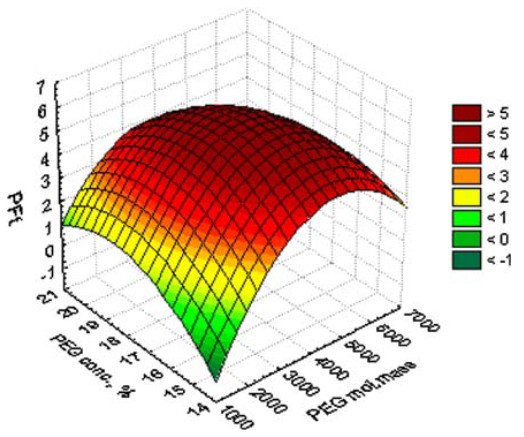 Figure 1. Response surface plot of experimental design. (Peričin et al., 2009)