Long-Term and Accelerated Stability Studies
Characterizing the stability of biopharmaceutical proteins under defined storage and stress conditions is fundamental to ensuring product quality, patient safety, and regulatory compliance throughout the product lifecycle. Long-term and accelerated stability studies provide the empirical foundation for shelf-life determination, storage condition specification, and degradation pathway understanding.
Profacgen provides integrated long-term and accelerated stability study services designed to generate regulatory-compliant data that support formulation development, process validation, and commercialization programs. Our studies are conducted with rigorous protocol design, validated analytical methods, and comprehensive documentation to meet the expectations of global regulatory agencies.
Scientific Background: Stability Study Design Principles
Stability study design is governed by ICH Q1A(R2) guidelines and complementary regulatory frameworks, which establish the scientific and procedural requirements for evaluating how drug substance and drug product quality attributes change over time under the influence of environmental factors. These principles apply directly to biopharmaceutical proteins, where structural complexity and sensitivity to physical and chemical stress necessitate careful study planning.
Three core study types form the basis of regulatory stability programs:
- Long-term stability studies: Conducted under intended storage conditions to establish the retest period or shelf life
- Accelerated stability studies: Conducted under elevated stress conditions to identify degradation trends and support provisional shelf-life claims
- Stress testing: Conducted under more severe conditions to elucidate degradation pathways and evaluate intrinsic stability
Long-term studies typically span the proposed shelf life plus an appropriate extension, with testing intervals designed to capture degradation kinetics. Accelerated studies are conducted at elevated temperature (e.g., 25°C/60% RH or 30°C/75% RH for biologics) over shorter durations to provide early indicators of stability performance. The relationship between long-term and accelerated data is critical for extrapolation, risk assessment, and regulatory decision-making.
For biopharmaceutical proteins, stability-indicating analytical methods must be capable of detecting changes in potency, purity, aggregation, charge heterogeneity, and higher-order structure. Method selection and validation are therefore integral to study integrity and regulatory acceptance.
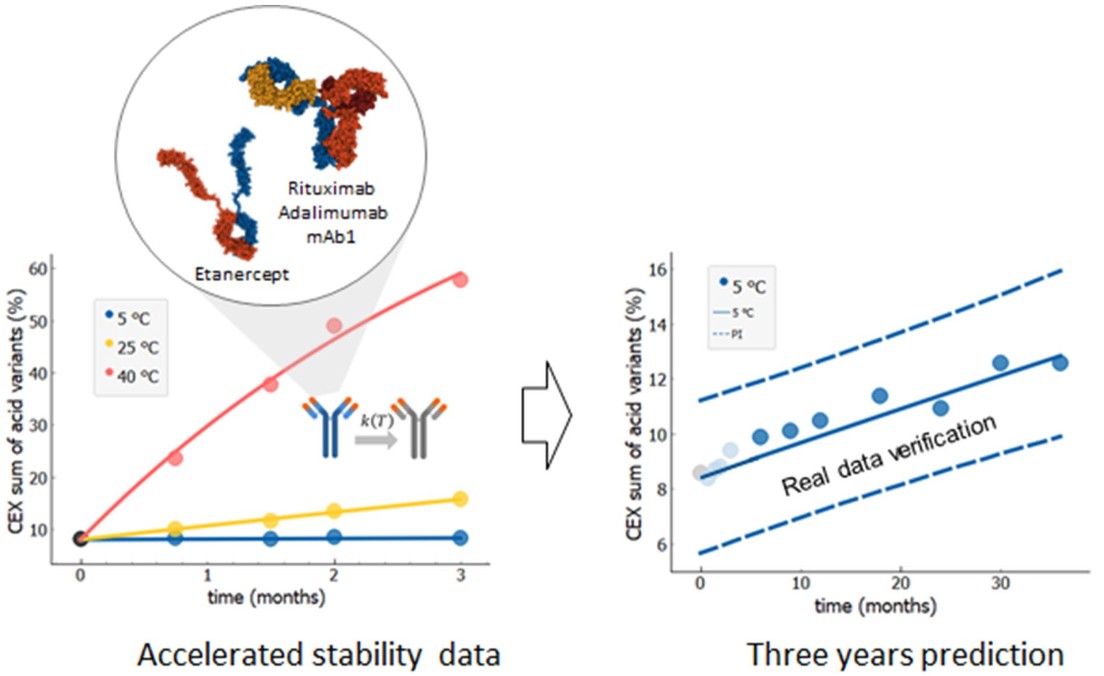 Figure 1. Long-term (36 months) stability prediction based on accelerated stability data (3 months) and kinetic modelling which included Arrhenius temperature dependence of kinetic rates. Accelerated stability data (left, data points) are used to develop the kinetic model (left, full lines) to predict long-term stability at intendent storage conditions (right). (Kuzman et al., 2021)
While regulatory guidelines provide the structural framework, successful stability programs require protein-specific customization. Factors such as molecular class (monoclonal antibodies, fusion proteins, enzymes), formulation composition, container-closure system, and intended storage and distribution conditions all influence study design, testing frequency, and analytical strategy.
Role of Stability Studies in Regulatory and Commercial Programs
Long-term and accelerated stability data support multiple critical decisions across the product lifecycle:
- Establishment of retest periods for drug substance and shelf life for drug product
- Definition of labeled storage conditions and handling instructions
- Support for post-approval changes in manufacturing, formulation, or packaging
- Justification of transport and distribution strategies, including temperature excursions
- Biocomparability assessments following process or formulation modifications
- Regulatory submission packages for IND, BLA, NDA, and marketing authorization applications
By generating stability data in alignment with regulatory expectations from the earliest development stages, clients can reduce program risk, avoid costly delays, and ensure that stability information remains valid and transferable across development phases.
Stability Analysis Services Offered
Our long-term and accelerated stability study services include, but are not limited to:
- Protocol design and regulatory consultation to align study parameters with ICH guidelines, regional regulatory requirements, and program-specific objectives
- Long-term stability program execution under ICH-compliant storage conditions with scheduled pull points and comprehensive analytical testing
- Accelerated stability studies at elevated temperature and humidity to support early shelf-life estimation and formulation ranking
- Forced degradation and stress testing under thermal, photolytic, oxidative, and pH stress to elucidate degradation mechanisms and validate stability-indicating methods
- Stability-indicating analytical method development and validation for potency, purity, aggregation, charge variants, and structural integrity assessment
- Data analysis, trend evaluation, and statistical modeling to support shelf-life determination and regulatory justification
- Comprehensive documentation and reporting in formats suitable for regulatory submission, quality systems, and internal decision-making
Each study is designed with consideration for the specific protein, formulation, container-closure system, and regulatory pathway, rather than applied as a standardized protocol.
Study Types and Conditions
Profacgen conducts stability studies across a range of conditions tailored to program requirements:
- ICH Q1A(R2) long-term conditions: Typically 2–8°C for refrigerated biologics, with appropriate humidity control where relevant
- Accelerated conditions: 25°C/60% RH or 30°C/75% RH for specified durations to support provisional shelf-life claims
- Stress testing: Elevated temperature (e.g., 40°C/75% RH), freeze-thaw cycles, agitation, and light exposure to evaluate robustness
- In-use stability studies: Simulation of clinical or commercial handling conditions, including reconstitution, dilution, and administration
- Transport and distribution stability: Evaluation of temperature excursion tolerance and shipping simulation
- Orthogonal analytical testing panels: Combining chromatographic, spectroscopic, and functional assays for comprehensive characterization
Study design is guided by regulatory expectations, scientific rationale, and practical development needs, with flexibility to accommodate program-specific requirements.
Data Integration, Trend Analysis, and Regulatory Support
Stability data achieve maximum value when interpreted within the broader development and regulatory context. Profacgen integrates stability findings with:
- Analytical characterization and method validation data
- Formulation and process development parameters
- Manufacturing scale-up and technology transfer documentation
- Quality target product profile (QTPP) and critical quality attribute (CQA) definitions
Data are analyzed for trends, rate constants, and activation energies where applicable, with statistical approaches applied to support shelf-life extrapolation. Results are summarized in comprehensive reports suitable for regulatory submission, internal quality review, and cross-functional program discussion.
Inquiry
Why Choose Profacgen for Stability Studies
- Deep expertise in ICH Q1A(R2) and regional regulatory stability requirements for biologics.
- Experience across development stages, from preclinical formulation screening to commercial GMP stability programs.
- Access to validated stability chambers, advanced analytical instrumentation, and GMP-aligned quality systems.
- Integrated protocol design that links stability data to formulation, process, and regulatory strategies.
- Comprehensive documentation and reporting packages prepared for direct regulatory submission.
- Alignment with GMP Stability Programs and quality frameworks, with full traceability and audit readiness.
Our goal is not only to execute stability studies, but to ensure that generated data are scientifically robust, regulatory compliant, and strategically valuable across the product lifecycle.
Representative Program Scenarios
Scenario 1: Long-Term Stability Program for Phase III Clinical Supply
Program Context:
A biopharmaceutical company advancing a monoclonal antibody therapeutic into Phase III clinical trials required a comprehensive long-term stability program to support the planned shelf-life claim and upcoming BLA submission. The program needed to demonstrate stability performance under intended storage conditions with data integrity suitable for regulatory review.
Objective:
To design and execute a long-term stability study under ICH-compliant conditions, with accelerated data to support provisional shelf-life claims, and to generate a complete regulatory documentation package.
Approach:
Profacgen developed a stability protocol aligned with ICH Q1A(R2) and FDA/EMA expectations, incorporating drug substance and drug product testing at defined intervals. A panel of stability-indicating methods was validated for potency (cell-based assay), purity (SEC-HPLC, CE-SDS), charge heterogeneity (icIEF), aggregation (SEC-MALS), and higher-order structure (CD spectroscopy). Accelerated studies at 25°C/60% RH were conducted in parallel to support early shelf-life estimation.
Outcome:
The long-term data supported a 24-month shelf-life claim at 2–8°C, with accelerated data providing confidence in degradation kinetics and supporting the regulatory justification. The comprehensive report package was integrated directly into the BLA submission, contributing to a successful regulatory review.
Scenario 2: Accelerated Stability Screening for Formulation Selection
Program Context:
An early-stage biopharmaceutical program was evaluating multiple formulation candidates for a therapeutic fusion protein with documented aggregation susceptibility. The development team required rapid, data-driven formulation ranking to advance the most stable candidate into process development and IND-enabling studies.
Objective:
To conduct accelerated stability screening across formulation variables (buffer, pH, excipient composition) to identify conditions that minimized aggregation and preserved structural integrity under stress.
Approach:
Profacgen designed a comparative accelerated stability study at 30°C/75% RH over 12 weeks, with analytical testing focused on aggregation kinetics (SEC-HPLC, DLS), conformational stability (DSC, CD), and chemical degradation (peptide mapping, mass spectrometry). Formulations were ranked based on integrated stability performance, with statistical analysis applied to differentiate candidates.
Outcome:
The accelerated data enabled clear differentiation between formulation candidates, identifying a lead formulation with significantly improved thermal stability and reduced aggregation propensity. The selected formulation advanced into process development with confidence, and the stability data supported the IND submission rationale.
Request a Consultation
Frequently Asked Questions (FAQs)
Q: What regulatory guidelines govern long-term and accelerated stability studies for biologics?
A: Long-term and accelerated stability studies for biopharmaceutical proteins are primarily governed by ICH Q1A(R2) (Stability Testing of New Drug Substances and Products), with additional guidance from ICH Q5C (Stability Testing of Biotechnological/Biological Products), FDA guidance documents, and EMA reflection papers. Regional regulatory agencies may have specific requirements that influence study design, testing frequency, and documentation standards.
Q: How long must long-term stability studies continue for a commercial biologic?
A: Long-term stability studies must continue through the proposed shelf life plus an appropriate extension, typically covering the duration of the regulatory submission and post-approval commitment period. For biologics with a 24-month shelf life, studies would continue for at least 24 months at the intended storage condition, with data available at defined intervals (e.g., 0, 3, 6, 9, 12, 18, 24 months). Ongoing annual stability programs are required post-approval.
Q: Can accelerated stability data replace long-term data for regulatory submissions?
A: Accelerated stability data cannot fully replace long-term data for establishing shelf life, but it serves as a valuable complement. Under ICH Q1E, accelerated data may support shelf-life extrapolation beyond the available long-term data, subject to statistical justification and demonstration of linear degradation kinetics. For biologics, regulatory agencies generally require substantial long-term data, with accelerated data used to support provisional claims and provide early stability indicators.
Q: What analytical methods are typically included in stability-indicating testing panels?
A: Stability-indicating analytical panels for biopharmaceutical proteins typically include potency assays (cell-based or binding assays), purity methods (SEC-HPLC, CE-SDS, RP-HPLC), charge heterogeneity analysis (icIEF, ion-exchange chromatography), aggregation assessment (SEC-MALS, DLS, AUC), and structural integrity evaluation (CD spectroscopy, FTIR, DSC). The specific panel is customized based on the protein class, known degradation pathways, and regulatory expectations.
Q: Are stability studies conducted under GMP conditions at Profacgen?
A: Yes. Profacgen conducts stability studies under GMP-aligned frameworks with validated equipment, documented procedures, trained personnel, and comprehensive data integrity controls. Where required, studies may be fully integrated with our GMP Stability Programs, including ICH-compliant stability chambers, validated analytical methods, and audit-ready documentation packages suitable for regulatory inspection.
Q: Can stability studies be combined with other Profacgen development services?
A: Yes. Stability studies can be integrated seamlessly with upstream and downstream process development, analytical characterization, formulation development, GMP manufacturing, and quality control services. This integration ensures data continuity, reduces program complexity, and enables holistic interpretation of stability findings within the broader development and manufacturing context.
References:
- Kuzman D, Bunc M, Ravnik M, Reiter F, Žagar L, Bončina M. Long-term stability predictions of therapeutic monoclonal antibodies in solution using Arrhenius-based kinetics. Sci Rep. 2021;11(1):20534. doi:10.1038/s41598-021-99875-9