We use cookies to understand how you use our site and to improve the overall user experience. This includes personalizing content and advertising. Read our
Privacy Policy
Profacgen's Reference Standard Management service provides comprehensive, GMP-aligned programs for the characterization, qualification, storage, inventory control, and requalification of reference standards used in biopharmaceutical analytical testing. Our programs ensure that reference materials maintain established potency, purity, and integrity throughout their lifecycle, safeguarding the reliability of all analytical data dependent upon them.
Reference standards are the silent foundation of analytical quality in biopharmaceutical development and manufacturing. Every potency determination, purity assessment, and identity confirmation relies implicitly on the assumption that the reference standard itself is authentic, stable, and correctly assigned. When reference standards degrade, are mishandled, or are inadequately characterized, the resulting analytical errors propagate through release decisions, stability assessments, and regulatory submissions—often undetected until consequences become severe.
Why Reference Standard Management Matters
Regulatory agencies and pharmacopeial authorities impose stringent requirements on reference standard management. USP General Chapters <11> and <1041>, EP General Chapter 5.12, and ICH Q6B establish expectations for standard preparation, characterization, assignment, storage, and monitoring. FDA and EMA inspectors consistently examine reference standard programs during GMP inspections, with deficiencies frequently cited as observations affecting data integrity and batch release reliability.
The operational complexity of reference standard management increases with program maturity. Early development may rely on research-grade materials with minimal documentation; commercial manufacturing requires fully characterized, formally qualified standards with established expiration dates, defined storage conditions, and documented chain of custody. Bridging this evolution without disruption to analytical continuity demands structured programs that scale with regulatory and operational requirements.
Key value drivers include:
Assured analytical accuracy through rigorous standard characterization and potency assignment
Supply security via controlled inventory management and multi-tier standard strategies
Regulatory compliance with documented qualification, storage, and requalification programs
Reduced risk of OOS investigations, batch release delays, and regulatory observations
Traceability and chain-of-custody documentation supporting audit readiness and data integrity
These priorities ensure that reference standards function as reliable analytical anchors rather than hidden sources of variability and risk.
Core Capabilities of Reference Standard Management
Profacgen provides an integrated Reference Standard Management service encompassing characterization, storage, inventory control, and requalification within a unified GMP-aligned framework.
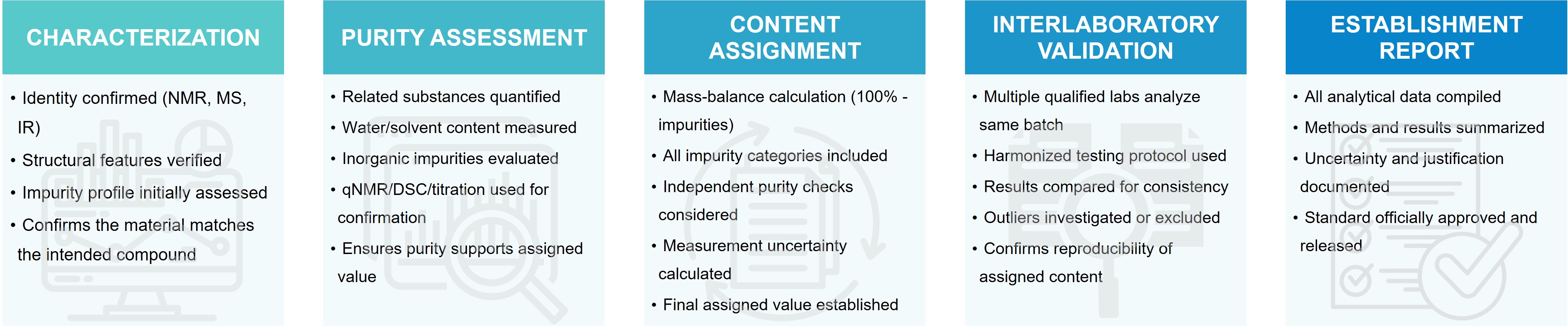
Comprehensive analytical characterization and formal qualification of primary, working, and in-house reference standards with documented potency assignment and acceptance criteria. Capabilities include:
Identity confirmation by peptide mapping, intact mass, and physicochemical methods
Purity assessment by SEC-HPLC, CE-SDS, and icIEF with impurity profiling and quantification
Potency assignment using validated bioassays with statistical evaluation of assay precision and confidence intervals
Stability evaluation under intended storage conditions to support expiration dating
Qualification packages include comprehensive protocols, raw data, statistical analyses, and formal reports suitable for regulatory submission and quality system integration.
Controlled storage, inventory tracking, and distribution management ensuring reference standard integrity and availability. Capabilities include:
Temperature-monitored storage with continuous data logging and alarm systems
Inventory management with lot tracking, usage logging, and reorder point establishment
Chain-of-custody documentation from receipt through dispensing, use, and disposal
Environmental excursion assessment and impact evaluation procedures
Storage and inventory systems are designed to prevent degradation, avoid stockouts, and maintain complete traceability for regulatory inspection and data integrity requirements.
Periodic requalification and stability monitoring to verify continued suitability of reference standards throughout their assigned shelf life. Capabilities include:
Scheduled requalification testing at defined intervals with trending and statistical evaluation
Accelerated stability studies to support shelf-life extension or early replacement decisions
Degradation product profiling and comparison against initial qualification baseline
Replacement strategy development with bridging studies to new standard lots
Requalification programs ensure that reference standards remain fit-for-purpose and that analytical continuity is maintained across standard lot changes.
Reference Standard Types and Applications
Profacgen manages diverse reference standard categories supporting biopharmaceutical analytical programs:
Primary reference standards — highly characterized materials established as the ultimate reference for potency and purity; typically sourced from pharmacopeial authorities (USP, EP, WHO) or qualified through extensive collaborative study
Working reference standards — qualified materials calibrated against primary standards for routine use; prepared in sufficient quantity to support extended analytical programs with periodic requalification
In-house reference standards — materials prepared and qualified within the organization for proprietary analytes, novel therapeutics, or specifications not covered by pharmacopeial standards
System suitability standards — materials used for chromatographic and electrophoretic system performance verification, with less stringent qualification requirements but defined acceptance criteria
Analytical Accuracy Assurance: Rigorous characterization and potency assignment with statistical confidence intervals ensure that reference standards provide reliable calibration, preventing systematic analytical bias that compromises release decisions and stability assessments.
Regulatory Compliance and Inspection Readiness: Programs aligned with USP <11>, EP 5.12, and ICH Q6B expectations, with documented qualification, storage, and requalification records that withstand regulatory scrutiny and support confident inspection presentations.
Supply Security and Continuity: Controlled inventory management with multi-tier standard strategies, reorder point systems, and replacement planning prevents stockouts and analytical disruptions that delay manufacturing campaigns and batch releases.
Degradation Detection and Prevention: Scheduled requalification with stability trending identifies standard degradation before it affects analytical results, enabling proactive replacement and preventing retrospective investigation of compromised data.
Seamless Lot Transition: Bridging studies and comparability assessments for new standard lots ensure analytical continuity across replacements, maintaining trend consistency in stability data and release testing history.
Program Scalability: Reference standard strategies that evolve from research-grade materials through development qualification to commercial GMP programs, ensuring appropriate investment at each stage without redundant effort or premature over-qualification.
Representative Program Scenarios
Scenario 1: Reference Standard Qualification for BLA Submission
Program Context:
A biopharmaceutical company advancing a novel therapeutic antibody to BLA submission required formal qualification of a working reference standard for potency, purity, and identity. The standard had been used during development but lacked comprehensive characterization and documented potency assignment suitable for regulatory review.
Objective:
To characterize and qualify the working reference standard with full analytical documentation, assign potency with statistical confidence, establish expiration dating, and generate a qualification package suitable for BLA inclusion.
Approach:
Profacgen executed a comprehensive qualification program including identity confirmation by peptide mapping and intact mass, purity assessment by SEC-HPLC and CE-SDS, and potency assignment using a validated cell-based assay with eight independent determinations. Statistical analysis established potency with 95% confidence intervals and evaluated inter-assay precision. Accelerated stability studies at elevated temperatures supported a 24-month expiration date under defined storage conditions. A formal qualification report documented all analytical data, statistical analyses, and acceptance criteria justification.
Outcome:
The qualification package was successfully incorporated into the regulatory submission without major questions regarding reference standard suitability. The assigned potency value supported consistent relative potency determination for commercial batches, and the established expiration timeline enabled predictable replacement planning. The standard remained in routine use for 18 months before scheduled replacement with a newly qualified lot.
Scenario 2: Post-Inspection Reference Standard Program Remediation
Program Context:
A commercially approved therapeutic protein received an FDA inspection observation citing inadequate reference standard storage documentation and lack of formal requalification procedures. The observation threatened escalation to a warning letter and required rapid implementation of a compliant reference standard management program.
Objective:
To design and implement a comprehensive reference standard management program addressing the inspection observation, with documented storage controls, formal requalification procedures, and retrospective assessment of standard integrity during the period of identified deficiency.
Approach:
Profacgen conducted an immediate retrospective assessment of reference standard integrity, analyzing historical storage temperature data, usage records, and analytical performance trends to evaluate whether the deficiency had compromised standard suitability. A formal management program was implemented with temperature-monitored storage, continuous data logging with alarm systems, inventory tracking with lot-specific usage logs, and a requalification schedule with predefined testing intervals and acceptance criteria. Standard operating procedures were drafted for receipt, storage, dispensing, use, and disposal. Training was provided to all relevant personnel with competency assessment.
Outcome:
The retrospective assessment demonstrated that standard integrity had not been compromised during the deficiency period, supported by stable analytical performance data. The implemented management program was subsequently reviewed during a follow-up quality inspection, and the observation was considered satisfactorily addressed. Since implementation, the program has maintained consistent compliance through multiple subsequent inspections with no reference standard-related observations.
Q: What is the difference between primary and working reference standards?
A: Primary reference standards are the ultimate reference materials, typically sourced from pharmacopeial authorities or qualified through extensive collaborative study, with the highest level of characterization and traceability. Working reference standards are calibrated against primary standards for routine analytical use, prepared in quantities sufficient for extended programs, and requalified periodically to verify continued suitability. In-house standards are prepared internally for proprietary analytes not covered by pharmacopeial materials.
Q: How is reference standard potency assigned?
A: Potency is assigned using validated analytical methods, typically bioassays for therapeutic proteins, with multiple independent determinations to establish a mean potency value with statistical confidence intervals. The assignment process includes evaluation of assay precision, parallelism between standard and sample, and calibration against a primary standard where available. Potency assignment reports document all analytical data, statistical analyses, and uncertainty estimates.
Q: What triggers reference standard replacement?
A: Replacement is triggered by approaching expiration date, requalification failure, degradation detected during stability monitoring, inventory depletion, or significant process change affecting the analytical relationship between standard and sample. Profacgen develops replacement strategies with bridging studies that demonstrate equivalency between outgoing and incoming standard lots, ensuring analytical continuity.
Q: How are reference standard storage excursions handled?
A: Temperature or environmental excursions trigger immediate notification and impact assessment. The assessment evaluates excursion magnitude, duration, standard stability knowledge, and analytical performance history to determine whether standard suitability has been compromised. Affected standards may be subjected to accelerated requalification testing or segregated pending evaluation. All excursions and assessments are documented with formal disposition decisions.
Q: What documentation is required for regulatory submission?
A: Regulatory documentation includes qualification protocols and reports with identity, purity, and potency data; potency assignment with statistical confidence intervals; stability data supporting expiration dating; storage condition specifications; and requalification schedules. For BLA submissions, reference standard information is typically included in the analytical procedures section or as supporting documentation.
Q: Can Profacgen manage reference standards for biosimilar programs?
A: Yes. Biosimilar programs require reference product characterization for analytical similarity assessment. Profacgen provides reference product sourcing, comprehensive characterization, and qualification for comparative analytical studies. Programs include extensive physicochemical and biological characterization to establish the reference product profile against which biosimilar similarity is evaluated.
References:
United States Pharmacopeia. USP General Chapter <11>: USP Reference Standards. United States Pharmacopeial Convention; current edition.
United States Pharmacopeia. USP General Chapter <1041>: Biologics. United States Pharmacopeial Convention; current edition.
ICH Q6B. Specifications: Test Procedures and Acceptance Criteria for Biotechnological/Biological Products. International Council for Harmonisation of Technical Requirements for Pharmaceuticals for Human Use; 1999.
European Pharmacopoeia. Ph. Eur. Chapter 5.12: Reference Standards. European Directorate for the Quality of Medicines; current edition.
Online Inquiry
Fill out this form and one of our experts will respond to you within one business day.