We use cookies to understand how you use our site and to improve the overall user experience. This includes personalizing content and advertising. Read our
Privacy Policy
Profacgen's Protein Degrader Discovery Services deliver end-to-end targeted protein degradation (TPD) solutions, from ligand identification and degrader design to cellular validation and mechanism-of-action studies, accelerating therapeutic programs from concept to candidate.
Targeted protein degradation has emerged as a transformative therapeutic modality that selectively eliminates disease-causing proteins by co-opting the cellular ubiquitin-proteasome system. Unlike traditional inhibitors that merely block protein function, degraders induce protein removal, offering superior efficacy, prolonged pharmacodynamic effects, and the ability to target previously undruggable proteins.
Profacgen leverages deep expertise in chemical biology, structural characterization, and assay development to support the discovery of molecular glues, PROTACs, and other heterobifunctional degraders. Our integrated platform combines Ligand Discovery and Design Service with advanced biophysical and cellular validation capabilities to deliver robust degrader candidates with optimized potency, selectivity, and drug-like properties.
Overview of Targeted Protein Degradation
Targeted protein degradation (TPD) represents a paradigm shift in drug discovery, utilizing the cell's natural protein disposal machinery to achieve sustained target elimination:
Mechanism-driven therapeutic advantage: Degraders induce catalytic target destruction rather than stoichiometric inhibition, enabling lower effective doses and overcoming resistance mechanisms associated with traditional inhibitors
Expanded druggable proteome: TPD enables functional modulation of proteins lacking defined enzymatic active sites, including transcription factors, scaffold proteins, and other challenging targets
Prolonged pharmacodynamic effect: Protein resynthesis following degradation creates a durable therapeutic window, reducing dosing frequency and improving patient compliance
Event-driven pharmacology: Degraders function through formation of transient ternary complexes, allowing optimization of cooperativity, selectivity, and residence time through rational design
Figure 1. Schematic illustration of PROTAC-mediated targeted protein degradation. The heterobifunctional degrader recruits an E3 ligase to the target protein, inducing ubiquitination and subsequent proteasomal degradation. (Sampson et al., 2023)
Our platform encompasses the full degrader discovery spectrum, from target validation and ligand identification through ternary complex characterization, cellular degradation profiling, and mechanism-of-action elucidation. We deploy state-of-the-art biophysical techniques including surface plasmon resonance (SPR), isothermal titration calorimetry (ITC), and NMR spectroscopy to quantitatively assess ternary complex formation and cooperativity.
Degrader Discovery Platform
Profacgen provides specialized discovery modules tailored to diverse target classes, E3 ligase preferences, and therapeutic objectives. Each module integrates our Ligand Discovery and Design Service with degrader-specific optimization and validation workflows.
PROTAC Design and Optimization
Comprehensive development of heterobifunctional degraders linking target ligands to E3 ligase recruiters through optimized linkers.
Target ligand identification: Fragment-based screening, virtual screening, and hit-to-lead optimization for target-binding warheads
E3 ligase recruiter selection: Rational selection and optimization of VHL, CRBN, IAP, and emerging ligase binders based on target expression and tissue specificity
Linker optimization: Structure-guided and property-driven linker design to enhance ternary complex stability, cellular permeability, and metabolic stability
Structure-activity relationship (SAR): Iterative optimization of degrader potency (DC50), maximal degradation (Dmax), and selectivity profiles
Molecular Glue Discovery
Identification and optimization of small molecules that induce novel protein-protein interactions between target and E3 ligase.
Target-centric screening: Phenotypic and chemoproteomic approaches to identify glue compounds that redirect E3 ligase substrate specificity
Mechanism validation: Biochemical and structural confirmation of neosubstrate recruitment, ubiquitination site mapping, and proteasome-dependence verification
Lead optimization: Medicinal chemistry optimization to improve potency, selectivity, and physicochemical properties while maintaining glue mechanism
Cellular Degradation Profiling
Quantitative assessment of degrader performance in physiologically relevant cellular systems.
Degradation kinetics: Time-course analysis of target protein levels by quantitative Western blot, mass spectrometry proteomics, and high-content imaging
DC50 and Dmax determination: Dose-response characterization of degradation potency and efficacy across multiple cell lines
Hook effect analysis: Evaluation of bell-shaped dose-response curves to guide linker length and affinity optimization
Selectivity profiling: Global proteome analysis to assess off-target degradation and identify potential safety liabilities
Ternary Complex Characterization
Biophysical and structural analysis of target-degrader-ligase complex formation and cooperativity.
Binding affinity determination: SPR, ITC, and bio-layer interferometry (BLI) measurement of binary and ternary complex Kd values
Cooperativity assessment: Quantitative analysis of positive or negative cooperativity in ternary complex formation to guide linker optimization
Structural elucidation: Cryo-EM and X-ray crystallography of ternary complexes to inform rational degrader design
Ligand Discovery and Design Service
Successful degrader development begins with high-quality target ligands. Our Ligand Discovery and Design Service provides the foundational binding modules essential for degrader construction, offering:
Fragment-based ligand discovery: Sensitive biophysical screening (NMR, SPR, X-ray) to identify weak-binding fragments suitable for degrader warhead elaboration
Hit-to-lead optimization: Structure-guided medicinal chemistry to improve binding affinity, selectivity, and developability while preserving linker attachment vectors
Computational ligand design: Molecular docking, pharmacophore modeling, and AI-driven virtual screening to expand chemical diversity and accelerate lead identification
Co-crystal structure determination: High-resolution structural data to guide rational degrader design and linker placement
This service integrates seamlessly with our degrader optimization platform, ensuring that ligand selection is informed by downstream degrader requirements from the earliest stages of discovery.
Applications
Our Protein Degrader Discovery Services support a broad spectrum of therapeutic and research applications:
Oncology: Degradation of oncogenic drivers, transcription factors, and epigenetic regulators; overcoming resistance to kinase inhibitors; targeting tumor suppressor loss-of-function mechanisms
Immunology and Inflammation: Targeted degradation of inflammatory mediators, immune checkpoint regulators, and signaling scaffold proteins
Neurodegeneration: Removal of aggregated or misfolded proteins; modulation of protein quality control pathways
Antiviral and Antimicrobial: Degradation of viral or pathogen proteins; host factor targeting to disrupt infection cycles
Undruggable Target Space: Functional modulation of proteins lacking enzymatic active sites, including transcription factors, non-kinase scaffolds, and protein-protein interaction hubs
Key Advantages of Our Platform
Integrated Discovery-to-Validation Workflow: Seamless progression from ligand identification through cellular degradation confirmation, eliminating handoff inefficiencies and accelerating program timelines.
Quantitative Ternary Complex Analysis: Advanced biophysical characterization of cooperativity and binding thermodynamics to guide rational linker optimization and predict cellular behavior.
Comprehensive E3 Ligase Coverage: Access to established (VHL, CRBN, IAP) and emerging ligase recruiters, enabling tissue- and target-specific degrader design strategies.
Mechanism-of-Action Validation: Rigorous biochemical and cellular confirmation of ubiquitin-proteasome dependence, ternary complex requirement, and catalytic degradation mechanism.
Cross-Platform Structural Biology: Integration with cryo-EM, X-ray crystallography, and NMR to provide atomic-resolution guidance for degrader optimization.
Deliverables
Profacgen provides structured, decision-ready documentation aligned with your degrader discovery objectives:
Parameter
Description
Screening Data
Primary screening results, hit confirmation, and binding affinity (Kd, Ki) for identified ligands and degrader candidates
Degrader Optimization Report
SAR analysis, DC50 and Dmax values, selectivity profiles, and physicochemical property assessment for lead series
Cellular Degradation Profile
Time-course degradation kinetics, dose-response curves, hook effect analysis, and global proteome selectivity data
Ternary Complex Biophysics
Binary and ternary complex binding affinities, cooperativity coefficients, and thermodynamic parameters (SPR, ITC, BLI)
Structural Data
Co-crystal structures, cryo-EM reconstructions, or NMR assignments of ternary complexes with resolution and quality metrics
Comprehensive Study Report
Structured documentation of experimental design, analytical methods, results, statistical analysis, and expert interpretation suitable for internal decision-making or regulatory preparation
Deep TPD Expertise: Our scientists possess extensive experience in degrader design, chemical biology, and targeted protein degradation mechanisms, ensuring scientifically rigorous experimental design and data interpretation.
Customized Project Design: We tailor discovery strategies—target selection, E3 ligase matching, linker chemistry, and assay formats—to your specific therapeutic target, biological question, and program constraints.
Advanced Biophysical Platform: State-of-the-art instrumentation for quantitative ternary complex analysis, including SPR, ITC, BLI, and NMR, providing mechanistic insights that drive rational optimization.
End-to-End Project Support: From initial target assessment and ligand discovery through cellular validation, structural characterization, and lead optimization, we provide comprehensive support at every stage of your degrader program.
Representative Program Scenarios
Scenario 1: PROTAC Development for a Recalcitrant Kinase Target
Program Context:
A kinase inhibitor program had encountered resistance mutations and poor selectivity against closely related family members. The team sought a degradation-based approach to achieve superior selectivity and overcome resistance while maintaining pathway modulation.
Objective:
To design and optimize a VHL-recruiting PROTAC that selectively degrades the target kinase, demonstrate cellular degradation, and establish a structure-activity relationship for lead optimization.
Approach:
Profacgen initiated the program through our ligand discovery and design service to identify a selective kinase inhibitor warhead with an appropriate exit vector for linker attachment. The identified fragment was optimized to a nanomolar binder with confirmed selectivity against off-target kinases. We then designed and synthesized a panel of PROTACs with varying linker lengths and compositions, screening for ternary complex formation by SPR and cellular degradation potency by quantitative Western blot. Lead compounds were advanced through DC50 and Dmax determination, hook effect analysis, and global proteome selectivity profiling.
Outcome:
The optimized PROTAC achieved a DC50 of 5 nM with >90% maximal degradation in target-expressing cell lines. Selectivity profiling revealed a 50-fold improvement in selectivity index compared to the parent inhibitor, with minimal off-target degradation. The compound demonstrated sustained target suppression for >72 hours following a single dose, supporting advancement to in vivo pharmacokinetic and pharmacodynamic studies.
Scenario 2: Molecular Glue Discovery for a Transcription Factor Target
Program Context:
A transcription factor implicated in aggressive malignancy lacked druggable pockets and had resisted conventional inhibitor development. The program required an alternative mechanism to functionally eliminate the target protein.
Objective:
To identify molecular glue compounds that redirect an endogenous E3 ligase to ubiquitinate and degrade the transcription factor, and to validate the mechanism through biochemical and cellular studies.
Approach:
Profacgen deployed a chemoproteomic screening platform using cell-based degradation assays and affinity-based mass spectrometry to identify compounds inducing target-specific degradation. Hit compounds were validated for proteasome dependence, E3 ligase specificity, and direct target engagement. Mechanistic studies included ubiquitination site mapping, ternary complex reconstitution, and structural analysis to confirm the glue mechanism. Lead optimization focused on improving cellular potency while maintaining the neosubstrate recruitment mechanism.
Outcome:
The campaign identified a novel molecular glue that induced potent and selective degradation of the target transcription factor (DC50 = 12 nM). Mechanistic validation confirmed CRBN-dependent ubiquitination at a specific lysine residue, with no detectable degradation of the top 200 closest homologs. The compound suppressed downstream oncogenic gene expression signatures and inhibited tumor cell proliferation, providing a first-in-class chemical starting point for a previously undruggable target.
Q: What is the difference between PROTACs and molecular glues?
A: PROTACs (Proteolysis Targeting Chimeras) are heterobifunctional molecules containing two distinct ligands connected by a linker: one binds the target protein and the other recruits an E3 ubiquitin ligase. Molecular glues are monovalent small molecules that induce novel protein-protein interactions between a target and an E3 ligase by stabilizing a cryptic binding interface. PROTACs offer modular design and predictable structure-activity relationships, while molecular glues typically possess superior drug-like properties (lower molecular weight, better oral bioavailability) but require serendipitous discovery or sophisticated screening approaches. Profacgen supports both modalities.
Q: How do you select the appropriate E3 ligase for my target?
A: E3 ligase selection depends on target expression patterns, tissue distribution, cellular context, and the desired therapeutic profile. We evaluate established recruiters (VHL, CRBN, IAP) based on target co-expression, ligase substrate specificity, and prior clinical validation. For tissue-specific applications, we assess emerging ligases with restricted expression profiles. Our platform includes a panel of validated ligase recruiters and can evaluate novel ligases based on your target biology and program requirements.
Q: What target classes are amenable to degradation?
A: Targeted protein degradation has been successfully applied to diverse protein classes including kinases, transcription factors, epigenetic regulators, E3 ligases themselves, and scaffold proteins. The key requirement is the presence of a surface amenable to ligand binding or the ability to induce a neosubstrate interaction. Our platform can assess target degradability through structural analysis, surface druggability evaluation, and proof-of-concept screening prior to full program commitment.
Q: How does the hook effect impact degrader design?
A: The hook effect describes the bell-shaped dose-response curve observed when high degrader concentrations inhibit degradation by forming non-productive binary complexes (target-degrader or ligase-degrader) rather than the productive ternary complex. This phenomenon is influenced by linker length, relative binding affinities, and cooperativity. We characterize hook effects systematically during optimization and use quantitative biophysical data to guide linker design that maximizes the therapeutic window between effective and counterproductive concentrations.
Q: What is the typical timeline for a degrader discovery program?
A: Program timelines vary based on target complexity, starting point availability, and program scope. A typical PROTAC program from ligand identification to cellular lead candidate requires 12–18 months. Molecular glue discovery timelines are more variable due to the serendipitous nature of neosubstrate identification, typically ranging from 18–24 months. We provide detailed milestone planning and regular progress updates to ensure alignment with your development objectives.
Q: Can you support programs starting from a known inhibitor?
A: Yes. If you possess a validated inhibitor with known binding mode, we can evaluate its suitability as a degrader warhead, identify optimal linker attachment points through structural analysis, and design PROTACs or molecular glues. This approach significantly accelerates program timelines by leveraging existing structure-activity relationship data. We can also support fragment-based de novo ligand discovery when no suitable starting point exists.
References:
Ding B, Hu J, Shou B, et al. Phenotypic screening for targeted protein degradation: strategies, challenges, and emerging opportunities. J Med Chem. 2025;68(17):18024-18039. doi:10.1021/acs.jmedchem.5c00949
Sampson C, Wang Q, Otkur W, et al. The roles of E3 ubiquitin ligases in cancer progression and targeted therapy. Clinical & Translational Med. 2023;13(3):e1204. doi:10.1002/ctm2.1204
Online Inquiry
Fill out this form and one of our experts will respond to you within one business day.

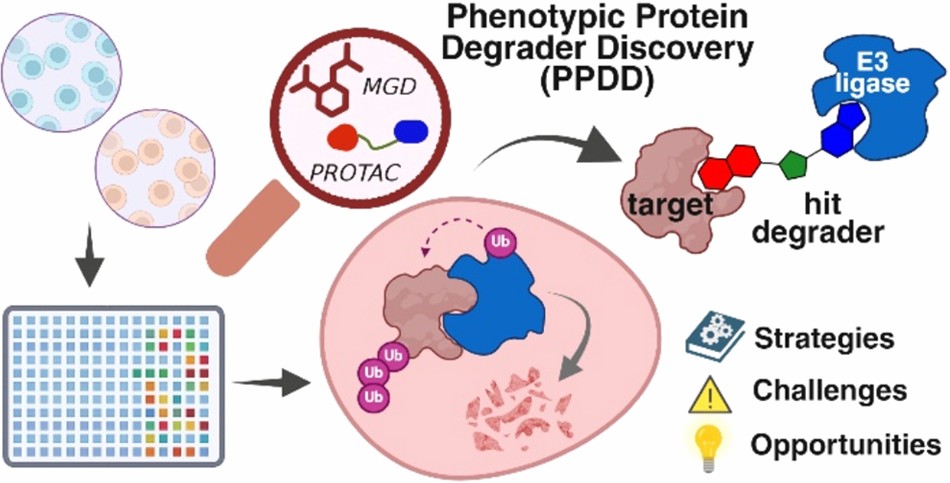
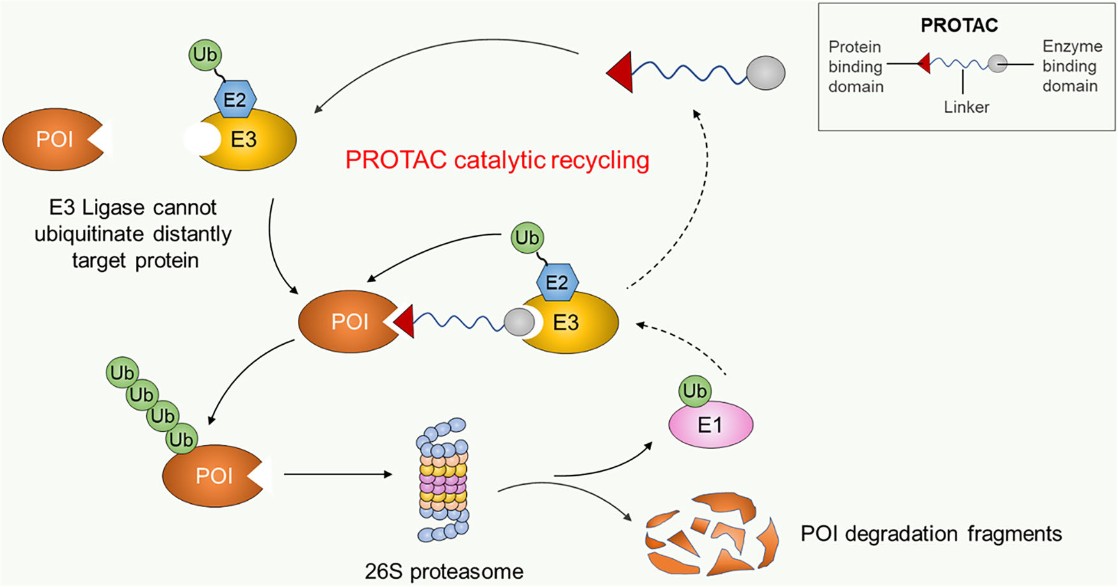 Figure 1. Schematic illustration of PROTAC-mediated targeted protein degradation. The heterobifunctional degrader recruits an E3 ligase to the target protein, inducing ubiquitination and subsequent proteasomal degradation. (Sampson et al., 2023)