We use cookies to understand how you use our site and to improve the overall user experience. This includes personalizing content and advertising. Read our
Privacy Policy
Antigen-antibody binding kinetics define the temporal dynamics of immune recognition, governing how rapidly an antibody engages its target, how long the complex persists, and how these parameters collectively determine biological efficacy. While equilibrium affinity (KD) provides a static measure of binding strength, the constituent rate constants—association rate (ka or kon) and dissociation rate (kd or koff)—reveal the mechanistic basis of recognition and enable rational optimization of therapeutic antibodies for desired pharmacological profiles. A antibody with identical KD to another may exhibit markedly different clinical behavior if one dissociates within seconds while the other remains bound for hours. Profacgen provides comprehensive Antigen-Antibody Binding Kinetics services utilizing surface plasmon resonance (SPR), bio-layer interferometry (BLI), and advanced solution-phase methods to deliver precise kinetic rate constants, affinity rankings, and mechanistic insights that guide antibody discovery, biosimilar development, and therapeutic optimization.
Background: Principles of Antigen-Antibody Binding Kinetics
The interaction between an antibody and its cognate antigen is a bimolecular reversible reaction described by the law of mass action:
Ab + Ag ⇌ AbAg
kon [Ab][Ag] = koff [AbAg]
At equilibrium, the ratio of rate constants defines the affinity:
KD = koff / kon
However, this equilibrium description masks the kinetic heterogeneity that critically influences biological function. Two antibodies with identical KD = 1 nM may achieve this through fundamentally different mechanisms: one via rapid association (kon = 106 M−1s−1) and rapid dissociation (koff = 10−3 s−1), the other via slow association (kon = 104 M−1s−1) and very slow dissociation (koff = 10−5 s−1). The latter, with a residence time of ~28 hours, may provide sustained target engagement and prolonged pharmacodynamic effect despite identical equilibrium affinity.
Figure 1. Antigen-antibody binding kinetics. SPR sensorgrams illustrate association and dissociation phases. (Hearty et al., 2018)
Kinetic Parameters and Their Biological Relevance
Parameter
Symbol/Unit
Physical Meaning
Therapeutic Implication
Association Rate Constant
kon (M−1s−1)
The rate at which antibody and antigen form a complex upon encounter; limited by diffusion and molecular orientation
Determines time to maximal receptor occupancy; rapid kon enables fast onset of action in acute settings
Dissociation Rate Constant
koff (s−1)
The rate at which the antibody-antigen complex dissociates; reflects the energy barrier of the bound state
Determines duration of target engagement; slow koff enables prolonged efficacy, reduced dosing frequency, and improved tumor penetration
Residence Time
τ = 1/koff (s, min, h)
The average duration a single antibody remains bound to its antigen before dissociation
Directly correlates with pharmacodynamic duration; increasingly recognized as an independent optimization parameter beyond KD
Equilibrium Dissociation Constant
KD = koff/kon (M)
The antigen concentration at which 50% of antibody binding sites are occupied at equilibrium
Standard affinity metric; must be decomposed into kinetic components for mechanism-informed engineering
Binding Models for Kinetic Analysis
Profacgen applies appropriate kinetic models based on the mechanistic complexity of each antibody-antigen system:
1:1 Langmuir Binding: Simple bimolecular interaction with a single binding site; applicable to monovalent Fab fragments and monomeric antigens. Fitting yields a single set of kon, koff, and KD values.
Bivalent Analyte Model: Accounts for avidity effects when IgG or dimeric constructs bind multivalent antigens or surface-immobilized targets. The first arm binds with intrinsic monovalent kinetics; the second arm binds with enhanced apparent affinity due to reduced effective off-rate.
Heterogeneous Ligand Model: Two independent binding sites with distinct kinetic properties; applied when antigen exhibits conformational heterogeneity or antibody populations contain subspecies with different binding characteristics.
Conformational Change Model: Two-step binding involving initial encounter complex formation followed by a conformational rearrangement (induced fit); reveals hidden binding intermediates relevant to allosteric modulation and internalization kinetics.
What We Offer: Assay Services
Profacgen provides a comprehensive suite of kinetic characterization services spanning discovery screening, lead optimization, biosimilar comparability, and regulatory-compliant therapeutic validation.
Affinity Ranking and Antibody Screening
High-throughput kinetic profiling to identify and prioritize antibody candidates with optimal binding properties:
Single-Cycle Kinetic Screening
BLI-based single-cycle kinetic analysis enabling 96-antibody screening per biosensor in 2 hours. Antigen is loaded onto streptavidin biosensors; each antibody is associated and dissociated in a single sequential injection, eliminating regeneration variability. Ideal for hybridoma supernatant screening and phage display output triage.
Multi-Cycle Kinetic Profiling
SPR-based multi-cycle analysis with full regeneration between injections, providing highest precision kon and koff determination. Applied to 20–50 lead candidates for detailed kinetic comparison, epitope binning correlation, and structure-kinetic relationship establishment.
Affinity Maturation Monitoring
Iterative kinetic characterization across directed evolution rounds, tracking koff reduction as the primary optimization metric. Kinetic fingerprint libraries enable identification of beneficial mutation combinations that improve residence time without compromising developability.
Solution-Phase Kinetics by ITC
Isothermal titration calorimetry providing thermodynamic and kinetic binding parameters in free solution without surface immobilization artifacts. Complementary to SPR/BLI for validating surface-based results and detecting conformational coupling in binding mechanisms.
Biosimilar Comparison and Regulatory Kinetics
Rigorous kinetic comparability assessment supporting biosimilar development and regulatory submission:
Kinetic Similarity Assessment: Head-to-head SPR or BLI comparison of biosimilar and innovator antibody against the same antigen batch, with statistical evaluation of kon, koff, and KD equivalence using predefined similarity margins
Temperature and pH Stress Kinetics: Kinetic parameter monitoring under forced degradation conditions (40°C, low pH, oxidation) to establish kinetic stability as a critical quality attribute and distinguish degradation mechanisms
Lot-to-Lot Consistency: Kinetic fingerprinting across manufacturing lots to demonstrate process control and identify drift in critical kinetic parameters before clinical impact
Reference Standard Qualification: Kinetic characterization of primary and working reference standards with documented uncertainty budgets for regulatory-compliant assay transfer
Detection Platforms
Profacgen deploys multiple detection technologies matched to the kinetic regime, sample format, and throughput requirements of each project:
Platform
Principle
Kinetic Range
Best Suited For
Surface Plasmon Resonance (SPR)
Real-time refractive index change at a gold sensor surface upon binding; label-free, mass-proportional detection
Profacgen executes antigen-antibody kinetic characterization through a rigorous, standardized workflow ensuring data precision, reproducibility, and mechanistic interpretability.
Antigen Immobilization Strategy: Selection of capture chemistry (amine coupling, thiol coupling, biotin-streptavidin, anti-Fc, protein A/G) based on antigen stability, orientation requirements, and regeneration tolerance; surface density optimization to minimize mass transport limitation and avidity artifacts
Assay Development and Validation: Buffer screening (HBS-P, PBS-P, acetate buffers) for optimal signal and baseline stability; reference antibody kinetic confirmation against literature values; blank injection and buffer-only control for bulk refractive index correction; regeneration scouting (glycine pH 1.5–3.0, NaOH, phosphoric acid) for complete surface renewal without activity loss
Association Phase Acquisition: Serial dilution of antibody across 5–7 concentrations spanning 0.1× to 10× expected KD; injection at flow rates eliminating mass transport limitation (typically 30–50 µL/min for SPR); replicate injections for statistical robustness
Dissociation Phase Acquisition: Extended dissociation monitoring (≥5× expected residence time) for accurate koff determination; buffer switching to competitor-containing buffer for rapid off-rate measurement of ultra-high-affinity interactions
Global Kinetic Fitting: Simultaneous fitting of all concentration-dependent sensorgrams to 1:1, bivalent, or conformational change models using nonlinear least-squares algorithms; residual analysis and statistical weighting to validate model selection; χ² and R2 metrics for goodness-of-fit assessment
Residence Time Analysis and Therapeutic Guidance: Calculation of τ = 1/koff; correlation with in vivo pharmacokinetic/pharmacodynamic data when available; kinetic parameter ranking for candidate selection; structure-kinetic relationship hypothesis generation for engineering guidance
Multi-Platform Kinetic Infrastructure: SPR (Biacore 8K, T200), BLI (Octet RED96e), MST, and ITC platforms under one roof enable cross-validation and platform selection optimized for each kinetic regime and sample format
High-Throughput Screening Capability: BLI single-cycle kinetics enabling 500+ antibody kinetic profiles per week; Biacore 8K parallel injection capacity for 8-antibody simultaneous analysis; automated sample handling and LIMS-integrated data processing
Kinetic-First Optimization Philosophy: We prioritize koff reduction and residence time extension as independent optimization parameters beyond KD, aligning with emerging clinical evidence that sustained target engagement drives superior therapeutic outcomes
Biosimilar Kinetic Fingerprinting: Established equivalence testing protocols with statistical frameworks for kon, koff, and KD similarity assessment; experience supporting FDA, EMA, and NMPA biosimilar submissions
Integrated Discovery-to-Development Continuity: Seamless transfer of kinetic leads from screening-grade BLI to regulatory-grade SPR with consistent antigen surfaces and reference standards; coordination with downstream cell-based potency, ADCC, and pharmacokinetic studies
Regulatory-Compliant Documentation: Full instrument qualification (IQ/OQ/PQ), software validation, analyst training records, and study-specific audit trails supporting IND, BLA, and marketing application dossiers
Representative Case Studies
Case 1: Residence Time-Directed Affinity Maturation of an Anti-PD-1 Therapeutic Antibody
Background:
An immuno-oncology program sought to improve the clinical durability of an anti-PD-1 checkpoint inhibitor. The lead antibody exhibited sub-nanomolar equilibrium affinity (KD = 0.4 nM) but rapid dissociation (koff = 2.4 × 10⁻³ s−1, τ = 7 minutes), suggesting that transient binding might permit rapid PD-1 reactivation and immune checkpoint restoration. The hypothesis that extended residence time would enhance T cell activation and antitumor efficacy required kinetic optimization beyond standard affinity maturation.
Our Solution:
Profacgen established a kinetic-first screening cascade: (1) BLI single-cycle kinetics of 2,400 variants from a CDR-H3 saturation mutagenesis library, filtering for koff < 10−4 s−1 (τ > 2.8 hours); (2) SPR multi-cycle confirmation of 48 hits with full kinetic decomposition; (3) thermodynamic analysis by ITC to ensure enthalpy-optimized binding without compensatory entropy penalties; (4) developability screening (aggregation, viscosity, thermal stability) to eliminate kinetically improved but manufacturably compromised variants.
Final Results:
Three variants with 20–50-fold slower koff (τ = 3–6 hours) and maintained kon were identified. Despite 5–10-fold higher KD due to kon reduction, the extended residence time variants demonstrated superior T cell IFN-γ production in mixed lymphocyte reactions and improved tumor growth inhibition in a syngeneic MC38 model. The kinetically optimized antibody entered Phase I with a differentiated mechanism-of-action hypothesis centered on sustained checkpoint blockade, supported by comprehensive kinetic documentation in the IND.
Case 2: Kinetic Biosimilarity Assessment for a Trastuzumab Biosimilar
Background:
A biosimilar developer required comprehensive kinetic comparability data for a trastuzumab candidate referencing Herceptin. Regulatory guidelines emphasize functional similarity, and while cell-based HER2 signaling inhibition assays demonstrated equivalence, the kinetic basis of binding—particularly the balance between association and dissociation rates—remained uncharacterized. Kinetic fingerprint differences, even with identical KD, could signal subtle conformational or glycosylation differences with clinical implications for antibody-dependent cellular cytotoxicity (ADCC) and pharmacokinetics.
Our Solution:
Profacgen conducted a head-to-head kinetic comparison using Biacore T200 SPR with HER2-ECD amine-coupled to CM5 sensor chips. Both biosimilar and innovator were injected at 8 concentrations (3.125–200 nM) in HBS-EP+ buffer at 30 µL/min. Sensorgrams were globally fitted to a bivalent analyte model accounting for IgG avidity. Equivalence was assessed using a two-one-sided test (TOST) procedure with 90% confidence intervals against predefined similarity margins (±20% for kon, koff, and KD).
Final Results:
The biosimilar demonstrated kinetic equivalence for all parameters: kon within 8% (5.2 × 10⁵ vs. 5.6 × 10⁵ M−1s−1), koff within 12% (3.1 × 10⁻⁴ vs. 3.5 × 10⁻⁴ s−1), and KD within 5% (0.60 vs. 0.63 nM). The 90% CI for all parameters fell entirely within the equivalence margins. Notably, the monovalent Fab kinetics (after papain cleavage and Fab purification) also matched, confirming that the similarity extended to the intrinsic antigen-binding site rather than being an avidity artifact. These kinetic data, combined with mass spectrometry glycan profiling and ADCC potency, formed a cohesive analytical similarity package supporting the biosimilar's BLA submission and successful FDA approval.
Q: Why is kinetic characterization important when equilibrium affinity (KD) is already known?
A: Equilibrium affinity compresses two independent rate constants into a single parameter, obscuring mechanistic information critical for therapeutic optimization. Two antibodies with identical KD can exhibit vastly different in vivo behavior based on kon and koff differences. Rapid koff leads to short receptor residence time and transient pharmacodynamic effect, while slow koff enables sustained target engagement. Rapid kon accelerates onset in acute indications, while slow kon may limit efficacy in rapidly evolving disease settings. Kinetic decomposition enables rational engineering of these properties independently, and residence time has emerged as a validated predictor of clinical duration in multiple therapeutic classes.
Q: What is the difference between SPR and BLI for kinetic analysis?
A: SPR measures refractive index changes at a continuous gold surface with microfluidic flow, providing the highest sensitivity and widest kinetic range (kon up to 107 M−1s−1, koff down to 10−6 s−1). The flow cell format enables precise control of association and dissociation phases and sophisticated binding model fitting. BLI measures wavelength shifts at the tip of a disposable biosensor in a dip-and-read format, offering greater sample flexibility (crude supernatants, particulate samples) and simpler operation but slightly reduced sensitivity and kinetic range. SPR is preferred for regulatory studies, bivalent analysis, and ultra-high-affinity measurements; BLI excels in screening, crude sample analysis, and applications requiring minimal sample preparation. Profacgen employs both platforms with cross-validation for critical projects.
Q: How does bivalent binding (IgG avidity) affect kinetic interpretation?
A: IgG antibodies possess two identical antigen-binding Fab arms, enabling simultaneous engagement of two antigen epitopes when surface density or multivalency permits. This avidity effect dramatically reduces the apparent dissociation rate (koff,app) compared to monovalent Fab kinetics, as release of one arm still leaves the antibody tethered via the second arm, enabling rapid re-binding. SPR and BLI analysis of IgG kinetics must employ bivalent analyte models or Fab fragment comparison to deconvolute intrinsic affinity from avidity. Profacgen routinely performs papain or IdeS cleavage to generate Fab fragments for monovalent kinetic confirmation, ensuring that reported kinetics reflect true binding site properties rather than surface density artifacts.
Q: Can kinetic parameters predict in vivo pharmacokinetics or pharmacodynamics?
A: Kinetic parameters correlate with but do not solely determine in vivo behavior. Slow koff (long residence time) generally correlates with prolonged target-mediated drug disposition (TMDD) and extended pharmacodynamic duration, as seen with anti-PD-1 and anti-HER2 antibodies. However, in vivo efficacy also depends on Fc effector function, glycosylation, tissue penetration, and immunogenicity. Profacgen integrates kinetic data with cell-based potency, ADCC, and pharmacokinetic modeling to generate predictive in vivo hypotheses. For biosimilar development, kinetic similarity is a necessary but not sufficient condition for clinical equivalence; it must be combined with functional and physicochemical comparability.
Q: What is mass transport limitation, and how is it controlled in kinetic assays?
A: Mass transport limitation occurs when the rate of analyte diffusion to the sensor surface becomes slower than the chemical binding rate, causing the observed kinetics to reflect diffusion rather than intrinsic molecular interaction. This artifactually reduces apparent kon and can obscure true affinity differences. Control strategies include: (1) increasing flow rate (SPR) or shake speed (BLI) to enhance analyte delivery; (2) reducing surface ligand density to decrease local depletion; (3) using reference surfaces with non-specific binding correction; and (4) fitting with mass transport-coupled models when limitation is unavoidable. Profacgen optimizes these parameters during assay development and reports mass transport coefficients (km) to document assay validity.
Q: What is the typical project timeline for antigen-antibody kinetic characterization?
A: Standard timelines are: (1) 2–3 weeks for single-antibody SPR or BLI kinetic characterization with available antigen and optimized surface chemistry; (2) 4–6 weeks for assay development including immobilization strategy selection, regeneration scouting, and reference antibody validation; (3) 6–8 weeks for high-throughput BLI screening of 100+ antibodies with single-cycle kinetics and automated data processing; (4) 8–10 weeks for comprehensive kinetic-thermodynamic profiling combining SPR, BLI, and ITC with structure-kinetic relationship analysis; and (5) 10–12 weeks for full GLP-compliant kinetic validation with instrument qualification, software validation, and regulatory documentation. Biosimilar kinetic comparability studies typically require 6–8 weeks including statistical equivalence analysis.
References:
Tummino PJ, Copeland RA. Residence time of receptor-ligand complexes and its effect on biological function. Biochemistry. 2008;47(20):5481-5492.
Schuck P. Kinetic analysis of macromolecular interactions using surface plasmon resonance. Annual Review of Biophysics and Biomolecular Structure. 1997;26:541-566.
Hearty S, Leonard P, Ma H, O’Kennedy R. Measuring antibody-antigen binding kinetics using surface plasmon resonance. In: Nevoltris D, Chames P, eds. Antibody Engineering. Vol 1827. Springer New York; 2018:421-455. doi:10.1007/978-1-4939-8648-4_22
Online Inquiry
Fill out this form and one of our experts will respond to you within one business day.

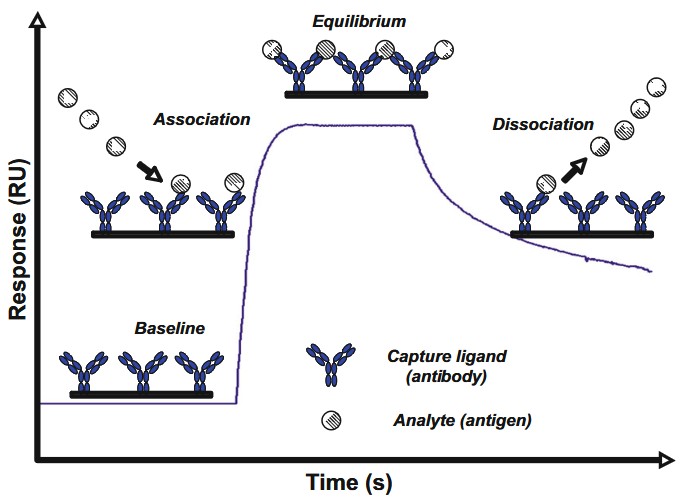 Figure 1. Antigen-antibody binding kinetics. SPR sensorgrams illustrate association and dissociation phases. (Hearty et al., 2018)