We use cookies to understand how you use our site and to improve the overall user experience. This includes personalizing content and advertising. Read our
Privacy Policy
Profacgen offers Biophysical Characterization Services, providing a comprehensive, high-resolution analysis of the structural, conformational, and solution properties of biomolecules. . This enables data-driven decisions across therapeutic development, formulation optimization, and quality assessment workflows.
Biophysical characterization is fundamental to understanding how proteins, antibodies, vaccines, and complex macromolecules behave in solution. The ability to accurately assess protein structure, conformational integrity, aggregation propensity, thermal stability, colloidal behavior, and formulation compatibility directly influences developability, manufacturability, regulatory acceptance, and clinical performance. When your program depends on molecular quality rather than sequence information alone, biophysical characterization becomes a strategic enabler.
Understanding Biophysical Properties of Biomolecules
Biophysical characterization addresses the critical quality attributes that define biomolecular behavior in development and manufacturing environments:
Protein structure: Secondary, tertiary, and quaternary structural organization that determines functional activity and immunogenicity risk
Conformational integrity: Maintenance of native folding and active-site geometry essential for biological activity and stability
Aggregation propensity: Tendency to form soluble oligomers, subvisible particles, or visible aggregates that impact safety, efficacy, and shelf-life
Thermal stability: Resistance to unfolding and denaturation under thermal stress, informing formulation design and storage conditions
Colloidal behavior: Charge, solubility, and intermolecular interaction profiles that influence manufacturability and injectability
Formulation compatibility: Stability and behavior across diverse buffer systems, excipient compositions, and container-closure configurations
Figure 1. Key biophysical properties of biomolecules: structure, conformation, stability, aggregation, and colloidal behavior.
These biophysical properties are critical quality attributes for the development of:
Therapeutic antibodies: Monoclonal, bispecific, and Fc-fusion proteins requiring conformational fidelity, stability, and low aggregation for clinical efficacy and safety
Recombinant proteins: Enzymes, growth factors, and cytokines where structural integrity directly correlates with biological activity and immunogenicity profile
Vaccines: Antigen-adjuvant complexes, virus-like particles, and subunit vaccines where particle size, stability, and conformational presentation determine immunogenicity
Protein complexes: Multi-subunit assemblies and protein-protein interaction networks requiring stoichiometric integrity and cooperative stability assessment
Nanoparticles: Drug delivery systems, lipid nanoparticles, and nanozymes where size distribution, surface charge, and colloidal stability govern biodistribution and efficacy
Reliable biophysical characterization is a prerequisite for developability assessment, formulation optimization, comparability evaluation, and regulatory submission. When your program requires quantitative understanding of molecular behavior in solution, biophysical characterization becomes an indispensable component of the development workflow.
Our Biophysical Characterization Capabilities
Our biophysical characterization capabilities are organized into four interconnected analytical domains, each addressing a critical aspect of biomolecular quality. These modules can be deployed independently or integrated into a comprehensive characterization workflow.
Structural Characterization
Comprehensive assessment of secondary structure, conformational integrity, and folding behavior
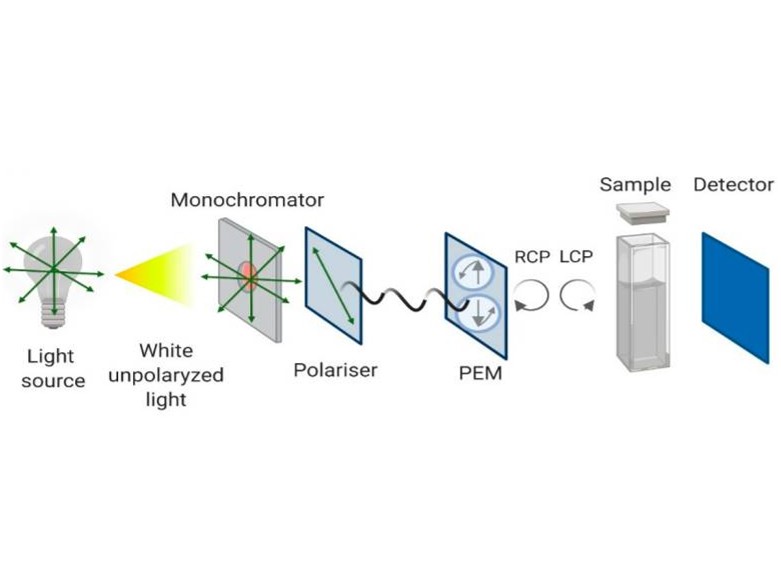
Secondary structure analysis by circular dichroism (CD) and Fourier-transform infrared spectroscopy (FTIR)
Conformational assessment using near-UV CD and intrinsic fluorescence
Folding and unfolding studies under thermal, chemical, and mechanical stress conditions
Comparative structural analysis for biosimilar and formulation evaluation
Particle Size & Aggregation Analysis
Quantitative evaluation of hydrodynamic size, aggregation state, and sample homogeneity
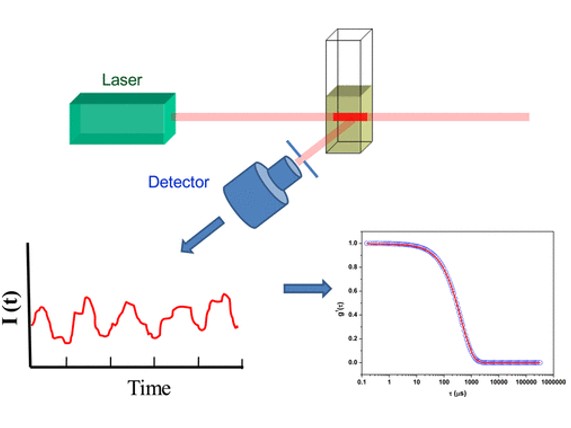
Hydrodynamic size distribution by dynamic light scattering (DLS) and nanoparticle tracking analysis (NTA)
Aggregation detection across soluble oligomers, subvisible particles, and visible aggregates
Sample homogeneity assessment and polydispersity index quantification
Real-time monitoring of aggregation kinetics under thermal and mechanical stress
Stability Characterization
Systematic evaluation of thermal stability, stress tolerance, and formulation robustness
Thermal stability profiling by differential scanning calorimetry (DSC) and thermal shift assays
Stress testing under accelerated thermal, oxidative, and photolytic conditions
Formulation screening across pH, ionic strength, excipient, and surfactant matrices
Real-time and accelerated stability monitoring with biophysical endpoints
Molecular Assembly & Solution Behavior
Analysis of oligomerization, self-association, and colloidal stability in solution
Oligomerization state determination and stoichiometry assessment
Self-association propensity evaluation by concentration-dependent DLS and sedimentation analysis
Colloidal stability assessment including zeta potential, osmotic second virial coefficient (B22), and kD measurements
Solution behavior prediction for manufacturability and high-concentration formulation design
Featured Services
Profacgen offers specialized biophysical characterization services with dedicated platforms and expert interpretation:
High-resolution analysis of hydrodynamic size, aggregation state, and colloidal stability for proteins, nanoparticles, and complex biomolecular assemblies.
Hydrodynamic radius and polydispersity index determination
Temperature-dependent size and aggregation profiling
Real-time kinetic monitoring of particle growth and stability
High-resolution structural and dynamic analysis of biomolecules using advanced NMR spectroscopy, providing detailed insights into protein conformation, ligand interactions, and molecular dynamics in solution.
Protein structure determination and conformational analysis in near-native solution conditions
Ligand binding and protein-protein interaction mapping with atomic resolution
Dynamic and kinetic characterization of molecular motions and exchange processes
Quality assessment of protein folding, stability, and batch-to-batch consistency
Comprehensive evaluation of protein aggregation propensity, particle characterization, and aggregate morphology to support formulation development, stability assessment, and regulatory requirements for biopharmaceutical products.
Multi-technique aggregation detection across soluble oligomers, subvisible particles, and visible aggregates
Quantitative assessment of aggregation kinetics under thermal, mechanical, and chemical stress
Particle size distribution, morphology, and count analysis by orthogonal methods
Comparative batch analysis and stability monitoring for quality control and comparability studies
Applications
Our Biophysical Characterization Services support a broad spectrum of applications across biotechnology and pharmaceutical development:
Therapeutic Antibody Development: Conformational integrity assessment, aggregation propensity profiling, and developability evaluation for monoclonal, bispecific, and Fc-fusion antibodies
Recombinant Protein Characterization: Folding verification, thermal stability determination, and formulation compatibility assessment for enzymes, cytokines, and growth factors
Biosimilar Development: Rigorous higher-order structure comparability testing to demonstrate physicochemical equivalence between innovator and candidate products
Vaccine Development: Particle size distribution, antigen conformation, and adjuvant interaction analysis for subunit, virus-like particle, and nanoparticle-based vaccines
Formulation Development: Buffer and excipient screening, stability optimization, and forced degradation studies to identify robust, manufacturable formulations
Developability Assessment: Early-stage biophysical profiling to identify aggregation-prone, unstable, or poorly soluble candidates before resource-intensive development investment
Why Choose Profacgen?
Comprehensive Biophysical Expertise: We provide a cohesive analytical platform spanning structural, particle, stability, and colloidal characterization, reducing the need for multiple vendors and ensuring data consistency.
Customized Study Design: We tailor analytical strategies to your specific molecule, development stage, and decision point—whether for early screening, formulation optimization, or regulatory comparability.
High-Quality Data Interpretation: We emphasize structured reporting, statistical rigor, and actionable interpretation that connects biophysical data to development decisions, not just raw measurements.
Typical Engagement Workflow
Our engagement workflow is designed to align analytical execution with your program timeline and decision points:
Consultation: Discussion of molecule characteristics, development stage, and intended application to define the optimal biophysical characterization strategy
Study Design: Selection of appropriate analytical techniques, sample requirements, and experimental parameters based on program objectives and regulatory context
Sample Analysis: Execution of assays under controlled conditions with instrument qualification, system suitability checks, and predefined acceptance criteria
Data Processing: Statistical evaluation, curve fitting, and comparative analysis using validated algorithms and appropriate modeling approaches
Final Report: Structured documentation of methods, raw data, analyzed results, and interpretative summaries suitable for internal review, regulatory submission, or publication support
Whether you require focused analysis of a single biophysical attribute or a comprehensive multi-technique characterization package, our Biophysical Characterization Services are designed to accelerate your path from molecular understanding to development success.
Explore our featured services above or contact us to discuss a customized solution tailored to your specific biomolecule and program needs.
References:
Pignataro MF, Herrera MG, Dodero VI. Evaluation of peptide/protein self-assembly and aggregation by spectroscopic methods. Molecules. 2020;25(20):4854. doi:10.3390/molecules25204854
Hassan PA, Rana S, Verma G. Making sense of brownian motion: colloid characterization by dynamic light scattering. Langmuir. 2015;31(1):3-12. doi:10.1021/la501789z
Online Inquiry
Fill out this form and one of our experts will respond to you within one business day.

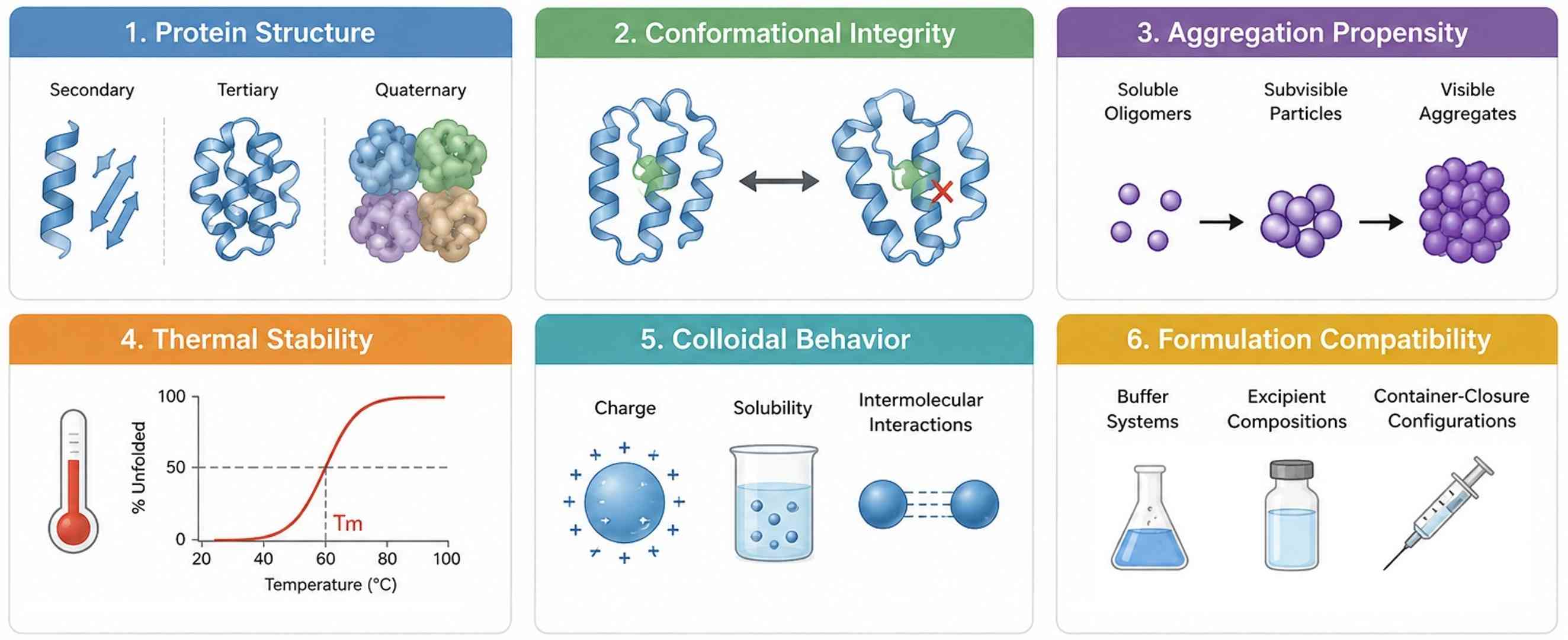 Figure 1. Key biophysical properties of biomolecules: structure, conformation, stability, aggregation, and colloidal behavior.