We use cookies to understand how you use our site and to improve the overall user experience. This includes personalizing content and advertising. Read our
Privacy Policy
At Profacgen, our protein immobilization services enable the stable, oriented attachment of proteins, antibodies, and enzymes to a wide variety of solid supports for applications in affinity purification, diagnostic assay development, biosensing, biocatalysis, and drug discovery. The immobilization of functional biomolecules onto surfaces or particles is a foundational technology in modern biotechnology, transforming soluble proteins into reusable, handleable reagents that can be integrated into devices, columns, and multiwell formats.
The key challenge in protein immobilization is preserving the biological activity of the attached protein while ensuring stable, irreversible coupling that withstands repeated use, harsh regeneration conditions, and extended storage. Random immobilization through surface amines often occludes active sites and yields heterogeneously oriented proteins with suboptimal performance. Profacgen addresses this through a portfolio of site-specific and oriented immobilization strategies—including affinity tag capture, bioorthogonal coupling, thiol-directed conjugation, and carbohydrate-directed attachment—that position the protein in a uniform, activity-preserving orientation on the support surface.
Our immobilization platform supports diverse solid phases including magnetic beads, agarose and sepharose resins, polystyrene microplates, gold and glass sensor surfaces, silica particles, and nanoparticles. Whether you need a high-capacity purification resin, a sensitive diagnostic capture surface, or a reusable biocatalytic matrix, Profacgen delivers optimized immobilization protocols with validated performance metrics.
Background: Principles of Protein Immobilization
Protein immobilization strategies can be classified into four categories based on the nature of the protein-support interaction: physical adsorption, covalent attachment, affinity capture, and bioorthogonal conjugation. Each approach offers distinct advantages and limitations that must be evaluated in the context of the target application.
Physical adsorption relies on non-covalent interactions (hydrophobic, electrostatic, van der Waals) between the protein and the support surface. While simple and non-destructive, adsorption typically produces randomly oriented, loosely bound proteins that can leach under operational conditions. This approach is generally suitable only for short-term analytical applications where mild conditions are maintained.
Covalent attachment forms stable chemical bonds between reactive groups on the protein (typically lysine amines or cysteine thiols) and functionalized support surfaces (epoxy, aldehyde, NHS ester, cyanogen bromide-activated hydroxyls). Covalent coupling provides irreversible attachment resistant to leaching, regeneration, and storage. However, random amine-targeted coupling can modify surface lysines near the active site, reducing or eliminating biological activity. The density and distribution of surface functional groups strongly influence coupling efficiency and protein orientation.
Affinity capture exploits high-affinity, non-covalent interactions between an affinity tag on the protein and a complementary ligand on the support. Common systems include Ni2+-NTA/histidine tag (KD ~10-6 M at pH 7.0), streptavidin/biotin (KD ~10-15 M), and Protein A/G/antibody Fc. Affinity capture offers rapid, gentle immobilization under native conditions with defined orientation determined by the tag position. The main limitation is potential tag leaching under competitive elution conditions or at extreme pH, though the streptavidin-biotin system provides essentially irreversible binding under physiological conditions.
Bioorthogonal conjugation combines the specificity of affinity capture with the permanence of covalent attachment. A bioorthogonal handle (azide, alkyne, tetrazine, TCO) is introduced into the protein at a defined site (via genetic code expansion, chemical modification, or glycoengineering), then reacted with a complementary handle on the support surface through a rapid, chemoselective bioorthogonal reaction. This strategy achieves oriented, site-specific, covalent immobilization with minimal activity loss.
Figure 1. Schematic illustrating protein immobilization methods. (Adapted from Shishparenok et al., 2024)
Our Immobilization Strategies
Profacgen offers a comprehensive suite of immobilization chemistries matched to diverse applications and support types:
Affinity Tag-Based Immobilization
Rapid, non-covalent capture of tagged proteins under native conditions. Ideal for purification, pull-down assays, and applications requiring reversible elution.
Ni2+-NTA: Binds His6-, His8-, or His10-tagged proteins; capacity 10–50 mg/mL; elution by imidazole or low pH
Streptavidin: Captures biotinylated proteins with femtomolar affinity; essentially irreversible under physiological conditions
Protein A/G/L: Binds antibody Fc region for oriented immobilization; capacity 20–40 mg IgG/mL
Anti-FLAG: Captures FLAG-tagged proteins with gentle elution by FLAG peptide
Anti-GST: Binds GST-tagged proteins; elution by reduced glutathione
Covalent Coupling Chemistries
Irreversible attachment through defined chemical bonds. Best for reusable resins, long-term storage, and applications requiring harsh regeneration.
NHS ester: Reacts with protein amines at pH 7–9; forms stable amide bonds
Epoxy: Reacts with amines, thiols, and hydroxyls at pH 8–10; highly stable ether/thioether linkages
Aldehyde: Reacts with amines via reductive amination; forms secondary amine bonds
Cyanogen bromide (CNBr): Activates hydroxyl groups on agarose for amine coupling; high coupling efficiency
Thiol-reactive: Maleimide, pyridyl disulfide, or iodoacetyl for cysteine-directed coupling
Oriented Immobilization via Bioorthogonal Chemistry
Site-specific, covalent attachment preserving active site accessibility and uniform orientation.
Protein engineered with unique surface cysteine for thiol-directed coupling
UAA incorporation (azide, ketone, alkyne) for click chemistry immobilization
Glycan oxidation (periodate) + hydrazide support for carbohydrate-directed coupling
Controlled valency: monovalent to defined multivalent attachment
Typically 2–5× higher activity retention vs. random coupling
Support Functionalization
We provide or modify diverse solid phases matched to application requirements.
Magnetic beads: Superparamagnetic, rapid separation; ideal for IP, cell isolation, automated workflows
Agarose/Sepharose: Low non-specific binding; high capacity; standard for column chromatography
Polystyrene plates: Cost-effective for ELISA and high-throughput screening
Gold/glass slides: For SPR, QCM, and electrochemical biosensors
Silica particles: For solid-phase extraction and catalysis
Comprehensive protein coupling services for magnetic, silica, and agarose beads. Supports streptavidin, Ni-NTA, Protein A/G, and covalent chemistries for affinity purification, immunoprecipitation, cell isolation, and assay development.
Oriented Surface Immobilization
Site-specific protein attachment to SPR chips, microplates, glass slides, and gold surfaces using bioorthogonal chemistry, thiol-directed coupling, and affinity capture. Optimized for biosensors, ELISA, and diagnostic devices.
Applications
Affinity purification: Immobilized antibodies, Protein A/G, or affinity ligands for capture of target proteins from complex mixtures (serum, cell lysate, culture supernatant)
Immunoprecipitation and co-IP: Antibody-conjugated magnetic beads for rapid, gentle isolation of target proteins and interaction partners
Enzyme immobilization for biocatalysis: Covalent or affinity-based enzyme attachment to magnetic beads or silica for continuous-flow reactor applications with enhanced stability and reusability
Diagnostic assay development: Oriented antibody immobilization on microplate wells, lateral flow membranes, or biosensor surfaces for ELISA, rapid tests, and point-of-care devices
Biosensor functionalization: Protein attachment to SPR, QCM, and electrochemical sensor chips with controlled orientation for optimal binding kinetics and minimal non-specific adsorption
Cell isolation and sorting: Antibody-conjugated magnetic beads for positive or negative selection of cell populations (T cells, stem cells, circulating tumor cells)
Representative Case Studies
Case Study 1: Oriented Antibody Immobilization for High-Sensitivity Troponin ELISA
Background:
A diagnostic company developing a cardiac troponin I (cTnI) assay needed to improve the sensitivity of their sandwich ELISA from 50 pg/mL to <5 pg/mL to enable early detection of myocardial infarction. Their existing assay used random amine-coupled capture antibody, resulting in heterogeneous orientation and reduced binding capacity.
Approach:
Profacgen compared three immobilization strategies on polystyrene microplates: (A) random NHS coupling of anti-cTnI; (B) Protein G-mediated Fc capture followed by chemical crosslinking; and (C) site-directed coupling through a unique surface cysteine engineered distal from the antigen-binding site. Each format was evaluated for capture antibody surface density, antigen-binding capacity, and assay sensitivity.
Outcome:
The oriented cysteine-directed immobilization (strategy C) showed 3.5-fold higher effective antigen-binding capacity compared to random coupling, despite 40% lower total antibody density. The improved orientation reduced steric hindrance and maximized Fab accessibility. The resulting ELISA achieved an LoD of 2.1 pg/mL—a 24-fold improvement over the original format—with an analytical range of 2–500 pg/mL suitable for clinical decision-making at the 99th percentile cutoff. The oriented format also showed 50% lower lot-to-lot variation, improving manufacturing consistency.
Case Study 2: Enzyme Immobilization on Magnetic Beads for a Continuous-Flow Bioreactor
Background:
A pharmaceutical process development group needed to immobilize a transaminase enzyme onto magnetic beads for a continuous-flow biocatalytic reactor producing an active pharmaceutical ingredient (API) intermediate. The enzyme required oriented immobilization to preserve active site accessibility and needed to withstand 50°C operational temperature for >500 hours.
Approach:
Profacgen engineered a unique C-terminal cysteine onto the transaminase and coupled it to tosyl-activated magnetic beads (2.8 μm diameter) via thiol-maleimide chemistry. The coupling orientation positioned the enzyme active site away from the bead surface. A control batch was prepared by random amine coupling for comparison. Both batches were evaluated for enzyme loading, specific activity retention, thermal stability, and operational longevity in a packed-bed reactor at 50°C.
Outcome:
Oriented immobilization achieved 85% specific activity retention versus 35% for random coupling. Enzyme loading was 12 mg/g of beads. The oriented enzyme retained >80% activity after 720 hours of continuous operation at 50°C, while the randomly coupled enzyme lost 60% activity within 200 hours. The immobilized biocatalyst was used for 15 production batches (total 3 kg API intermediate) with consistent conversion (>99.5%) and enantioselectivity (>99.9% ee), demonstrating industrial viability.
Q: What is the difference between random and oriented protein immobilization?
A: Random immobilization attaches proteins to the support through any available reactive group (typically surface lysines), resulting in a mixture of orientations where some proteins have their active sites occluded against the surface. This reduces the effective binding capacity and can diminish biological activity. Oriented immobilization attaches proteins through a defined point (affinity tag, unique cysteine, bioorthogonal handle, or glycan) distal from the active site, ensuring uniform presentation with maximal accessibility. Oriented immobilization typically achieves 2–5× higher activity retention and more reproducible performance compared to random coupling.
Q: How do I choose the right immobilization strategy for my application?
A: Selection depends on: (1) whether the protein has an affinity tag or can be engineered with one; (2) whether you need reversible elution or permanent attachment; (3) the operational conditions (pH, temperature, detergent, regeneration); (4) the required binding capacity; and (5) cost constraints. For purification resins requiring reusable, stable attachment: covalent coupling (NHS, epoxy). For rapid assay development: affinity capture (streptavidin-biotin, Protein A/G). For biosensors requiring optimal kinetics: oriented immobilization via bioorthogonal chemistry or thiol coupling. For high-throughput screening: affinity tag capture on pre-functionalized plates. We provide consultation to match the optimal strategy to your requirements.
Q: What binding capacities can be achieved?
A: Binding capacities vary by support type, coupling chemistry, and protein size. Typical values: agarose resins (NHS or CNBr activated): 5–20 mg protein/mL resin; magnetic beads (tosyl or epoxy activated): 5–15 μg protein/mg beads; polystyrene microplates (amine or carboxyl surface): 100–500 ng protein/cm2; gold sensor chips (thiol SAM + NHS): 1–5 ng/mm2. For affinity capture systems: Ni-NTA agarose binds 5–50 mg His-tagged protein/mL; streptavidin beads bind 5–20 μg biotinylated protein/mg; Protein A/G binds 15–40 mg IgG/mL. We optimize coupling conditions to maximize capacity for each project.
Q: How stable are immobilized proteins during storage and use?
A: Covalently immobilized proteins on properly stored resins typically remain active for 6–24 months at 4°C in appropriate storage buffers (usually PBS + 0.05% sodium azide or 20% ethanol). Affinity-captured proteins are generally stable for 3–12 months depending on the tag-ligand system. Operational stability depends on regeneration conditions: mild conditions (pH 4–8, no detergent) support thousands of cycles, while harsh conditions (pH 2–3, guanidine HCl) may limit longevity to tens of cycles. We provide stability data under simulated operational conditions and recommended storage protocols for each immobilized product.
Q: Can you immobilize membrane proteins?
A: Yes. Membrane proteins present unique challenges because they require a lipid or detergent environment to maintain native conformation. We offer three strategies: (1) immobilization of detergent-solubilized proteins via affinity tags (His-tag on Ni-NTA, FLAG on anti-FLAG), maintaining detergent in all buffers; (2) reconstitution into liposomes or nanodiscs followed by biotin-streptavidin capture on sensor surfaces; and (3) capture of full-length membrane proteins on antibody-conjugated beads in the context of native membrane fragments. Each strategy is selected based on the protein's stability requirements and the intended application.
Shishparenok AN, Furman VV, Dobryakova NV, Zhdanov DD. Protein immobilization on bacterial cellulose for biomedical application. Polymers. 2024;16(17):2468. doi:10.3390/polym16172468
Online Inquiry
Fill out this form and one of our experts will respond to you within one business day.

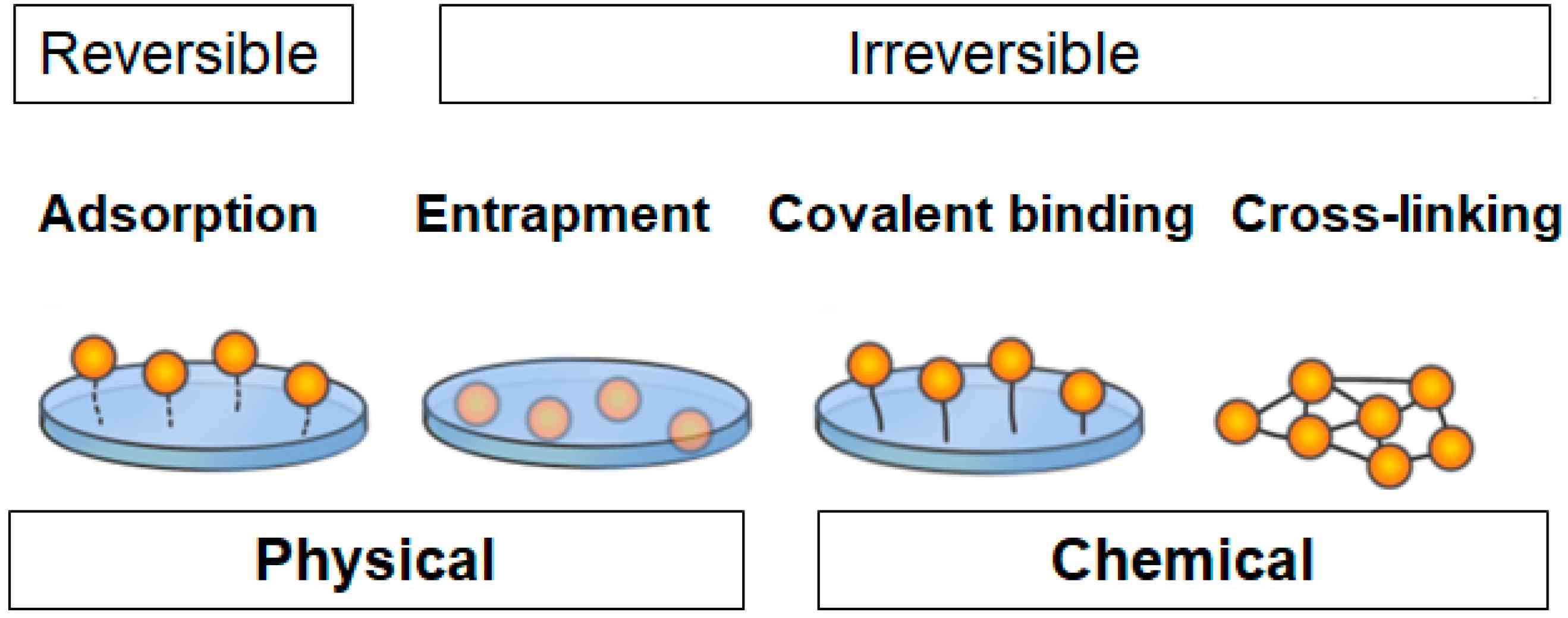 Figure 1. Schematic illustrating protein immobilization methods. (Adapted from Shishparenok et al., 2024)