
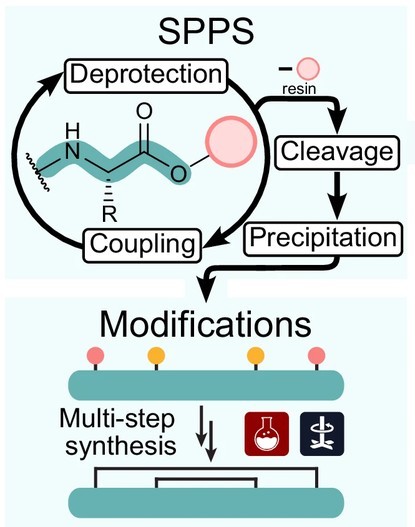
Profacgen's Custom Peptide Synthesis service provides comprehensive, high-quality peptide manufacturing solutions that support every stage of peptide drug discovery and development. Peptide therapeutics occupy a unique space between small molecules and biologics, offering high target specificity, low toxicity, and the ability to modulate protein-protein interactions that are challenging for conventional small molecules. As a foundational technology, custom peptide synthesis enables structure-activity relationship (SAR) studies, epitope mapping, probe development, and therapeutic candidate evaluation.
We employ both solid-phase peptide synthesis (SPPS) and solution-phase approaches to accommodate projects of varying complexity and scale. Our capabilities span from short oligomers to long peptides exceeding 100 amino acid residues, with a wide range of modifications including phosphorylation, acetylation, methylation, biotinylation, fluorescent labels (FAM, TAMRA, FITC), cyclization (head-to-tail, disulfide, stapled), non-natural amino acids, D-amino acids, PEGylation, and lipid conjugation. Every peptide undergoes rigorous quality control, including HPLC purity assessment and MALDI-TOF/ESI-MS confirmation, with optional amino acid analysis (AAA) and NMR characterization available. Production scales range from milligram for screening to multi-gram for in vivo studies.
The peptide therapeutics market is experiencing rapid growth, driven by the clinical and commercial success of GLP-1 agonists, peptide oncology drugs, and antimicrobial peptides. This expansion has increased demand for reliable, flexible synthesis partners capable of delivering high-quality peptides across diverse chemistries and scales. Custom peptide synthesis is essential for several reasons:
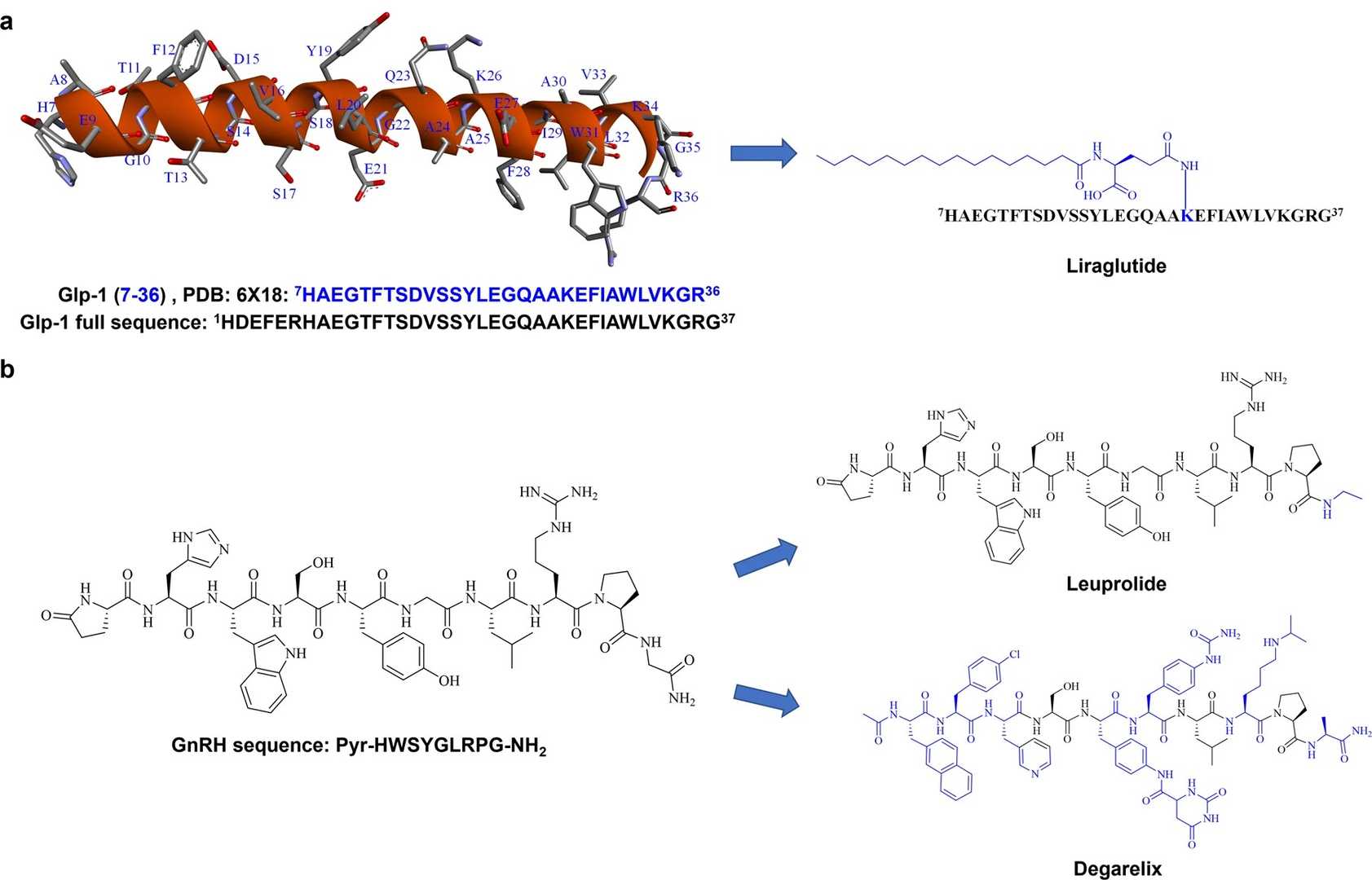 Figure 1. Sequences and structures of natural hormones GLP-1 and GnRH and their peptidomimetic drugs. a Liraglutide is a GLP-1 derived peptide drug, modified on 26th residue (K) of its natural sequence. b Leuprolide and degarelix are modified from the natural sequence of GnRH. (Wang et al., 2022)
| Service Component | Description |
| Peptide Design & Sequence Optimization | Computational solubility prediction, stability optimization, modification strategy consulting, and retro-inverso design support to maximize the likelihood of successful synthesis and biological activity. |
| Solid-Phase Peptide Synthesis | Fmoc/tBu chemistry using both automated and manual synthesis platforms, supporting peptides from 5 to 100+ amino acid residues at scales ranging from milligram to gram quantities. |
| Peptide Modifications & Labeling | Comprehensive modification portfolio including phosphorylation, acetylation, fluorescent labeling (FAM, TAMRA, FITC), biotinylation, cyclization (head-to-tail, disulfide, stapled), non-natural amino acids, and PEGylation. |
| Purification & Quality Control | Reverse-phase HPLC purification, MALDI-TOF/ESI-MS identity confirmation, purity assessment to >95%, with optional amino acid analysis (AAA) and peptide content determination. |
| Scale-Up & GMP Synthesis | Seamless transition from research-grade to GMP-grade production with batch-to-batch consistency, full regulatory documentation, and milligram to multi-gram manufacturing capacity. |
Background:
A client was developing inhibitors of the MDM2-p53 protein-protein interaction, a high-value oncology target that has historically been considered "undruggable" by conventional small molecules. Cyclic peptides offer a promising modality for such targets due to their constrained conformations and enhanced binding affinity, but their synthesis presents significant challenges in ring closure efficiency and side-chain compatibility.
Our Solution:
Profacgen designed and synthesized a series of 15 head-to-tail cyclic peptides with varying ring sizes and side chain modifications. Using Fmoc-based SPPS on 2-chlorotrityl chloride resin, linear precursors were assembled, cleaved under mild conditions with protected side chains, and cyclized in dilute solution to minimize dimerization. Cell permeability was systematically optimized through selective N-methylation of backbone amides identified by computational modeling.
Final Results:
All 15 cyclic peptides were delivered at >95% purity with confirmed molecular weights by ESI-MS. The lead compound exhibited an IC50 of 200 nM in a fluorescence polarization binding assay and showed measurable cellular activity in a p53 reporter assay, advancing the client's lead optimization campaign.
Background:
A research group investigating kinase signaling pathways required a defined library of phosphorylated peptides to profile substrate specificity across a panel of recombinant kinases. Site-specific phosphorylation at Ser, Thr, and Tyr residues demands specialized coupling conditions and careful deprotection to avoid beta-elimination and other side reactions.
Our Solution:
Profacgen synthesized a library of 48 peptides (12-15 residues in length) with site-specific phosphorylation at designated Ser, Thr, or Tyr positions. Phosphorylated building blocks (Fmoc-Ser(PO(OBzl)OH)-OH, Fmoc-Thr(PO(OBzl)OH)-OH, and Fmoc-Tyr(PO(OBzl)OH)-OH) were incorporated using extended coupling times and enhanced coupling reagents. Peptides were printed onto arrays for quantitative kinase activity measurements.
Final Results:
All 48 phosphorylated peptides were delivered at >98% purity as confirmed by analytical HPLC and MALDI-TOF MS, with no detectable dephosphorylated byproducts. The high purity enabled quantitative kinase specificity profiling, revealing previously uncharacterized substrate preferences for two client kinases of interest.
References:
Fill out this form and one of our experts will respond to you within one business day.