We use cookies to understand how you use our site and to improve the overall user experience. This includes personalizing content and advertising. Read our
Privacy Policy
Saturation mutagenesis is a systematic protein engineering approach in which every amino acid position of interest is simultaneously substituted with all 20 natural amino acids. By comprehensively sampling all possible side-chain chemistries at specific sites, saturation mutagenesis reveals the complete contribution of each position to protein stability, catalytic efficiency, ligand recognition, and conformational dynamics. This method represents one of the most powerful strategies for mapping structure-function relationships and optimizing proteins for research, diagnostic, and therapeutic applications.
At Profacgen, we design saturation mutagenesis libraries using codon degeneracy strategies that maximize amino acid coverage while minimizing the frequency of stop codons and reducing screening burden. Whether your project requires interrogating a single critical residue, scanning a functional domain, or performing iterative rounds of combinatorial optimization, our platform delivers sequence-verified libraries with the diversity and quality your screening campaign demands.
Background: Codon Degeneracy and the Rise of Smart Libraries
Saturation mutagenesis exploits the degeneracy of the genetic code by incorporating nucleotide mixtures at target codons during oligonucleotide synthesis, generating libraries in which each position encodes multiple amino acids rather than a single one. Effective codon design must balance amino acid diversity with stop-codon suppression and library size control.
A key advance was iterative saturation mutagenesis (ISM), introduced by Reetz and colleagues in the early 2000s. ISM applies sequential rounds of mutagenesis to promising positions, progressively enriching for optimal genotypes. This iterative strategy drastically reduces screening demands while often yielding superior variants compared to simultaneous multi-site approaches.
Figure 1. Schematic illustration of iterative saturation mutagenesis involving (as an example) four randomization sites A, B, C and D: confined protein sequence space for evolutionary enzyme optimization. (Reetz and Carballeira, 2007)
Complementing ISM, the observation that natural evolution favors conservative substitutions inspired "smart" codons such as NDT and DBK, which encode chemically diverse yet physico-chemically balanced amino acid subsets. These reduced-degeneracy designs produce smaller, higher-quality libraries with improved hit rates—particularly advantageous when screening capacity is limited.
Codon Degeneracy Strategies
The choice of degenerate codon scheme directly impacts library quality, size, and screening efficiency. Profacgen employs several established and custom codon designs tailored to your project goals:
Codon Strategy
Amino Acid Coverage
Stop Codon Frequency
Relative Library Size
Best Suited For
NNK
All 20 AA
1/32 (3.1%)
Medium (32 codons)
General screening; balanced diversity
NNS
All 20 AA
1/32 (3.1%)
Medium (32 codons)
General screening; alternative to NNK
NDT
12 AA (A,F,H,I,L,N,R,S,T,V,Y)
0%
Small (12 codons)
Focused diversity; reduced screening
DBK (D = A/G/T)
8 AA (A,C,D,G,H,P,R,S)
0%
X-Small (8 codons)
Conservative exploration; structure-focused
Custom Mixed
Tailored
Minimized
Optimized
Position-specific requirements; smart libraries
The NNK and NNS codon schemes (where N = A/C/G/T; K = G/T; S = G/C) are the most widely used standard designs because they encode all 20 natural amino acids with only a single stop codon (TAG for NNK, TGA for NNS) out of 32 possibilities. Compared to NNN degeneracy, which generates 64 codons including three stop codons (4.7% frequency), NNK/NNS reduces the stop codon burden by more than 50% while maintaining complete amino acid coverage.
NDT and other reduced-degeneracy schemes sacrifice some amino acid diversity in exchange for dramatically smaller library sizes and zero stop codons. These "smart" libraries are ideal when screening capacity is limited or when structural considerations suggest that only certain amino acid classes are likely to be tolerated at a given position.
Our Saturation Mutagenesis Services
Single-Site Saturation
Complete amino acid scan at one defined position.
All 20 natural amino acids encoded at a single codon
NNK/NNS or custom codon design
19 functional variants + wild-type (20 total)
Ideal for validating computationally predicted hotspot residues
Fast turnaround: 2–3 weeks
Multi-Site Simultaneous Saturation
Parallel saturation of multiple discrete positions in one library.
Structure-function relationship mapping: Generate a complete positional sensitivity profile that correlates amino acid identity with functional readouts, enabling data-driven protein engineering decisions
Enzyme catalytic efficiency optimization: Identify amino acid substitutions at active-site proximal positions that enhance turnover rate (kcat), improve substrate affinity (KM), or relax substrate specificity
Protein-ligand interaction engineering: Redesign binding interfaces to increase affinity, alter specificity, or introduce allosteric regulation
Thermostability engineering: Discover mutations that increase melting temperature (Tm) or prolong half-life at elevated temperatures for industrial or therapeutic applications
pH profile modification: Shift enzyme activity optima toward acidic or alkaline conditions to match process requirements
Substrate specificity alteration: Convert enzymes to accept non-natural substrates or exclude competing substrates from the active site
Epitope mapping at single-residue resolution: Define antibody footprints by determining which positions must be conserved for binding and which can be freely substituted
Fluorescent protein engineering: Tune excitation/emission spectra, brightness, and photostability by saturating key chromophore-proximal positions
Why Choose Profacgen?
Comprehensive Amino Acid Coverage: Every position is evaluated with all 20 natural amino acids, ensuring no beneficial substitution is overlooked.
Codon-Optimized Library Design: NNK, NNS, NDT, and custom degeneracy schemes minimize stop codons, reduce library size, and maximize functional diversity.
Reduced Screening Burden: Smart codon strategies and iterative saturation approaches cut screening effort by 50–75% compared to naive NNN designs.
Compatible with Multiple Expression Systems: Libraries are delivered in vectors ready for expression in E. coli, yeast, insect, or mammalian hosts.
Expert Data Analysis Support: Optional high-throughput screening and statistical analysis convert variant libraries into actionable insights, including positional sensitivity scores and fitness landscapes.
Representative Case Studies
Case 1: Iterative Saturation of an Industrial Lipase for High-Temperature Detergent Application
Background:
A consumer products company required a thermostable lipase variant capable of retaining >80% activity after 30 minutes at 60 °C for next-generation detergent formulations. Wild-type lipase lost 70% of activity under these conditions, and rational design had failed to identify effective stabilizing mutations, suggesting that distributed, non-obvious mutations would be necessary.
Our Solution:
Profacgen executed a three-round iterative saturation mutagenesis (ISM) campaign. Round 1 saturated 8 surface-exposed positions predicted to influence thermostability using NNK codons. Screening identified 4 beneficial mutations at 3 positions. Round 2 saturated combinations of these positions plus 4 newly identified proximal hotspots using NDT codons to manage library size. Round 3 combined the most promising mutations and subjected them to focused NDT-based saturation to fine-tune packing interactions. All variants were expressed in Bacillus subtilis and screened for residual activity after heat challenge.
Final Results:
The optimized variant (containing 5 mutations: L92F, A154V, T178S, Q231L, K289R) retained 94% activity after 30 minutes at 60 °C and exhibited a 12 °C increase in Tm compared to wild-type. Importantly, catalytic efficiency on triglyceride substrates was maintained, and expression yield in the production host improved by 40%. The engineered biocatalyst was transferred to pilot-scale detergent formulation trials within 6 months of project initiation, meeting all performance benchmarks for commercial development.
Case 2: Rewiring the Substrate Specificity of a Kinase for Targeted Cancer Therapeutics
Background:
A precision medicine program sought to develop a kinase variant that could selectively phosphorylate a non-natural amino acid analog incorporated into a tumor-targeting antibody, enabling site-specific payload conjugation. The wild-type kinase phosphorylated the natural substrate (tyrosine) efficiently but showed negligible activity on the bulky analog (para-azidophenylalanine), which was 3Å larger and had distinct electrostatic properties.
Our Solution:
Profacgen designed a regional saturation scanning campaign targeting the 18 residues lining the kinase ATP-binding pocket. Each position was saturated using NNK codons, generating a library of 360 variants. The library was expressed in E. coli as GST-fusions and screened using a coupled spectrophotometric assay with the non-natural amino acid analog as phosphate acceptor. Positions showing improved analog phosphorylation were subjected to second-round saturation with focused subsets of amino acids identified in Round 1.
Final Results:
A double mutant (M78L, V121A) emerged with a 65-fold improvement in kcat/KM for the non-natural substrate, achieving catalytic efficiency comparable to wild-type activity on natural tyrosine. The enlarged binding pocket created by V121A accommodated the azido group, while M78L optimized the positioning of the γ-phosphate for transfer. Importantly, the variant showed >200-fold selectivity for the analog over competing natural amino acids, enabling clean site-specific conjugation. The engineered kinase was subsequently incorporated into the company's antibody-drug conjugate manufacturing process.
Q: What is the difference between NNK and NNS codon schemes?
A: Both NNK and NNS encode all 20 natural amino acids with a single stop codon (3.1% frequency). The difference lies in the third codon position: NNK uses G or T at the third position, producing the stop codon TAG; NNS uses G or C, producing the stop codon TGA. From a practical standpoint, both schemes perform equivalently for most applications. NNK is slightly more commonly used in the literature. Our scientists can advise on the optimal choice based on your expression host and downstream assay requirements.
Q: How many positions can be saturated simultaneously?
A: The number of simultaneously saturated positions depends on your screening capacity. Each additional position increases library size by a factor of 20 (for NNK/NNS). As a practical guideline: single-site saturation generates ~20 clones; 2-site generates ~400; 3-site generates ~8,000; 4-site generates ~160,000. For multi-site projects, we often recommend reduced-degeneracy codons (NDT, DBK) or iterative strategies to keep library sizes within manageable screening limits. We work with you to design a project scope that matches your resources.
Q: What library size should I aim for to achieve good coverage?
A: For NNK/NNS libraries encoding all 20 amino acids at one position, we recommend screening at least 100–200 clones to achieve >95% coverage of all possible amino acids. For multi-site libraries, the target scales with library complexity. Our team calculates the required screening depth during project design to ensure your experimental investment yields statistically meaningful results. For reduced-degeneracy schemes (NDT, DBK), smaller screens (50–100 clones) are typically sufficient.
Q: Can you completely eliminate stop codons from saturation libraries?
A: Yes. By using reduced-degeneracy codon schemes such as NDT (12 amino acids, 0% stop), DBK (8 amino acids, 0% stop), or fully custom codon mixtures, we can design libraries with absolutely no stop codons. The trade-off is reduced amino acid coverage. For many applications, a carefully selected subset of amino acids provides sufficient diversity. We help you balance coverage against library quality based on your project goals.
Q: Which expression systems do you support for saturation libraries?
A: We deliver saturation mutagenesis libraries in vectors compatible with all major expression systems: E. coli (various T7 and tac-based systems), Pichia pastoris (pPICZ, pGAPZ series), Saccharomyces cerevisiae (pYES, pESC series), insect cells (pFastBac for BEVS/BacMam), and mammalian cells (pcDNA3.1, pTT5, and custom vectors). If you require a specific vector backbone not listed here, we can accommodate custom cloning as part of the project scope.
Q: How does iterative saturation mutagenesis (ISM) differ from simultaneous multi-site saturation?
A: In simultaneous multi-site saturation, all target positions are randomized in a single library. This approach can discover synergistic mutations but generates large libraries that may exceed screening capacity. ISM applies saturation to one or a few positions per round, identifies beneficial mutations, combines them, and proceeds to the next round. ISM typically requires smaller screens per round and often discovers superior mutants by allowing beneficial combinations to emerge sequentially. We recommend ISM for most enzyme optimization projects and simultaneous saturation when epistatic interactions are expected to be strong.
Q: Do you provide statistical analysis of screening data?
A: Yes. Our optional data analysis package includes: positional sensitivity scores (quantifying how much each position contributes to the measured phenotype), amino acid preference profiles (identifying which substitutions are tolerated or beneficial at each position), fitness landscape visualization, and recommendations for follow-up experiments. This analysis transforms raw screening data into actionable engineering insights.
References:
Reetz MT, Carballeira JD. Iterative saturation mutagenesis (ISM) for rapid directed evolution of functional enzymes. Nat Protoc. 2007;2(4):891-903. doi:10.1038/nprot.2007.72
Online Inquiry
Fill out this form and one of our experts will respond to you within one business day.

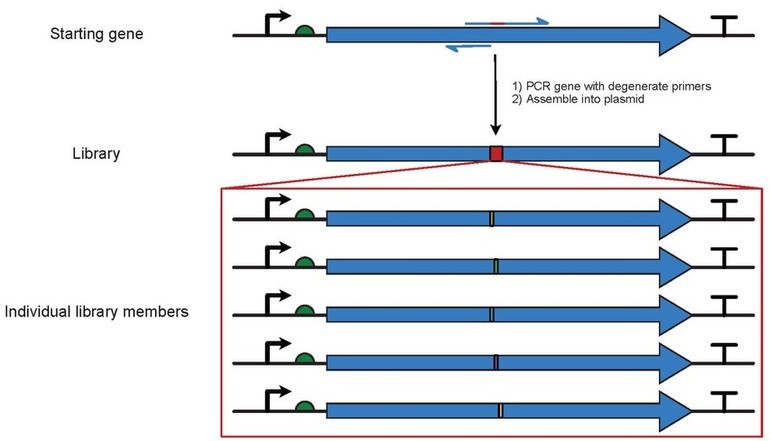
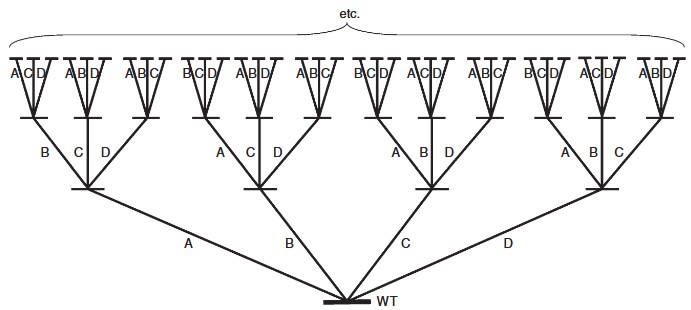 Figure 1. Schematic illustration of iterative saturation mutagenesis involving (as an example) four randomization sites A, B, C and D: confined protein sequence space for evolutionary enzyme optimization. (Reetz and Carballeira, 2007)