
Severe acute respiratory syndrome coronavirus 2 (SARS-CoV-2) has demonstrated substantial genomic diversity since its emergence, with mutations accumulating across structural, nonstructural, and accessory proteins. These variations can alter receptor binding, antigenic profiles, viral fitness, and therapeutic susceptibility. Access to well-characterized recombinant mutant proteins is therefore essential for research programs investigating variant-specific immune responses, therapeutic efficacy, vaccine cross-protection, and diagnostic assay performance.
At Profacgen, we provide a Customized Expression Service of Mutant SARS-CoV-2 Proteins designed to produce research-grade recombinant viral proteins with defined sequence variations. Our integrated platform supports construct design, expression optimization, purification, and analytical characterization, enabling scientists to obtain reliable protein reagents tailored to specific variant sequences and research objectives.
We support expression of mutant proteins across key SARS-CoV-2 targets, including:
By combining molecular biology expertise with multi-system expression capabilities, we help clients generate the variant-specific reagents needed to keep pace with evolving virological and immunological research demands.
SARS-CoV-2 variants of concern and interest have introduced amino acid substitutions, deletions, and insertions that can meaningfully alter protein structure and function. Research programs increasingly require recombinant proteins that faithfully recapitulate these specific changes rather than relying solely on ancestral strain sequences.
Common research drivers for mutant protein expression include:
Commercially available protein catalogs may not cover newly identified or client-specific mutations. Customized expression services bridge this gap by producing defined variants on demand with documented sequence fidelity and quality attributes.
Profacgen can express SARS-CoV-2 proteins with client-specified mutations, deletions, or domain boundaries. The following table summarizes representative targets and the types of modifications that can be incorporated.
| Protein Target | Common Construct Forms | Representative Mutations Supported |
|---|---|---|
| Spike (S) full-length or ectodomain | Trimeric, soluble ectodomain, S1 subunit, S2 subunit, prefusion-stabilized | N501Y, E484K/Q/A, K417N/T, L452R/Q, T478K, P681H/R, D614G, and client-defined substitutions |
| Receptor-binding domain (RBD) | Monomeric or dimeric, tagged or tag-free, biotinylated | Single or combinatorial mutations in the receptor-binding motif; domain deletions |
| Nucleocapsid (N) | Full-length, N-terminal domain, C-terminal domain, phosphomimetic variants | Client-defined point mutations, truncation variants |
| Main protease (Mpro/3CLpro) | Active enzyme, catalytic-site mutants, substrate-binding variants | Resistance-associated mutations; catalytic triad modifications |
| Papain-like protease (PLpro) | Full-length catalytic domain, deubiquitinase-active variants | Client-defined active-site or substrate-binding mutations |
| Other nonstructural proteins | Domain constructs, full-length variants | Project-specific mutations based on sequence requirements |
Construct boundaries, fusion tags, stabilization mutations (such as proline substitutions in the spike ectodomain), and oligomeric states are reviewed during project consultation to align the protein design with the intended downstream application.
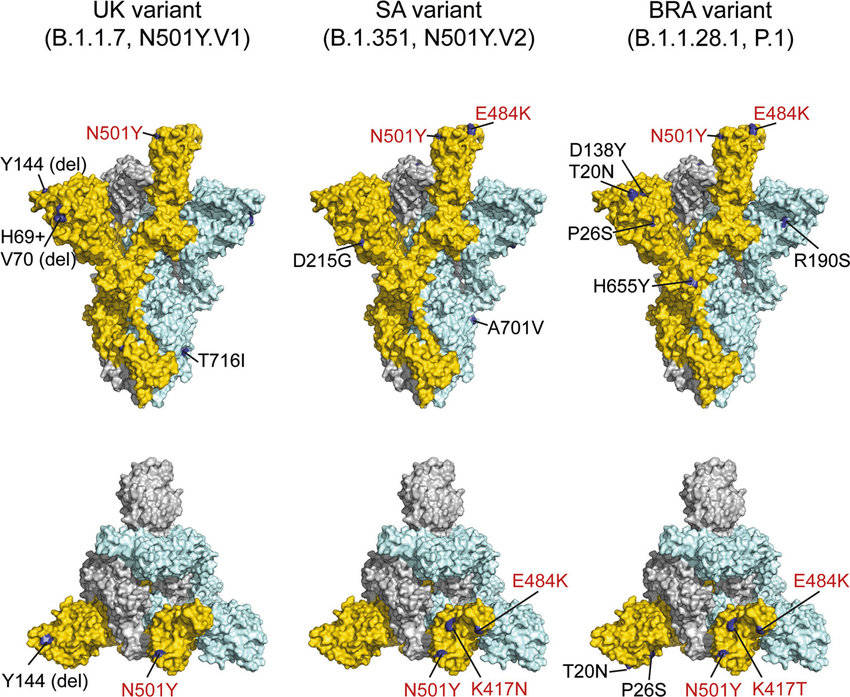 Figure 1. SARS-CoV-2 spike protein with mutations of variants. (Heinz and Stiasny, 2021)
Selection of the appropriate expression system depends on protein size, post-translational modification requirements, solubility, yield targets, and downstream assay compatibility. Profacgen offers multiple platforms and can evaluate more than one system when project requirements warrant comparative assessment.
| Expression System | Typical Applications | Key Considerations |
|---|---|---|
| Escherichia coli | Intracellular domains, catalytic domains, N protein fragments, small RBD constructs | High yield, rapid turnaround, no glycosylation; inclusion body risk for complex domains |
| Pichia pastoris (yeast) | Secreted glycoproteins, medium-complexity domains | Eukaryotic folding machinery, glycosylation (high-mannose type), scalable fermentation |
| Mammalian (HEK293/CHO) | Spike ectodomain, RBD, full-length S protein, complex glycoproteins | Native-like glycosylation, proper disulfide formation, trimerization support; higher cost and longer timeline |
| Baculovirus-insect cell | Large multidomain proteins, proteins requiring moderate glycosylation | High expression levels for secreted proteins, compatible with complex folding requirements |
For spike and RBD proteins intended for antibody binding or vaccine-related studies, mammalian expression systems are generally preferred due to their ability to produce properly folded, glycosylated proteins that more closely resemble native viral antigens. For enzymatic or intracellular domains, bacterial or yeast systems may provide efficient alternatives.
Each project follows a structured workflow designed to maximize the probability of producing soluble, active, and well-characterized protein:
Protein quality is assessed through a fit-for-purpose analytical panel selected according to the protein type and intended use. Standard characterization may include:
Analytical depth is tailored to the project. A protein intended for crystallization may require higher purity and homogeneity standards than one used for preliminary western blot controls. We discuss analytical requirements during project setup to avoid unnecessary cost or insufficient characterization.
Customized SARS-CoV-2 mutant proteins from Profacgen have supported diverse research programs:
Challenge:
A research group required milligram quantities of a recombinant SARS-CoV-2 RBD variant carrying three clinically relevant mutations (N501Y, E484K, and K417N) for use in neutralization surrogate assays and antibody epitope mapping. Initial attempts using an in-house bacterial expression system yielded insoluble, aggregated protein that failed to bind ACE2 in surface plasmon resonance (SPR) assays, suggesting improper folding and lack of native disulfide formation.
Solution:
Profacgen transitioned the project to a mammalian HEK293 expression platform with a secretion signal peptide to enable disulfide bond formation in the oxidizing endoplasmic reticulum environment. We evaluated three fusion tag configurations (His-tag, Fc-fusion, and tag-free) in parallel small-scale expressions. The His-tagged construct demonstrated superior soluble yield and monodispersity. Scale-up to 3-liter suspension cultures, followed by nickel affinity purification and preparative size-exclusion chromatography, produced highly homogeneous protein.
Outcome:
The purified RBD variant was delivered at >95% purity by SDS-PAGE and SEC-HPLC, with endotoxin levels below 0.1 EU/μg. SPR analysis confirmed high-affinity ACE2 binding with a dissociation constant comparable to published values for the same variant. The client successfully employed the protein in a panel of competitive binding assays, enabling comparative assessment of therapeutic antibody susceptibility across multiple variant RBDs.
Challenge:
A vaccine development team needed a harmonized panel of prefusion-stabilized spike ectodomain trimers representing five distinct SARS-CoV-2 variants for use in serological cross-reactivity studies. The challenge lay in producing structurally consistent trimers across all variants, as certain mutations introduced expression level variability, trimerization defects, or aggregation propensity that compromised assay comparability.
Solution:
Profacgen designed a unified construct architecture incorporating the same proline-stabilizing mutations (2P or 6P), furin cleavage site modification, and C-terminal trimerization motif across all variant sequences. Expression was conducted in CHO suspension cells under harmonized culture conditions. For variants with lower initial yields, we optimized transfection protocols and evaluated temperature-shift strategies during expression. Purification employed a standardized two-step protocol: Strep-Tactin affinity chromatography followed by polishing size-exclusion chromatography.
Outcome:
All five variant spike trimers were delivered with consistent purity (>90%), confirmed trimeric state by native PAGE and SEC-MALS, and comparable endotoxin profiles. The harmonized production approach minimized batch-to-batch technical variation, enabling the client to conduct reliable cross-variant serological comparisons. The panel supported identification of variant-specific neutralization gaps that informed subsequent vaccine candidate refinement.
Request a Project Consultation
References:
Fill out this form and one of our experts will respond to you within one business day.