Neutralizing Antibody (NAb) Test Service
Neutralizing antibody (NAb) testing addresses a critical question in immunogenicity assessment: do antibodies present in a subject's sample inhibit the biological activity of the therapeutic product? While anti-drug antibody (ADA) evaluation determines whether antibodies bind to the drug, NAb testing specifically measures whether those antibodies interfere with the drug's intended mechanism of action. This functional distinction is essential because not all binding ADAs possess neutralizing activity, yet NAbs can directly compromise therapeutic efficacy and alter pharmacodynamic responses.
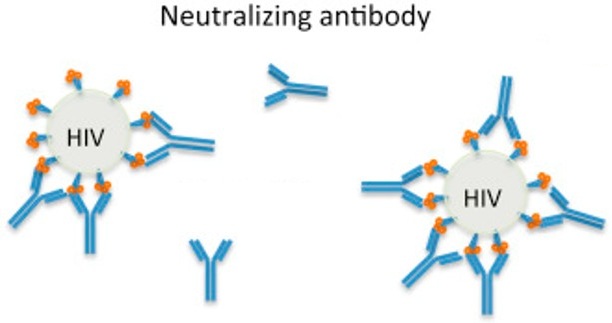
At Profacgen, we provide specialized Neutralizing Antibody (NAb) Test Services designed to evaluate functional antibody-mediated inhibition across diverse biologic modalities. Our approach emphasizes mechanism-of-action-driven assay selection, rigorous assay development, and careful interpretation of results within the broader context of ADA, PK/PD, and clinical data.
A fundamental principle guides our NAb programs: all NAbs are drug-reactive antibodies, but not all binding ADAs have neutralizing activity. This distinction underlies our assay design philosophy and our recommendations for when and how NAb testing should be conducted.
When Is NAb Testing Needed?
The decision to conduct NAb testing should be based on a risk-based assessment of the therapeutic's mechanism, clinical consequences of neutralization, and regulatory requirements. NAb testing is typically indicated in the following scenarios:
- Follow-up characterization of confirmed ADA-positive samples: Once ADA binding is confirmed, NAb testing determines whether those antibodies functionally inhibit drug activity.
- Clinical immunogenicity assessment: Regulatory agencies often expect NAb characterization for products where neutralization could affect efficacy or safety.
- Nonclinical toxicology or PK studies: NAb data in animal models helps interpret exposure reductions, efficacy changes, or immune complex-related findings.
- Investigation of reduced therapeutic response: Unexplained loss of efficacy in clinical or nonclinical settings may prompt targeted NAb investigation.
- Biosimilar immunogenicity comparison: Comparative NAb assessment supports demonstration of similar immunogenicity profiles between biosimilar and reference products.
- Post-market loss-of-efficacy investigations: Rare cases of treatment failure in commercial settings may warrant retrospective NAb analysis.
- Risk-based testing for high-consequence biologics: Therapeutics with narrow therapeutic windows, life-sustaining indications, or known immunogenicity liabilities may require comprehensive NAb monitoring regardless of observed clinical signs.
Whether to test all confirmed ADA-positive samples or to apply a reflex-testing strategy depends on the product risk profile, the regulatory pathway, and the specific study protocol. Profacgen advises clients on appropriate testing strategies during study design.
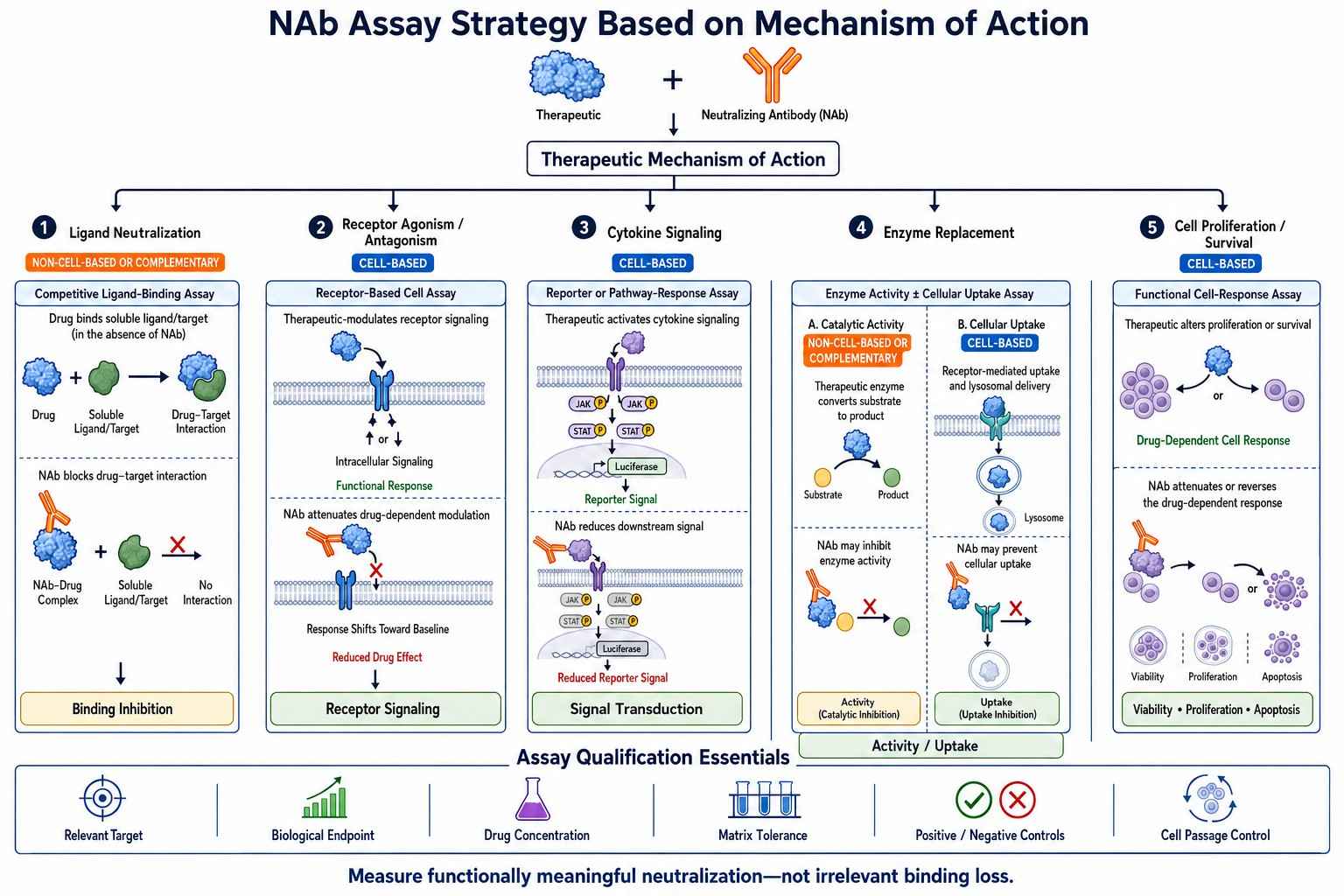
NAb Assay Strategy Based on Mechanism of Action
NAb assay design must reflect the therapeutic's biological mechanism. An assay that measures irrelevant binding inhibition provides little insight into clinically meaningful neutralization. Profacgen employs a mechanism-driven strategy that begins with thorough understanding of the drug's mode of action.
| Therapeutic Mechanism |
Preferred Assay Concept |
| Ligand neutralization |
Competitive ligand-binding assay measuring inhibition of drug-target interaction |
| Receptor agonism or antagonism |
Receptor-based cell assay evaluating functional modulation of receptor signaling |
| Cytokine signaling |
Reporter gene assay or pathway-response assay measuring downstream signal transduction |
| Enzyme replacement |
Enzyme activity inhibition assay quantifying catalytic function suppression |
| Cell proliferation or survival effect |
Functional cell-response assay measuring viability, proliferation, or apoptotic endpoints |
Our mechanism-of-action evaluation encompasses identification of the therapeutic's primary biological target, selection of a biologically relevant assay endpoint, evaluation of target, receptor, and downstream signaling pathways, consideration of drug concentration and expected exposure profiles, and definition of appropriate positive and negative controls. This foundation ensures that NAb results reflect functionally meaningful inhibition rather than artifactual signal suppression.
Cell-Based NAb Assays
Cell-based assays are generally preferred when the therapeutic's mechanism involves cellular signaling, receptor modulation, or functional cellular responses. These assays more closely replicate the drug's biological context, though they introduce additional complexity compared to ligand-binding formats.
Mechanism-relevant Cell Line Selection
Use of cell lines expressing the appropriate endogenous or engineered receptors, signaling pathways, and response elements.
Endogenous versus Engineered Receptor Expression
Evaluation of whether naturally expressing cell lines or transfected reporter systems better capture the therapeutic mechanism.
Reporter Gene Assays
Luciferase, GFP, or secreted alkaline phosphatase reporters linked to drug-responsive promoters for quantitative signal readout.
Phosphorylation and Signaling Readouts
Assessment of specific signaling intermediates (e.g., STAT phosphorylation, MAPK activation) by flow cytometry or western blot.
Cytokine-response Assays
Quantification of drug-induced cytokine production or suppression in responsive cell populations.
Assay Dynamic Range
Optimization of drug concentration and cell density to achieve robust signal windows suitable for detecting partial and complete neutralization.
Cell Passage and Performance Controls
Monitoring of cell line stability, passage limits, and batch-to-batch consistency to ensure assay reproducibility.
Cell-based assays offer superior biological relevance but may exhibit higher variability, matrix toxicity (particularly at low sample dilutions), longer development timelines, and stringent cell-bank and passage control requirements. Profacgen addresses these challenges through rigorous cell line qualification, optimized sample dilution protocols, and comprehensive system suitability criteria.
Competitive Ligand-Binding NAb Assays
Competitive ligand-binding assays represent an alternative or complementary approach, particularly when the therapeutic functions through direct target binding without requiring cellular signal transduction. These assays measure whether sample antibodies prevent the drug from binding to its soluble or surface-immobilized target.
Drug–Target Or Drug–Receptor Competition
Evaluation of antibody-mediated inhibition of the therapeutic's binding to its cognate target.
Assay Design Principles
Optimization of drug and target concentrations, detection reagents, and plate formats to maximize competitive signal.
Detection Formats
ELISA, ECL, or other surface-based methods configured for competitive inhibition readout.
ApproPriate Use Cases
Most suitable for therapeutics where binding inhibition directly correlates with functional neutralization, such as simple ligand-blocking antibodies.
Advantages in Robustness And Throughput
Generally lower variability, higher throughput, and simpler reagent requirements compared to cell-based methods.
Limitations
Competitive ligand-binding assays may not fully represent biological neutralization when the therapeutic mechanism involves complex cellular events, receptor internalization, or signal transduction cascades that are not captured by binding inhibition alone.
Profacgen does not advocate competitive ligand-binding assays as universal replacements for cell-based methods. Platform selection is determined by the therapeutic mechanism, assay feasibility, and the clinical relevance of the measured endpoint.
NAb Assay Development and Optimization
Successful NAb assay development requires meticulous attention to reagent quality, assay conditions, and analytical performance. Profacgen follows a systematic optimization workflow:
- Critical reagent selection: Identification and qualification of drug, target, receptor, detection antibodies, and cell reagents with appropriate purity, activity, and stability.
- Positive control NAb: Generation, procurement, or characterization of antibodies with confirmed neutralizing activity to serve as assay controls and sensitivity benchmarks.
- Drug and target concentrations: Titration to identify concentrations that produce robust assay signals while remaining sensitive to neutralizing antibody inhibition.
- Incubation conditions: Optimization of sample pre-incubation time, temperature, and buffer composition to maximize antibody-drug interaction while preserving sample integrity.
- Sample dilution: Determination of minimum required dilution (MRD) that reduces matrix effects without compromising NAb detection sensitivity.
- Assay signal window: Quantitative evaluation of the dynamic range between maximal and minimal assay responses.
- Dose–response characterization: Evaluation of positive control antibody titration curves to confirm assay sensitivity and establish quantitative relationships.
- Matrix compatibility: Assessment of serum, plasma, or other biological matrices for cytotoxicity, nonspecific inhibition, and background signal contributions.
- System suitability controls: Definition of acceptance criteria for positive controls, negative controls, and drug-only reference wells.
Drug Tolerance and Matrix Effects
NAb detection is frequently complicated by residual circulating therapeutic, soluble targets, and matrix components that can obscure or mimic neutralizing activity.
- Residual circulating therapeutic: Unbound drug can saturate target or receptor binding sites, requiring higher sample dilution or acid dissociation strategies to liberate NAb for detection.
- Soluble target and receptor interference: Endogenous or shed target molecules can bind drug and prevent NAb-mediated inhibition, or conversely, can compete with assay targets and produce false signals.
- Serum or plasma matrix effects: Nonspecific inhibitors, complement components, or growth factors in biological matrices may suppress assay signals independently of specific NAb activity.
- Complement and nonspecific cellular effects: In cell-based assays, complement activation or immune complex-mediated cytotoxicity may confound functional readouts.
- Sample cytotoxicity: Undiluted or minimally diluted serum or plasma may directly kill assay cells, producing signal suppression that mimics neutralization.
- Strategies for improving drug tolerance: Acid dissociation, increased pre-incubation time, optimized MRD, and alternative assay architectures.
- Confirming that inhibition is antibody mediated: Immunodepletion controls, isotype-specific secondary reagents, and immunoglobulin fractionation to verify that observed inhibition is attributable to antibodies rather than matrix artifacts.
For cell-based assays, particular care is taken to distinguish true neutralizing activity from sample-induced cytotoxicity or nonspecific cellular suppression through appropriate controls and dilution-response analysis.
NAb Assay Qualification and Validation
Profacgen conducts assay qualification for nonclinical and early-phase studies, and full validation for pivotal clinical trials, following systematic protocols that demonstrate assay fitness for purpose.
- Cut-point determination: Statistical analysis of drug-naïve subject matrices to establish the threshold for NAb-positive classification.
- Sensitivity: Lowest concentration of positive control NAb reliably detected at the established cut point.
- Precision: Intra-run and inter-run variability for controls and representative samples.
- Specificity: Confirmation that the assay detects neutralizing antibodies and not unrelated matrix inhibitors.
- Selectivity: Performance in disease-state matrices, concomitant medications, and relevant patient populations.
- Drug tolerance: Maximum residual drug concentration that does not preclude NAb detection.
- Matrix interference: Evaluation of nonspecific inhibition from diverse subject matrices.
- Robustness: Tolerance to minor deviations in incubation time, temperature, cell passage, or reagent lots.
- Cell-based assay system suitability: Cell viability, passage limit compliance, and positive control performance criteria specific to cell-based formats.
- Positive control performance: Consistent dose-response and acceptable variability across runs and operators.
- Sample and reagent stability: Integrity of positive controls, negative controls, and study samples under defined storage and handling conditions.
For qualitative or semi-quantitative NAb methods, results are reported as positive/negative status or relative neutralizing titers rather than precise antibody concentrations, avoiding over-interpretation of data.
Sample Testing and Result Interpretation
NAb results gain meaning only when interpreted within the broader immunogenicity, pharmacokinetic, and clinical context. Profacgen provides integrated data analysis and interpretation support.
- Testing population and reflex-testing strategy: Clear protocols defining which samples undergo NAb testing based on ADA status, study phase, or risk-based criteria.
- Screening or confirmatory logic: Application of defined cut points and repeat criteria to classify samples as NAb-positive or NAb-negative.
- Determination of NAb-positive status: Rigorous application of statistical cut points with documented adjudication rules for borderline results.
- Titer or relative neutralizing activity: Serial dilution analysis to estimate the relative magnitude of neutralizing capacity.
- Repeat and dilution analysis: Defined rules for retesting samples with equivocal results or inadequate assay performance.
- Integration with ADA results: Correlation of NAb status with confirmed ADA binding, titer, and isotype data.
- Correlation with PK, PD, efficacy, and safety: Evaluation of whether NAb-positive status associates with reduced drug exposure, loss of pharmacodynamic response, diminished clinical efficacy, or adverse events.
- Persistent versus transient neutralizing responses: Characterization of NAb duration to distinguish sustained functional inhibition from temporary neutralizing activity.
| ADA Result |
NAb Result |
General Interpretation |
| Negative |
Not tested / Negative |
No detected drug-reactive antibody response |
| Positive |
Negative |
Binding ADA detected without demonstrated neutralizing activity |
| Positive |
Positive |
ADA with measurable functional neutralization; may correlate with reduced efficacy |
| Negative |
Apparent positive |
Requires investigation for nonspecific matrix effects, assay artifacts, or pre-analytical variables |
NAb Testing for Biosimilars
Biosimilar development requires careful consideration of how NAb assays are applied to both the biosimilar candidate and its reference product.
- Comparative assay applicability: Evaluation of whether a single NAb assay can measure neutralizing antibodies against both the biosimilar and reference product with equivalent sensitivity.
- Evaluation of biosimilar and reference product: Confirmation that the assay responds equivalently to neutralizing antibodies directed against either product.
- Cross-reactive NAb responses: Demonstration that anti-biosimilar and anti-reference NAbs are detected with comparable assay performance.
- Consistent assay sensitivity: Equivalent positive control response and sensitivity limits across both products.
- Single-assay strategy where appropriate: When structural and functional similarity supports a single assay, streamlined comparative testing is implemented.
- Interpretation within comparative clinical immunogenicity studies: NAb incidence, titer, and persistence data integrated into the overall biosimilar immunogenicity comparability assessment.
Deliverables
Profacgen provides comprehensive documentation to support regulatory submissions, internal reviews, and quality audits:
- NAb assay feasibility report
- Assay development and optimization data
- Qualification or validation documentation
- Cut-point and sensitivity analysis
- Sample-level NAb results
- Relative neutralizing titer or activity data
- Raw and processed data in standardized formats
- Final study report with mechanism-based interpretation
- Integrated ADA/NAb interpretation summary
Why Choose Profacgen?
- Mechanism-of-action-driven assay selection: We design NAb assays around the therapeutic's biological function, not generic binding inhibition.
- Cell-based and competitive ligand-binding options: Our capabilities span both assay paradigms, with platform selection guided by scientific rationale.
- Integration with ADA evaluation: Seamless workflow from ADA screening and confirmation to NAb functional characterization.
- Matrix- and drug-tolerance optimization: Systematic strategies to overcome circulating drug, soluble targets, and nonspecific matrix inhibition.
- Support for antibodies, proteins, enzymes, and other biologics: Broad experience across therapeutic modalities and molecular classes.
- Nonclinical, clinical, and biosimilar program support: Assays designed to meet the evolving requirements from early development through regulatory submission.
Frequently Asked Questions (FAQs)
Q: What is the difference between ADA and NAb testing?
A: ADA testing detects antibodies that bind to the therapeutic drug, regardless of functional consequence. NAb testing specifically measures whether those antibodies inhibit the drug's biological activity. All NAbs are binding ADAs, but only a subset of binding ADAs demonstrate neutralizing capacity. NAb testing therefore provides functional information that ADA binding data alone cannot deliver.
Q: Does every ADA-positive sample need NAb testing?
A: No. The need for NAb testing depends on the therapeutic's risk profile, the clinical significance of functional neutralization, regulatory guidance, and study objectives. Some programs test all confirmed ADA-positive samples, while others employ risk-based reflex testing triggered by specific clinical or pharmacokinetic findings. Profacgen advises clients on appropriate strategies during protocol design.
Q: When should a cell-based NAb assay be used?
A: Cell-based assays are preferred when the therapeutic's mechanism involves cellular signaling, receptor modulation, proliferation, or other functional cellular responses. These assays capture the biological context of drug action more accurately than binding-based methods. However, they require longer development time, rigorous cell line control, and careful management of matrix cytotoxicity.
Q: Can a competitive ligand-binding assay replace a cell-based assay?
A: Not in all cases. Competitive ligand-binding assays are suitable when binding inhibition directly corresponds to functional neutralization, such as simple ligand-blocking antibodies. However, for therapeutics whose mechanism involves receptor signaling, internalization, or complex cellular events, binding inhibition may not reflect true biological neutralization. Platform selection should be based on mechanism of action rather than convenience.
Q: How does circulating drug affect NAb detection?
A: Residual drug can saturate assay targets or receptors, preventing NAbs from producing measurable inhibition. Strategies to mitigate drug interference include acid dissociation to release antibody-drug complexes, extended sample pre-incubation, optimized sample collection timing, and higher sample dilutions. Drug tolerance is formally evaluated during assay development and reported as part of validation.
Q: How are NAb results interpreted with PK and efficacy data?
A: NAb results are most informative when integrated with pharmacokinetic exposure, pharmacodynamic markers, and clinical outcomes. A positive NAb result that coincides with reduced drug exposure, loss of target engagement, or diminished clinical response supports a causal relationship between neutralizing antibodies and compromised efficacy. Isolated NAb positivity without PK or clinical correlates may indicate subclinical neutralization that requires continued monitoring.
Related Services
References:
- Baum LL, Mathieson BJ, Connick E. Immunity to hiv. In: Encyclopedia of Immunobiology. Elsevier; 2016:342-354. doi:10.1016/B978-0-12-374279-7.14021-4
Online Inquiry
Fill out this form and one of our experts will respond to you within one business day.