We use cookies to understand how you use our site and to improve the overall user experience. This includes personalizing content and advertising. Read our
Privacy Policy
< 1.0 EU per 1 microgram of protein (determined by LAL method)
Purity
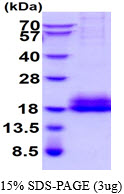
> 90% by SDS - PAGE
Storage
Can be stored at +4centigrade short term (1-2 weeks). For long term storage, aliquot and store at -20Centigrade or -70Centigrade. Avoid repeated freezing and thawing cycles.
Concentration
0.25mg/ml (determined by Absorbance at 280nm)
Warning
For research use only!
Background
This gene is a member of the immunoglobulin superfamily and encodes a protein which transmits an inhibitory signal to T cells. The protein contains a V domain, a transmembrane domain, and a cytoplasmic tail. Alternate transcriptional splice variants, encoding different isoforms, have been characterized. The membrane-bound isoform functions as a homodimer interconnected by a disulfide bond, while the soluble isoform functions as a monomer. Mutations in this gene have been associated with insulin-dependent diabetes mellitus, Graves disease, Hashimoto thyroiditis, celiac disease, systemic lupus erythematosus, thyroid-associated orbitopathy, and other autoimmune diseases.
References
Dai F., et al. (2015) Braz J Med Biol Res. 48:629-636. Ward FJ., et al. (2013) Eur J Immunol. 43:1274-1285. Romo-Tena J., et al. (2013) Autoimmun Rev. 12:1171-1176.
Tag
His tag
Species
Human
Source
Insect cells
BACKGROUND
Background
This gene is a member of the immunoglobulin superfamily and encodes a protein which transmits an inhibitory signal to T cells. The protein contains a V domain, a transmembrane domain, and a cytoplasmic tail. Alternate transcriptional splice variants, encoding different isoforms, have been characterized. The membrane-bound isoform functions as a homodimer interconnected by a disulfide bond, while the soluble isoform functions as a monomer. Mutations in this gene have been associated with insulin-dependent diabetes mellitus, Graves disease, Hashimoto thyroiditis, celiac disease, systemic lupus erythematosus, thyroid-associated orbitopathy, and other autoimmune diseases.
References
Dai F., et al. (2015) Braz J Med Biol Res. 48:629-636. Ward FJ., et al. (2013) Eur J Immunol. 43:1274-1285. Romo-Tena J., et al. (2013) Autoimmun Rev. 12:1171-1176.
Online Inquiry
Fill out this form and one of our experts will respond to you within one business day.