We use cookies to understand how you use our site and to improve the overall user experience. This includes personalizing content and advertising. Read our
Privacy Policy
< 1.0 EU per 1 microgram of protein (determined by LAL method)
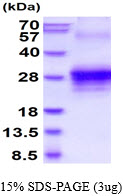
Purity
> 85% by SDS - PAGE
Storage
Can be stored at +4centigrade short term (1-2 weeks). For long term storage, aliquot and store at -20Centigrade or -70Centigrade. Avoid repeated freezing and thawing cycles.
Concentration
0.5mg/ml (determined by Absorbance at 280nm)
Warning
For research use only!
Background
The protein encoded by this gene is a cytokine that belongs to the tumor necrosis factor (TNF) ligand family. This cytokine is a ligand for TNFRSF8/CD30, which is a cell surface antigen and a marker for Hodgkin lymphoma and related hematologic malignancies. The engagement of this cytokine expressed on B cell surface plays an inhibitory role in modulating Ig class switch. This cytokine was shown to enhance cell proliferation of some lymphoma cell lines, while to induce cell death and reduce cell proliferation of other lymphoma cell lines. The pleiotropic biologic activities of this cytokine on different CD30+ lymphoma cell lines may play a pathophysiologic role in Hodgkin's and some non-Hodgkin's lymphomas. Two transcript variants encoding different isoforms have been found for this gene.
References
Duckett CS., et al. (1997) Mol. Cell. Biol. 17:1535-1542. Chiarle R., et al. (1999) J. Immunol. 163:194-205.
Tag
His tag
Species
Human
Source
Insect cells
BACKGROUND
Background
The protein encoded by this gene is a cytokine that belongs to the tumor necrosis factor (TNF) ligand family. This cytokine is a ligand for TNFRSF8/CD30, which is a cell surface antigen and a marker for Hodgkin lymphoma and related hematologic malignancies. The engagement of this cytokine expressed on B cell surface plays an inhibitory role in modulating Ig class switch. This cytokine was shown to enhance cell proliferation of some lymphoma cell lines, while to induce cell death and reduce cell proliferation of other lymphoma cell lines. The pleiotropic biologic activities of this cytokine on different CD30+ lymphoma cell lines may play a pathophysiologic role in Hodgkin's and some non-Hodgkin's lymphomas. Two transcript variants encoding different isoforms have been found for this gene.
References
Duckett CS., et al. (1997) Mol. Cell. Biol. 17:1535-1542. Chiarle R., et al. (1999) J. Immunol. 163:194-205.
Online Inquiry
Fill out this form and one of our experts will respond to you within one business day.